KO
|
EN
gitlite — search
Search
#javascript
#php
#python
#cplusplus
#java
#library
#dotfiles
#game
#ruby
#minecraft
#html
#hacktoberfest
xpresso
★ 182
Open GitHub ↗
A composable Python ASGI web framework
Download README (.md)
Explore Similar Repositories
apollo-opentracing
:
Performance trace your Apollo GraphQL server with Opentracing
EGObox
:
Efficient global optimization toolbox in Rust: bayesian optimization, mixture of gaussian processes, sampling methods
aframe-xr
:
INACTIVE - http://mzl.la/ghe-archive - System / Components to build WebXR experiences with A-frame
tanam
:
Plug-n-play CMS for websites on Firebase
vue-timer-hook
:
Vue timer hook is a custom hook, built to handle timer, stopwatch, and time logic/state in your vue 3 component.
// repository documentation
Was this content helpful?
★ 0
(0 ratings)
Select Rating:
★
★
★
★
★
Submit Feedback
Recent Feedback
×
Download README
Do you want to download the
README.md
file for
xpresso
?
Download (.md)
<p align="center"> <a href="https://www.xpresso-api.dev"><img src="https://github.com/adriangb/xpresso/raw/main/docs/assets/images/xpresso-title.png" alt="Xpresso"></a> </p> <p align="center"> <a href="https://github.com/adriangb/xpresso/actions?query=workflow%3ACI%2FCD+event%3Apush+branch%3Amain" target="_blank"> <img src="https://github.com/adriangb/xpresso/actions/workflows/workflow.yaml/badge.svg?event=push&branch=main" alt="Test"> </a> <a href="https://codecov.io/gh/adriangb/xpresso" target="_blank"> <img src="https://img.shields.io/codecov/c/github/adriangb/xpresso?color=%2334D058" alt="Coverage"> </a> <a href="https://pypi.org/project/xpresso" target="_blank"> <img src="https://img.shields.io/pypi/v/xpresso?color=%2334D058&label=pypi%20package" alt="Package version"> </a> <a href="https://pypi.org/project/xpresso" target="_blank"> <img src="https://img.shields.io/pypi/pyversions/xpresso.svg?color=%2334D058" alt="Supported Python versions"> </a> </p> Xpresso is an ASGI web framework built on top of [Starlette], [Pydantic] and [di], with heavy inspiration from [FastAPI]. Some of the standout features are: - ASGI support for high performance (within the context of Python web frameworks) - OpenAPI documentation generation - Automatic parsing and validation of request bodies and parameters, with hooks for custom extractors - Full support for [OpenAPI parameter serialization](https://swagger.io/docs/specification/serialization/) - Highly typed and tested codebase with great IDE support - A powerful dependency injection system, backed by [di] ## Requirements Python 3.7+ ## Installation ```shell pip install xpresso ``` You'll also want to install an ASGI server, such as [Uvicorn]. ```shell pip install uvicorn ``` ## Example Create a file named `example.py`: ```python from pydantic import BaseModel from xpresso import App, Path, FromPath, FromQuery class Item(BaseModel): item_id: int name: str async def read_item(item_id: FromPath[int], name: FromQuery[str]) -> Item: return Item(item_id=item_id, name=name) app = App( routes=[ Path( "/items/{item_id}", get=read_item, ) ] ) ``` Run the application: ```shell uvicorn example:app ``` Navigate to [http://127.0.0.1:8000/items/123?name=foobarbaz](http://127.0.0.1:8000/items/123?name=foobarbaz) in your browser. You will get the following JSON response: ```json {"item_id":123,"name":"foobarbaz"} ``` Now navigate to [http://127.0.0.1:8000/docs](http://127.0.0.1:8000/docs) to poke around the interactive [Swagger UI] documentation: 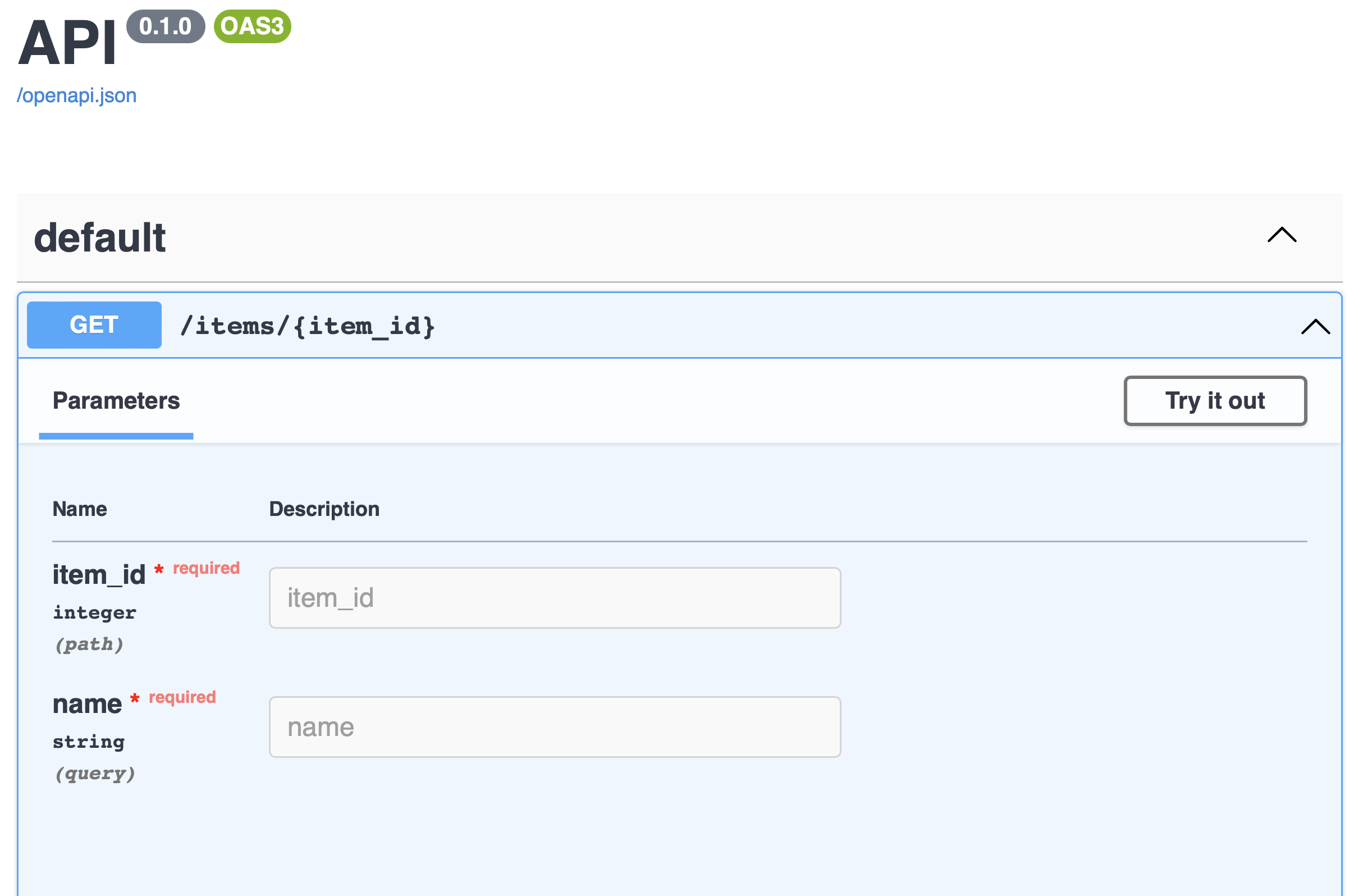 For more examples, tutorials and reference materials, see our [documentation]. ## Inspiration and relationship to other frameworks Xpresso is mainly inspired by FastAPI. FastAPI pioneered several ideas that are core to Xpresso's approach: - Leverage Pydantic for JSON parsing, validation and schema generation. - Leverage Starlette for routing and other low level web framework functionality. - Provide a simple but powerful dependency injection system. - Use that dependency injection system to provide extraction of request bodies, forms, query parameters, etc. Xpresso takes these ideas and refines them by: - Decoupling the dependency injection system from the request/response cycle, leading to an overall much more flexible and powerful dependency injection system, packaged up as the standalone [di] library. - Decoupling the framework from Pydantic by using `Annotated` ([PEP 593]) instead of default values (`param: FromQuery[str]` instead of `param: str = Query(...)`). - [Middleware on Routers] so that you can use generic ASGI middleware in a routing-aware manner (for example, installing profiling middleware on only some paths without using regex matching). - Support for [lifespans on any Router or mounted App] (this silently fails in FastAPI and Starlette) - [dependency injection into the application lifespan] and support for [multiple dependency scopes]. - Formalizing the framework for extracting parameters and bodies from requests into the [Binder API] so that 3rd party extensions can do anything the framework does. - Support for [customizing parameter and form serialization]. - Better performance by implementing [dependency resolution in Rust], [executing dependencies concurrently] and [controlling threading of sync dependencies on a per-dependency basis]. ### Inspiration **to** FastAPI When I originally concieved Xpresso I wasn't sure what the goal was. I didn't necessarily want to replace FastAPI, I know how much work open source is and was not and am not willing to commit to something like that. So I always thought of the project more as a testing ground for interesting ideas for ASGI web frameworks in general and FastAPI in particular. I am happy to report that in this sense it has been a _smash hit_. In the time since writing the above differences: - Starlette added support for middleware on routers. - The ASGI spec, Starlette and FastAPI added support for returning data from lifespans, which I think may be an even better idea than dependency scopes. - FastAPI added support for PEP593 annotations, taking direct inspiration from Xpresso's approach. - I've established a strong working relationship with Sebastián, FastAPI's author, and I foresee more ideas from Xpresso leaking into FastAPI in some way or another. So where does that leave Xpresso? It's going to stay around, but it's less likely to become a stable production ready framework: it can provide more value to the community as an exprimental proving ground for ideas than as yet another "production ready" web framework. [Starlette]: https://github.com/encode/starlette [Pydantic]: https://github.com/samuelcolvin/pydantic/ [FastAPI]: https://github.com/adriangb/xpresso [di]: https://github.com/adriangb/di [Uvicorn]: http://www.uvicorn.org/ [documentation]: https://www.xpresso-api.dev/ [Swagger UI]: https://swagger.io/tools/swagger-ui/ [dependency injection into the application lifespan]: https://xpresso-api.dev/latest/tutorial/lifespan [multiple dependency scopes]: https://xpresso-api.dev/latest/tutorial/dependencies/scopes/ [dependency resolution in Rust]: https://github.com/adriangb/graphlib2 [executing dependencies concurrently]: https://xpresso-api.dev/latest/advanced/dependencies/performance/#concurrent-execution [controlling threading of sync dependencies on a per-dependency basis]: https://xpresso-api.dev/latest/advanced/dependencies/performance/#sync-vs-async [PEP 593]: https://www.python.org/dev/peps/pep-0593/ [Binder API]: https://xpresso-api.dev/latest/advanced/binders/ [customizing parameter and form serialization]: https://xpresso-api.dev/latest/tutorial/query_params/#customizing-deserialization [lifespans on any Router or mounted App]: https://xpresso-api.dev/latest/tutorial/lifespan/ [Middleware on Routers]: https://xpresso-api.dev/0.14.1/tutorial/middleware/#middleware-on-routers
