KO
|
EN
gitlite — search
Search
#javascript
#python
#hacktoberfest
#react
#ai
#typescript
#llm
#go
#golang
#android
#machine-learning
#rust
#deep-learning
#linux
dbRackCsound
★ 19
Open GitHub ↗
No description available.
Download README (.md)
Explore Similar Repositories
simple_peer_flutter
:
Simple WebRTC for flutter (similar to the simple-peer project)
Astar-Path-Planner-for-2D-grid-map-in-ROS
:
A*-Path-Planner-for-2D-grid-map-in-ROS
awesome-pbbg
:
No description available.
remora-flexi-hal
:
Fork of LinuxCNC Remora project for Flexi-HAL CNC controller.
CloudSleepEngine
:
使用 云睡觉引擎,创作自己的 场景包,搭建自己的特色服务器
// repository documentation
Was this content helpful?
★ 0
(0 ratings)
Select Rating:
★
★
★
★
★
Submit Feedback
Recent Feedback
×
Download README
Do you want to download the
README.md
file for
dbRackCsound
?
Download (.md)
# dbRackCsound 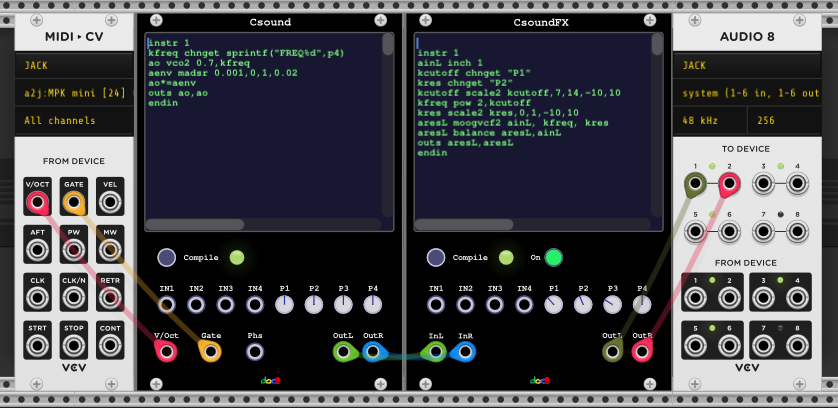 Some Csound modules for VCVRack v2. **Csound**: This module is designed for generating sound. It provides a V/Oct input and a Gate input (polyphonic). A Gate will activate the instrument 1 with the fractional instrument number 1 + channel/100 so that 16 polyphonic voices can be played. The channel number is passed in the p4 parameter of the instrument Note that the outputs are summed up in this variant, so OutL and OutR are monophonic. For polyphonic outputs **Csound16** can be used - which needs significant more CPU. There are fixed defined Csound channel names for communication between VCVRack and Csound: - FREQ[1-16] 16 special control rate channels providing the frequency computed from the V/Oct input where C4 = 0V - IN[1-4]C[1-16] 4x16 input control rate channels providing the values of the 4 inputs IN[1-4] - IN[1-4]CON channels for holding connection status of the inputs i.e. they have the value 1 if the corresponding input is connected 0 otherwise - P[1-4] 4 control rate channels providing the input of the 4 knobs So the smallest polyphonic sound generator look like this: ```csound-orc instr 1 kfreq chnget sprintf("FREQ%d",p4) ao vco2 0.7,kfreq outs ao,ao endin ``` See also further examples provided in the factory presets. **Csound16** This module behaves like Csound but it has polyphonic outputs. In order to use them the example above looks like this: ```csound-orc instr 1 kfreq chnget sprintf("FREQ%d",p4) ao vco2 0.7,kfreq outch p4*2-1,ao,p4*2,ao endin ``` Hint: Csound 16 provides 32 channels ranging von number 1 to 32 and which are interleaved for stereo. So the first left channel is 1 and the last right channel is 32. **CsoundFX**: This module is designed for processing sound. It provides two monophonic audio inputs (for polyphonic use Csound16FX), which can be accessed via the inch opcode and two monophonic outputs. Here an example: ```csound-orc instr 1 ainL inch 1 kcutoff chnget "P1" kres chnget "P2" kcutoff scale2 kcutoff,7,14,-10,10 kfreq pow 2,kcutoff kres scale2 kres,0,1,-10,10 aresL moogvcf2 ainL, kfreq, kres aresL balance aresL,ainL outs aresL,aresL endin ``` There are further examples provided int the factory presets. In CsoundFX the instrument 1 must be turned on with the On Knob. Currently the instrument 1 is turned off after (re-)compiling and must be turned on manually. (Using the turnon opcode can cause starting intrument 1 multiple times when recompiling which is not intended. There should be a solution in future versions). **Csound16FX**: Csound16FX behaves like Csound16 but has polyphonic inputs and outputs. The filter example looks like this: ```csound-orc instr 1 ainL inch p4*2-1 ainR inch p4*2 kcutoff chnget "P1" kres chnget "P2" kcutoff scale2 kcutoff,7,14,-10,10 kfreq pow 2,kcutoff kres scale2 kres,0,1,-10,10 aresL moogvcf2 ainL, kfreq, kres aresL balance aresL,ainL outch p4*2-1,aresL,p4*2,aresR endin ``` Here a small demo. For the sequencer (top left) there is a special built in opcode *smt* available which provides a Schmitt Trigger for processing the clock signal. The bottom line shows some "manual" written effects - chorus, delay, reverb. https://user-images.githubusercontent.com/1134412/197388214-8e12ffdf-dba5-4715-940a-09e9f547de96.mp4 **LICENCE** Csound is licensed under LGPL
