KO
|
EN
gitlite — search
Search
#typescript
#ai-agents
#ai
#dsh-plugin
#deepseek-harness
#open-source
#claude-code
#codex
#cli
#developer-tools
#react
#windows
Gaius.jl
★ 119
Open GitHub ↗
Divide and Conquer Linear Algebra
Download README (.md)
Explore Similar Repositories
litefy
:
a lightweight spotify client
smix-eleventy-starter
:
A standards-respecting starter kit for Eleventy. Go Indie.
deep_autoviml
:
Build tensorflow keras model pipelines in a single line of code. Now with mlflow tracking. Created by Ram Seshadri. Collaborators welcome. Permission granted upon request.
fastify-schedule
:
Fastify plugin for scheduling periodic jobs
fastify-sse-v2
:
Provide Server-Sent Events to Fastify
// repository documentation
Was this content helpful?
★ 0
(0 ratings)
Select Rating:
★
★
★
★
★
Submit Feedback
Recent Feedback
×
Download README
Do you want to download the
README.md
file for
Gaius.jl
?
Download (.md)
# Gaius.jl *Because Caesar.jl was taken* [![Continuous Integration][ci-img]][ci-url] [![Continuous Integration (Julia nightly)][ci-julia-nightly-img]][ci-julia-nightly-url] [![Code Coverage][codecov-img]][codecov-url] [ci-url]: https://github.com/MasonProtter/Gaius.jl/actions?query=workflow%3ACI [ci-julia-nightly-url]: https://github.com/MasonProtter/Gaius.jl/actions?query=workflow%3A%22CI+%28Julia+nightly%29%22 [codecov-url]: https://codecov.io/gh/MasonProtter/Gaius.jl [ci-img]: https://github.com/MasonProtter/Gaius.jl/workflows/CI/badge.svg "Continuous Integration" [ci-julia-nightly-img]: https://github.com/MasonProtter/Gaius.jl/workflows/CI%20(Julia%20nightly)/badge.svg "Continuous Integration (Julia nightly)" [codecov-img]: https://codecov.io/gh/MasonProtter/Gaius.jl/branch/master/graph/badge.svg "Code Coverage" Gaius.jl is a multi-threaded BLAS-like library using a divide-and-conquer strategy to parallelism, and built on top of the **fantastic** [LoopVectorization.jl](https://github.com/chriselrod/LoopVectorization.jl). Gaius spawns threads using Julia's depth first parallel task runtime and so Gaius's routines may be fearlessly nested inside multi-threaded Julia programs. Gaius is *not* stable or well tested. Only use it if you're adventurous. Note: Gaius is not actively maintained and I do not anticipate doing further work on it. However, you may find it useful as a relatively simple playground for learning about the implementation of linear algebra routines. There are other, more promising projects that may result in a scalable, multi-threaded pure Julia BLAS library such as: 1. [Tullio.jl](https://github.com/mcabbott/Tullio.jl) 2. [Octavian.jl](https://github.com/JuliaLinearAlgebra/Octavian.jl) In general: - Octavian is the most performant. - Tullio is the most flexible. ## Quick Start ```julia julia> using Gaius julia> Gaius.mul!(C, A, B) # (multi-threaded) multiply A×B and store the result in C (overwriting the contents of C) julia> Gaius.mul(A, B) # (multi-threaded) multiply A×B and return the result julia> Gaius.mul_serial!(C, A, B) # (single-threaded) multiply A×B and store the result in C (overwriting the contents of C) julia> Gaius.mul_serial(A, B) # (single-threaded) multiply A×B and return the result ``` Remember to start Julia with multiple threads with e.g. one of the following: - `julia -t auto` - `julia -t 4` - Set the `JULIA_NUM_THREADS` environment variable to `4` **before** starting Julia The functions in this list are part of the public API of Gaius: - `Gaius.mul!` - `Gaius.mul` - `Gaius.mul_serial!` - `Gaius.mul_serial` All other functions are internal (private). ## Matrix Multiplication Currently, fast, native matrix-multiplication is only implemented between matrices of types `Matrix{<:Union{Float64, Float32, Int64, Int32, Int16}}`, and `StructArray{Complex}`. Support for other other commonly encountered numeric `struct` types such as `Rational` and `Dual` numbers is planned. ### Using Gaius <details> <summary>Click to expand:</summary> Gaius defines the public functions `Gaius.mul` and `Gaius.mul!`. `Gaius.mul` is to be used like the regular `*` operator between two matrices whereas `Gaius.mul!` takes in three matrices `C, A, B` and stores `A*B` in `C` overwriting the contents of `C`. The functions `Gaius.mul` and `Gaius.mul!` use multithreading. If you want to run the single-threaded variants, use `Gais.mul_serial` and `Gaius.mul_serial!` respectively. ```julia julia> using Gaius, BenchmarkTools, LinearAlgebra julia> A, B, C = rand(104, 104), rand(104, 104), zeros(104, 104); julia> @btime mul!($C, $A, $B); # from LinearAlgebra 68.529 μs (0 allocations: 0 bytes) julia> @btime mul!($C, $A, $B); #from Gaius 31.220 μs (80 allocations: 10.20 KiB) ``` ```julia julia> using Gaius, BenchmarkTools julia> A, B = rand(104, 104), rand(104, 104); julia> @btime $A * $B; 68.949 μs (2 allocations: 84.58 KiB) julia> @btime let * = Gaius.mul # Locally use Gaius.mul as * operator. $A * $B end; 32.950 μs (82 allocations: 94.78 KiB) julia> versioninfo() Julia Version 1.4.0-rc2.0 Commit b99ed72c95* (2020-02-24 16:51 UTC) Platform Info: OS: Linux (x86_64-pc-linux-gnu) CPU: AMD Ryzen 5 2600 Six-Core Processor WORD_SIZE: 64 LIBM: libopenlibm LLVM: libLLVM-8.0.1 (ORCJIT, znver1) Environment: JULIA_NUM_THREADS = 6 ``` Multi-threading in Gaius works by recursively splitting matrices into sub-blocks to operate on. You can change the matrix sub-block size by calling `mul!` with the `block_size` keyword argument. If left unspecified, Gaius will use a (very rough) heuristic to choose a good block size based on the size of the input matrices. The size heuristics I use are likely not yet optimal for everyone's machines. </details> ### Complex Numbers <details> <summary>Click to expand:</summary> Gaius supports the multiplication of matrices of complex numbers, but they must first by converted explicity to structs of arrays using StructArrays.jl (otherwise the multiplication will be done by OpenBLAS): ```julia julia> using Gaius, StructArrays julia> begin n = 150 A = randn(ComplexF64, n, n) B = randn(ComplexF64, n, n) C = zeros(ComplexF64, n, n) SA = StructArray(A) SB = StructArray(B) SC = StructArray(C) @btime mul!($SC, $SA, $SB) @btime mul!($C, $A, $B) SC ≈ C end 515.587 μs (80 allocations: 10.53 KiB) 546.481 μs (0 allocations: 0 bytes) true ``` </details> ### Benchmarks #### Floating Point Performance <details> <summary>Click to expand:</summary> The following benchmarks were run on this ```julia julia> versioninfo() Julia Version 1.4.0-rc2.0 Commit b99ed72c95* (2020-02-24 16:51 UTC) Platform Info: OS: Linux (x86_64-pc-linux-gnu) CPU: AMD Ryzen 5 2600 Six-Core Processor WORD_SIZE: 64 LIBM: libopenlibm LLVM: libLLVM-8.0.1 (ORCJIT, znver1) Environment: JULIA_NUM_THREADS = 6 ``` and compared to [OpenBLAS](https://github.com/xianyi/OpenBLAS) running with `6` threads (`BLAS.set_num_threads(6)`). I would be keenly interested in seeing analogous benchmarks on a machine with an AVX512 instruction set and/or [Intel's MKL](https://software.intel.com/en-us/mkl). 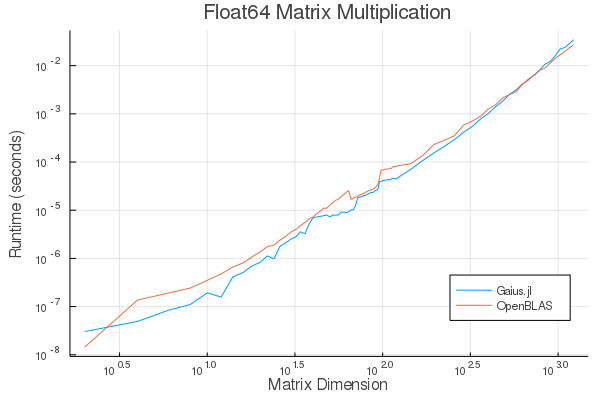 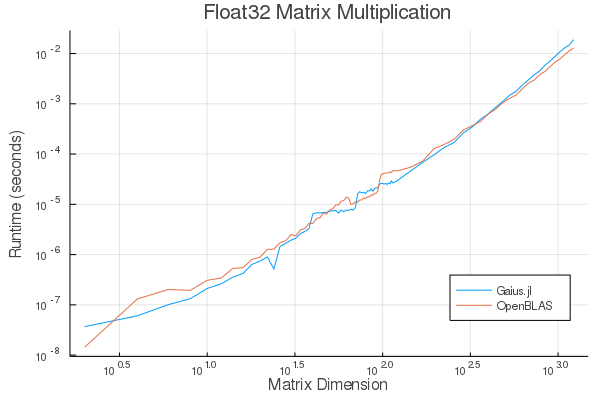 *Note that these are log-log plots.* Gaius outperforms [OpenBLAS](https://github.com/xianyi/OpenBLAS) over a large range of matrix sizes, but does begin to appreciably fall behind around `800 x 800` matrices for `Float64` and `650 x 650` matrices for `Float32`. I believe there is a large amount of performance left on the table in Gaius and I look forward to beating OpenBLAS for more matrix sizes. </details> #### Complex Floating Point Performance <details> <summary>Click to expand:</summary> Here is Gaius operating on `Complex{Float64}` structs-of-arrays competeing relatively evenly against OpenBLAS operating on `Complex{Float64}` arrays-of-structs: 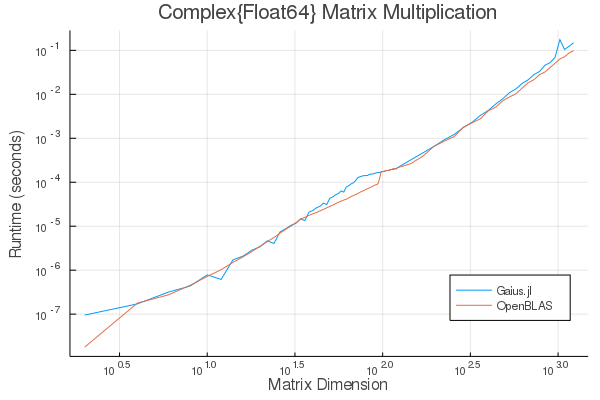 I think with some work, we can do much better. </details> #### Integer Performance <details> <summary>Click to expand:</summary> These benchmarks compare Gaius (on the same machine as above) and compare against Julia's generic matrix multiplication implementation (OpenBLAS does not provide integer mat-mul) which is not multi-threaded. 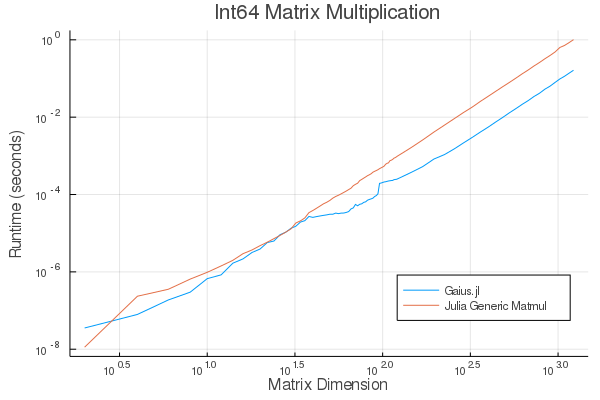 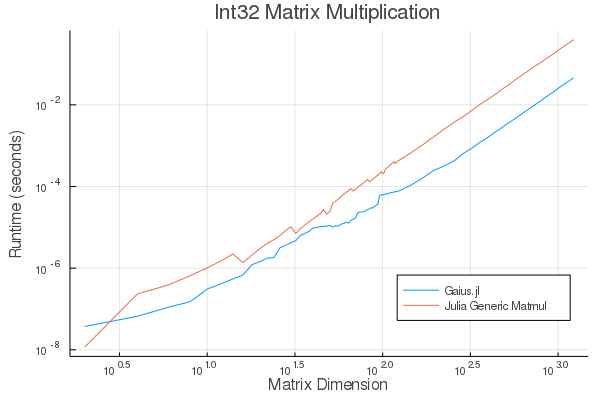 *Note that these are log-log plots.* Benchmarks performed on a machine with the AVX512 instruction set show an [even greater performance gain](https://github.com/chriselrod/LoopVectorization.jl). If you find yourself in a high performance situation where you want to multiply matrices of integers, I think this provides a compelling use-case for Gaius since it will outperform it's competition at *any* matrix size and for large matrices will benefit from multi-threading. </details> ## Other BLAS Routines I have not yet worked on implementing other standard BLAS routines with this strategy, but doing so should be relatively straightforward. ## Safety *If you must break the law, do it to seize power; in all other cases observe it.* -Gaius Julius Caesar If you use only the functions `Gaius.mul!`, `Gaius.mul`, `Gaius.mul_serial!`, and `Gaius.mul_serial`, automatic array size-checking will occur before the matrix multiplication begins. This can be turned off in `mul!` by calling `Gaius.mul!(C, A, B; sizecheck=false)`, in which case no sizechecks will occur on the arrays before the matrix multiplication occurs and all sorts of bad, segfaulty things can happen. All other functions in this package are to be considered *internal* and should not be expected to check for safety or obey the law. The functions `Gaius.gemm_kernel!` and `Gaius.add_gemm_kernel!` may be of utility, but be warned that they do not check array sizes.
