KO
|
EN
gitlite — search
Search
#python
#java
#css
#javascript
#html
#nodejs
#reactjs
#machine-learning
#tailwindcss
#golang
#firebase
#spring-boot
nmap-vulners
★ 3,400
Open GitHub ↗
NSE script based on Vulners.com API
Download README (.md)
Explore Similar Repositories
CppSharp
:
Tools and libraries to glue C/C++ APIs to high-level languages
OpenSK
:
OpenSK is an open-source implementation for security keys written in Rust that supports both FIDO U2F and FIDO2 standards.
iOS-9-Sampler
:
Code examples for the new features of iOS 9.
Gemini-API
:
✨ Reverse-engineered Python API for Google Gemini web app
parking_lot
:
Compact and efficient synchronization primitives for Rust. Also provides an API for creating custom synchronization primitives.
// repository documentation
Was this content helpful?
★ 0
(0 ratings)
Select Rating:
★
★
★
★
★
Submit Feedback
Recent Feedback
×
Download README
Do you want to download the
README.md
file for
nmap-vulners
?
Download (.md)
# nmap_vulners [](https://github.com/vulnersCom/nmap-vulners/releases/latest) [](https://github.com/vulnersCom/nmap-vulners/releases) [](https://paypal.me/videns) ## Description NSE script uses info about known services to provide data on vulnerabilities. Note that it is already included into the standard nmap NSE library. 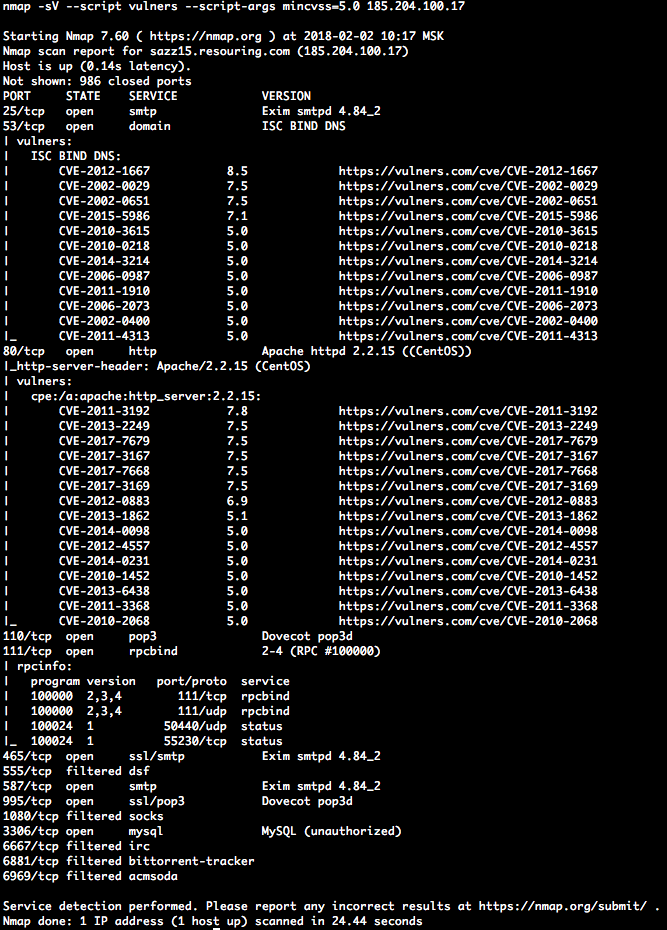 ## Dependencies: nmap libraries: http json string http-vulners-regex Keep in mind that the script depends on having information about software versions, so it only works with -sV flag. **NB:** Now it can actually be run without -sV flag if http-vulners-regex script is run as well. ## Installation locate where your nmap scripts are located on your system for *nix system it might be ~/.nmap/scripts/ or $NMAPDIR for Mac it might be /usr/local/Cellar/nmap/<version>/share/nmap/scripts/ for Windows it might be C:\Program Files (x86)\Nmap\scripts copy the provided script (vulners.nse) into that directory run *nmap --script-updatedb* to update the nmap script DB ## Usage Use it as straightforward as you can: nmap -sV --script vulners [--script-args mincvss=<arg_val>] <target> It is KISS after all. # http-vulners-regex ## Description NSE script scans HTTP responses and identifies CPEs for the mentioned software. It can therefore boost the efficiency of the main vulners script. 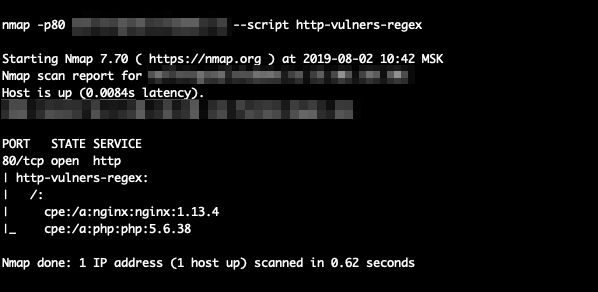 Or with the paths: 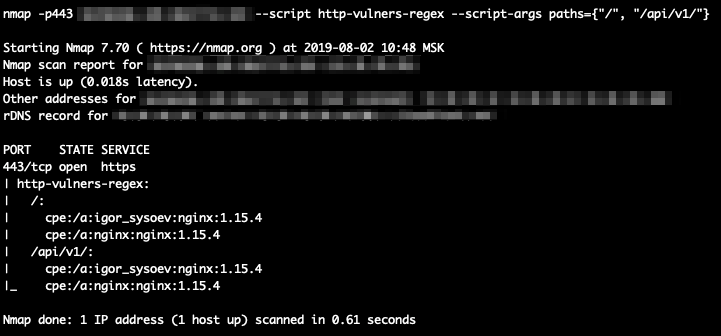 ## Dependencies nmap libraries: http json string stdnse shortport table ## Installation locate where nmap is located on your system for *nix system it might be ~/.nmap/ or $NMAPDIR for Mac it might be /usr/local/Cellar/nmap/<version>/share/nmap/ for Windows it might be C:\Program Files (x86)\Nmap\ copy the provided script (http-vulners-regex.nse) into <nmap_dir>/scripts/ copy the provided json with the regexes to <nmap_dir>/nselib/data/ copy the provided txt file with the default paths to <nmap_dir>/nselib/data/ note that you can specify your own file via command line run *nmap --script-updatedb* to update the nmap script DB ## Usage As a usual NSE script: nmap --script http-vulners-regex.nse [--script-args paths={"/"}] <target> # vulners_enterprise ## Description This is basically the good old faithfull nmap-vulners from above with an important exception: it requires an API_KEY to work. Moreover it specifically uses CVSS v3 score rather than v2 in its output. You can either specify it on the CLI using the 'api_key' script argument, set it into an envirotnment variable VULNERS_API_KEY, or store it in a file readable by the user running nmap. In this case you must specify the absolute path to the file using the 'api_key_file' script argument. 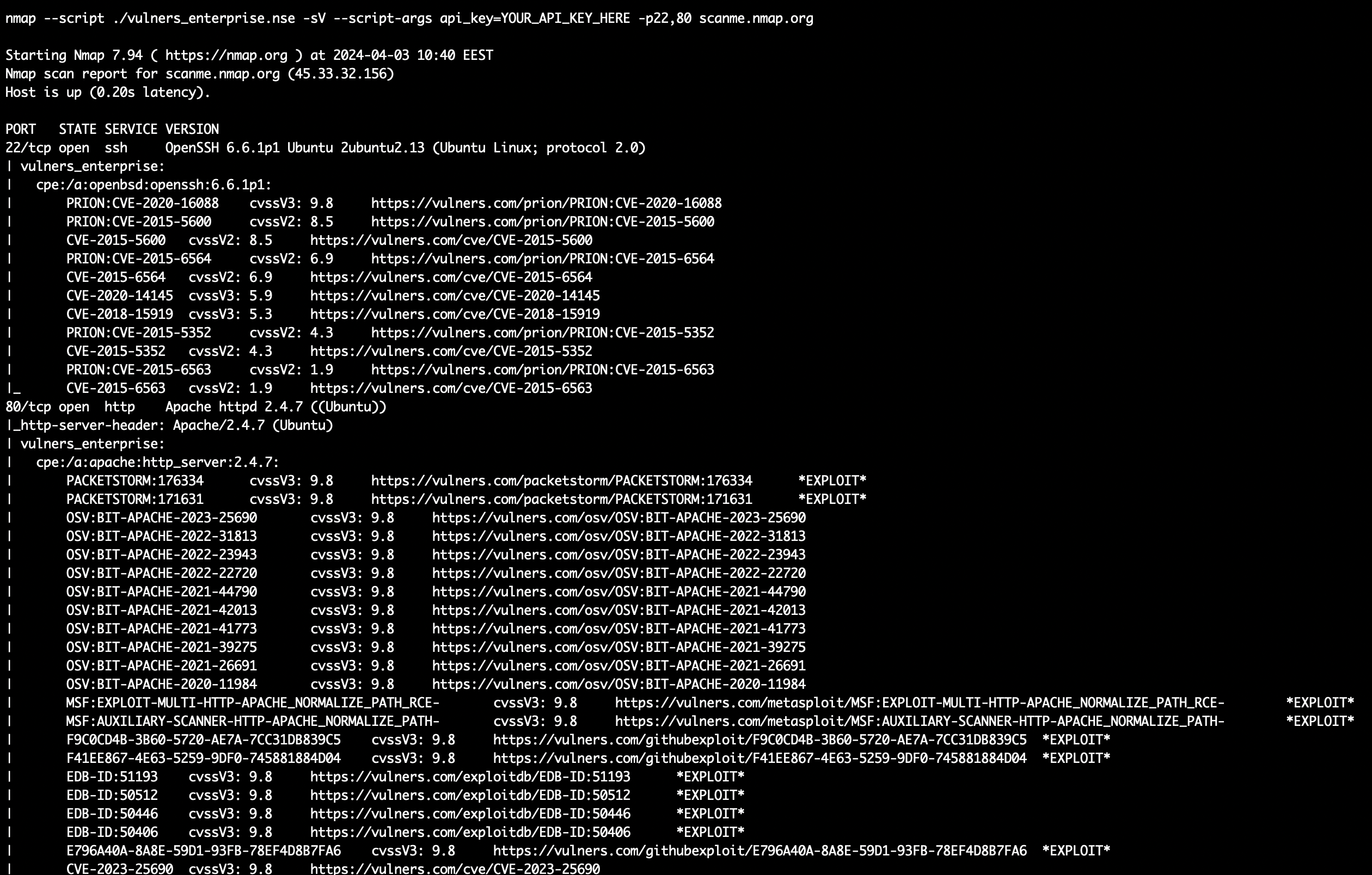 ## Usage As a usual NSE script: nmap -sV --script vulners_enterprise [--script-args mincvss=<arg_val>,api_key=<api_key>,api_key_file=<absolute_path>,api_host=http://my_host.com] <target> ### NSE Arguments **vulners_enterprise.mincvss** Limit CVEs shown to those with this CVSS score or greater. **vulners_enterprise.api_key** API token to be used in the requests **vulners_enterprise.api_key_file** Absolute path to the file with a single line containing the API token **vulners_enterprise.api_host** URL to vulners API without the leading slash. Defaults to https://vulners.com
