KO
|
EN
gitlite — search
Search
#python
#go
#golang
#android
#javascript
#csharp
#java
#react
#kotlin
#ruby
#bot
#hacktoberfest
NWQ-Sim
★ 35
Open GitHub ↗
No description available.
Download README (.md)
Explore Similar Repositories
Recursive_Refinement_Network
:
No description available.
Unity_SubtitleTimeline
:
No description available.
sample-golang-app
:
Sample Golang app to demonstrace OpenTelemetry instrumentation
cronJob
:
本项目采用FastAPI + APScheduler + ZeroRPC开发轻量级定时调度平台
choreography-saga-dotnet
:
No description available.
// repository documentation
Was this content helpful?
★ 0
(0 ratings)
Select Rating:
★
★
★
★
★
Submit Feedback
Recent Feedback
×
Download README
Do you want to download the
README.md
file for
NWQ-Sim
?
Download (.md)
# NWQSim: Northwest Quantum Circuit Simulation Environment ## Please check the user manual here: [User Manual](doc/user_manual.md), [VQE](https://github.com/pnnl/NWQ-Sim/tree/vqe_memory/vqe) A Quantum System Simulation Environment on classical multi-node, multi-CPU/GPU heterogeneous HPC systems. It currently includes a state-vector simulator SV-Sim ([SC'21](doc/svsim_sc21)) for high-performance ideal simulation, and a density matrix simulator DM-Sim ([SC'20](doc/dmsim_sc20)) for noise-aware simulation. It supports C++, Python, Q#/QIR, Qiskit, QASM, XACC as the front-ends, and X86/PPC CPU, NVIDIA/AMD GPU as the backends, see below: 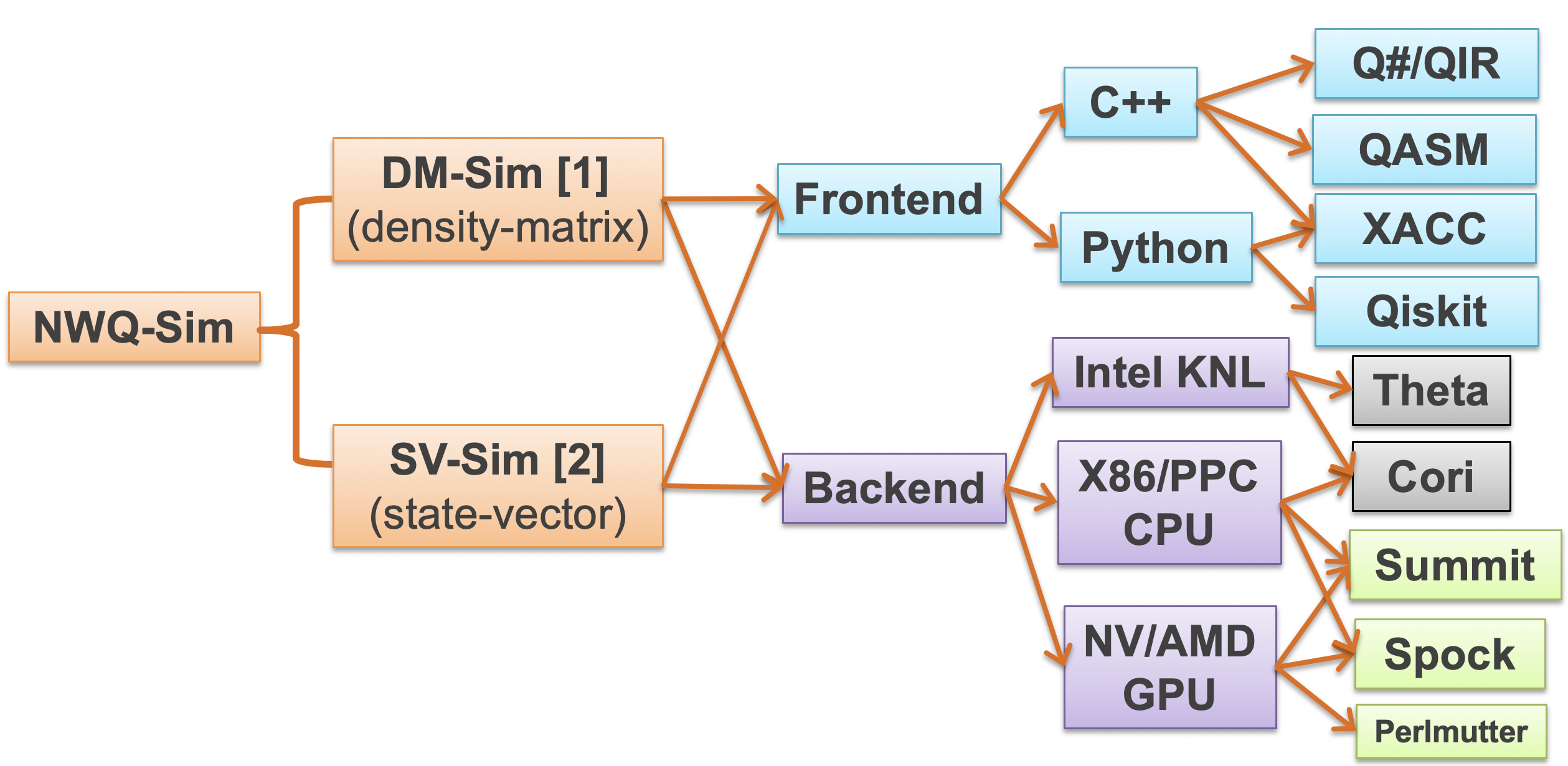 ### Current version 2.0 NWQSim is under active development. Please raise any bugs and suggest features. ## About SV-Sim SV-Sim is implemented in C++/CUDA/HIP for general full-state quantum circuit simulation. It assumes qubits are all-to-all connected unless the input circuits are with respect to circuit topology. We use internal gate representations for advanced optimization and profiling. 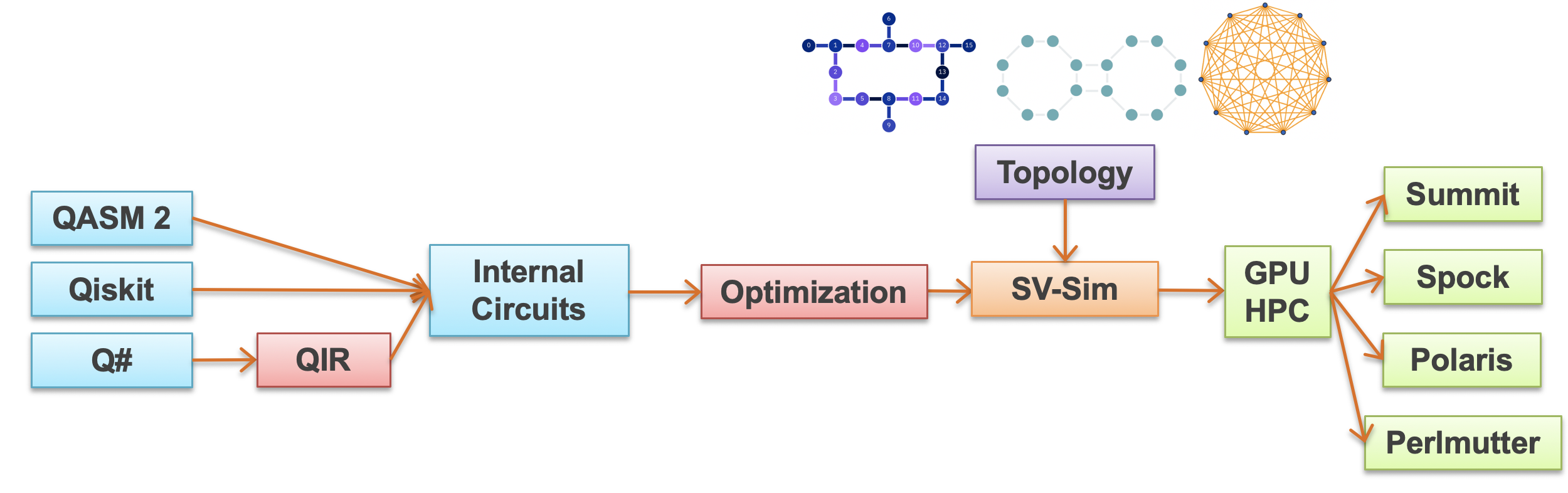 SV-Sim supports the following quantum gates as the interface based on [OpenQASM-2](https://arxiv.org/pdf/1707.03429.pdf), [OpenQASM-3](https://arxiv.org/pdf/2104.14722.pdf), [QIR](https://github.com/microsoft/qsharp-runtime/blob/) and [Qiskit](https://qiskit.org/documentation/apidoc/circuit_library.html): | Gate | Format | Meaning | |:-----: | ------ | ------- | | X | X(q) | Pauli-X gate on qubit q | | Y | Y(q) | Pauli-Y gate on qubit q | | Z | Z(q) | Pauli-Z gate on qubit q | | H | H(q) | Clifford Hadamard gate on qubit q | | S | S(q) | Clifford sqrt(Z) phase gate on qubit q | | SDG | SDG(q) | Clifford inverse of sqrt(Z) on qubit q | | T | T(q) | sqrt(S) phase gate on qubit q | | TDG | TDG(q) | Inverst of sqrt(S) on qubit q | | ID | ID(q) | Identiy gate on qubit q | | SX | SX(q) | sqrt(X) gate on qubit q, a basis gate for IBMQ | | RI | RI(theta, q) | Global phase gate, U(0,0,a) in QASM3 or RI in Q#| | RX | RX(theta, q) | Rotate around X axis for qubit q | | RY | RY(theta, q) | Rotate around Y axis for qubit q | | RZ | RZ(theta, q) | Rotate around Z axis for qubit q | | P | P(theta, q) | Phase gate on qubit q as defined by Qiskit | | U | U(theta, phi, lamb, q) | generic singl-qubit rotation gate with 3 Euler angles, see QASM2 | | CX | CX(ctrl, q) | CNOT or controlled X gate on qubit q| | CY | CY(ctrl, q) | Controlled Y gate on qubit q| | CZ | CZ(ctrl, q) | Controlled Z gate on qubit q| | CH | CH(ctrl, q) | Controlled H gate on qubit q| | CS | CS(ctrl, q) | Controlled S gate on qubit q| | CSDG | CSDG(ctrl, q) | Controlled SDG gate on qubit q| | CT | CT(ctrl, q) | Controlled T gate on qubit q| | CTDG | CTDG(ctrl, q) | Controlled TDG gate on qubit q| | CRX | CRX(theta, ctrl, q) | Controlled RX gate on qubit q| | CRY | CRY(theta, ctrl, q) | Controlled RY gate on qubit q| | CRZ | CRZ(theta, ctrl, q) | Controlled RZ gate on qubit q| | CSX | CSX(ctrl, q) | Controlled SX gate on qubit q| | CP | CP(theta, ctrl, q) | Controlled P gate on qubit q| | CU | CU(theta, phi, lamb, gamma, ctrl, q) | generic controlled U gate, see Qiskit CU gate | | SWAP | SWAP(ctrl, q) | Swap gate on ctrl and q | | M | M(q) | measure qubit q on pauli-Z basis | | MA | MA(n) | sample all qubits for n shots all-together | | RESET | RESET(q) | reset qubit q to zero state | Internally, it supports arbitrary 1 or 2 qubit gates for optimization and extension to support new gates: | Gate | Format | Meaning | |:-----: | ------ | ------- | | C1 | C1(a0-a3) | Arbitrary 1-qubit gate | | C2 | C2(a0-a15) | Arbitrary 2-qubit gate | ## About DM-Sim DM-Sim is implemented in C++/CUDA/HIP for general density-matrix quantum circuit simulation with noise. It needs to load backend device calibration data (including topology, T1, T2, SPAM, etc.) as a json file for runtime configuration to the simulator instance. We use an array to store the internal gate representations and perform density matrix gate fusion (with more restrictions compared to state-vector) for advanced performance. 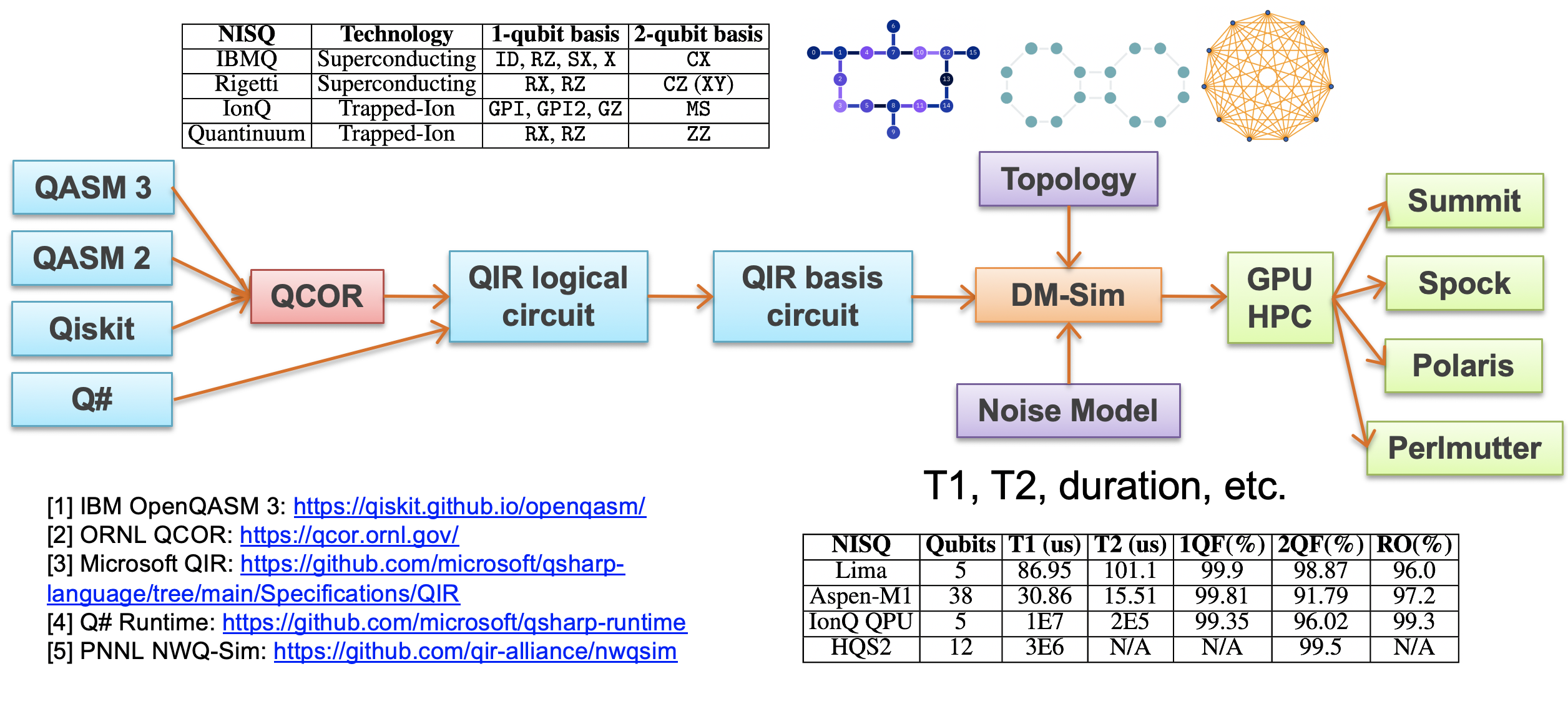 #### Noisy Simulation for IBMQ devices DM-Sim supports the following basis quantum gates for IBMQ devices: | Gate | Format | Meaning | |:-----: | ------ | ------- | | X | X(q) | Pauli-X gate on qubit q | | ID | ID(q) | Identiy gate on qubit q | | SX | SX(q) | sqrt(X) gate on qubit q, a basis gate for IBMQ | | RZ | RZ(theta, q) | Rotate around Z axis for qubit q | | CX | CX(ctrl, q) | CNOT or Controlled X gate on qubit q| #### Noisy Simulation for Rigetti devices | Gate | Format | Meaning | |:-----: | ------ | ------- | | RX | | | | RZ | | | | CX | | | #### Noisy Simulation for IonQ devices | Gate | Format | Meaning | |:-----: | ------ | ------- | | GPI | | | | GPI2 | | | | GZ | | | | MS | | | #### Noisy Simulation for Quantinuum devices | Gate | Format | Meaning | |:-----: | ------ | ------- | | RX | | | | RZ | | | | ZZ | | | Internally, it supports arbitrary 1 or 2 qubit gates for optimization and extension to support new gates: | Gate | Format | Meaning | |:-----: | ------ | ------- | | C2 | C2(array of 0-15) | Arbitrary density-matrix 1-qubit gate | | C4 | C4(array of 0-255) | Arbitrary density-matrix 2-qubit gate | ## Building and Running NWQ-Sim To build and run NWQ-Sim, please refer to the detailed instructions provided in the [User Manual](doc/user_manual.md). The User Manual contains step-by-step guidelines on installing dependencies, building from source, configuring runtime options, and more. ## Authors and Developers - Ang Li, Pacific Northwest National Laboratory - Matt Burns, University of Rochester and Pacific Northwest National Laboratory - Meng Wang, The University of British Columbia and Pacific Northwest National Laboratory - Chenxu Liu, Pacific Northwest National Laboratory Additionally, the following folks contribute the project: - Sriram Krishnamoorthy, Pacific Northwest National Laboratory - Bo Fang, Pacific Northwest National Laboratory - Muqing Zheng, Lehigh University and Pacific Northwest National Laboratory - Cassandra Granade, Microsoft - Martin Roetteler, Microsoft - Bettina Heim, Microsoft - Robin Kuzmin, Microsoft - Stefan Wernli, Microsoft - Guen Prawiroatmodjo, Microsoft - Alan Geller, Microsoft - Samuel Stein, Pacific Northwest National Laboratory - Thien Nguyen, Oak Ridge National Laboratory ## Citation format Please cite our SC'20 and SC'21 papers: - Ang Li, Bo Fang, Christopher Granade, Guen Prawiroatmodjo, Bettina Heim, Martin Roetteler and Sriram Krishnamoorthy, "SV-Sim: Scalable PGAS-based State Vector Simulation of Quantum Circuits" In Proceedings of the International Conference for High Performance Computing, Networking, Storage and Analysis, 2021. - Ang Li, Omer Subasi, Xiu Yang, and Sriram Krishnamoorthy. "Density Matrix Quantum Circuit Simulation via the BSP Machine on Modern GPU Clusters." In Proceedings of the International Conference for High Performance Computing, Networking, Storage and Analysis, 2020. Bibtex: ```text @inproceedings{li2021svsim, title={SV-Sim: Scalable PGAS-based State Vector Simulation of Quantum Circuits}, author={Li, Ang and Fang, Bo and Granade, Christopher and Prawiroatmodjo, Guen and Hein, Bettina and Rotteler, Martin and Krishnamoorthy, Sriram}, booktitle={Proceedings of the International Conference for High Performance Computing, Networking, Storage and Analysis}, year={2021} } @inproceedings{li2020density, title={Density Matrix Quantum Circuit Simulation via the BSP Machine on Modern GPU Clusters}, author={Li, Ang and Subasi, Omer and Yang, Xiu and Krishnamoorthy, Sriram}, booktitle={Proceedings of the International Conference for High Performance Computing, Networking, Storage and Analysis}, year={2020} } ``` ## License This project is licensed under the MIT License, see [LICENSE](LICENSE) file for details. ## Acknowledgments **PNNL-IPID: 32166-E, ECCN: EAR99, IR: PNNL-SA-161181** This project is fully supported by the [Quantum Science Center (QSC)](https://qscience.org/).The Pacific Northwest National Laboratory (PNNL) is operated by Battelle for the U.S. Department of Energy (DOE) under contract DE-AC05-76RL01830. ## Contributing Please contact us If you'd like to contribute to NWQ-Sim. See the contact in our paper or my [webpage](http://www.angliphd.com).
