KO
|
EN
gitlite — search
Search
#typescript
#ai-agents
#ai
#dsh-plugin
#deepseek-harness
#open-source
#cli
#claude-code
#codex
#developer-tools
#react
#windows
neuroblast-v3
★ 37
Open GitHub ↗
NeuroBLAST v3 architecture code
Download README (.md)
Explore Similar Repositories
pixitainer
:
Containerize your Pixi workspace with a single command!
webextensions
:
some webextensions
my_portfolio
:
No description available.
Experimental_RAG_Tech
:
A collection of experimental Retrieval Augmented Generation (RAG) Techniques to elevate your pipelines, all with code and intuitive explanations
SignLanguageDetectionLetters
:
No description available.
// repository documentation
Was this content helpful?
★ 0
(0 ratings)
Select Rating:
★
★
★
★
★
Submit Feedback
Recent Feedback
×
Download README
Do you want to download the
README.md
file for
neuroblast-v3
?
Download (.md)
# NeuroBLAST V3 A novel hybrid model designed with a biologically inspired "cortical" structure. ## Architecture Highlights NeuroBLAST differs from standard Transformers by utilizing a three-stage cortical design: - **Sensory Cortex**: A hybrid stage designed for initial feature extraction. It alternates between standard **Self-Attention** layers (for global context) and **Dilated Causal 2D Convolutions** (for local patterns). The convolutions use exponentially increasing dilation factors to capture multi-scale features effectively. - **Associative Cortex**: The core reasoning engine. It continues the hybrid Attention/Convolution pattern but introduces **Alternating RoPE**: standard attention layers alternate with "No-RoPE" attention layers, encouraging the model to balance between position-dependent and purely semantic (content-based) processing. - **Motor Cortex**: The output generation stage. It consists entirely of **Self-Attention** layers to refine the final representations. Like the Associative Cortex, it employs the **Alternating RoPE** strategy. - **Deep Residual Bridges**: Specialized long-range connections that mitigate signal degradation deep in the network. - Between Sensory and Associative stages: Injects the **original embeddings** (normalized and activated types). - Between Associative and Motor stages: Injects the **negated original embeddings**, a mechanism designed to provide contrastive grounding or subtractive reference to the initial context. 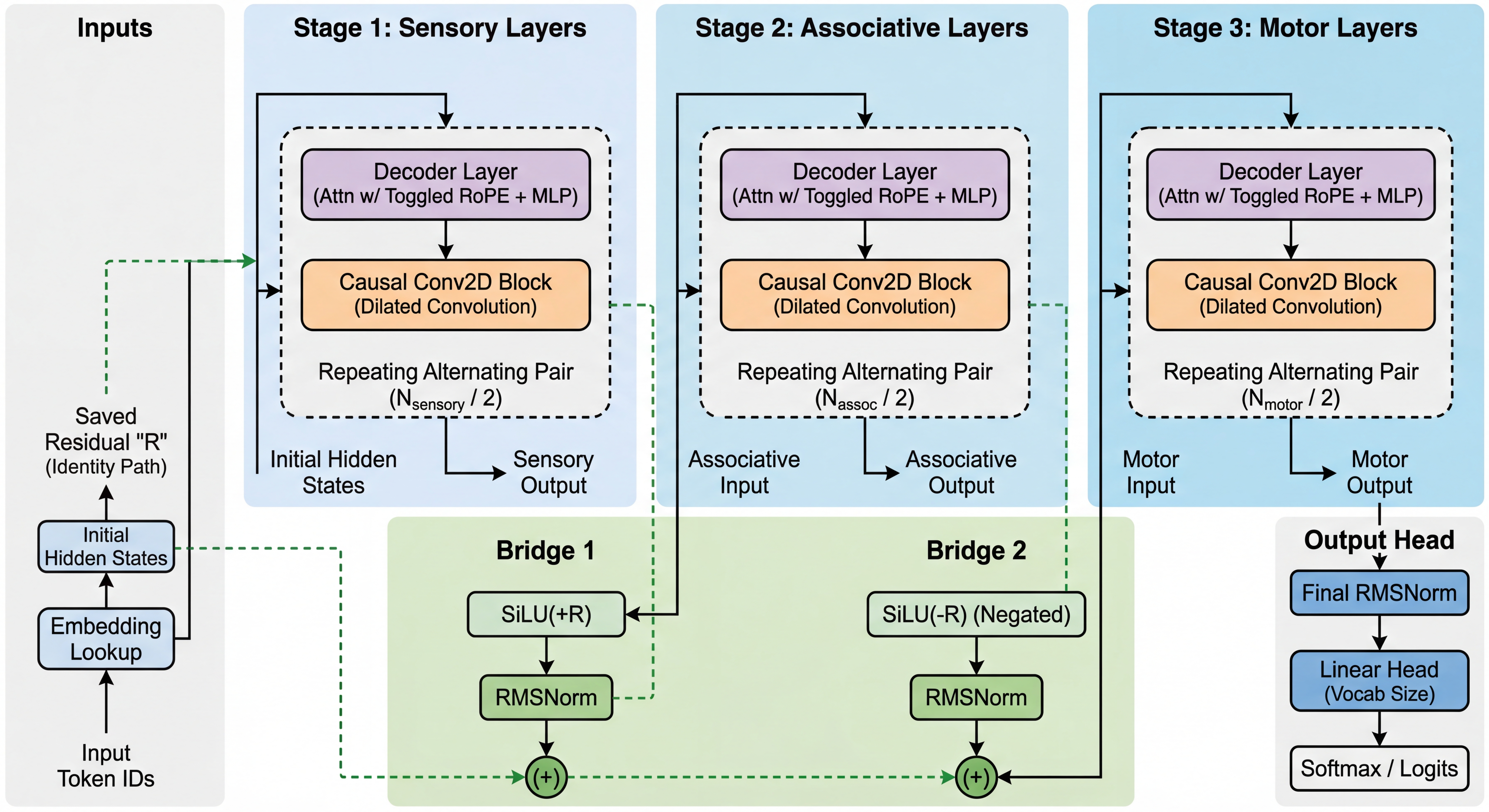 ## Implementation Details PyTorch and JAX implementations are available in the `model` directory. Early checkpoint: [NeuroBLAST V3 0.6M SYNTH EC 144B TOK](https://huggingface.co/mkurman/NeuroBLAST-V3-0.6M-SYNTH-EC-144B-TOK) trained on the [PleIAs/SYNTH](https://huggingface.co/datasets/PleIAs/SYNTH) dataset. ### Model Configuration The default configuration used in training: - **Hidden Size**: 512 - **Intermediate Size**: 3072 - **Total Layers**: 72 - Associative: 32 - Sensory: 24 - Motor: 16 - **Attention Heads**: 16 - **Key/Value Heads**: 8 - **Head Dimension**: 128 - **Max Position Embeddings**: 32768 ## Installation ### Prerequisites - Python >= 3.10 ### Standard Installation (PyTorch) ```bash uv pip install -e . ``` ### JAX / TPU Installation For JAX training on TPU, we recommend installing dependencies in the following order to ensure compatibility: ```bash # Install JAX with TPU support uv pip install -U jax[tpu] -f https://storage.googleapis.com/libtpu-releases/index.html # Install PyTorch with XLA support uv pip install "torch==2.8.0" "torch_xla[tpu]==2.8.1" -f https://storage.googleapis.com/libtpu-releases/index.html # Install package with JAX extras uv pip install -e ".[jax]" ``` ## Dataset & Tokenizer - **Dataset**: [PleIAs/SYNTH](https://huggingface.co/datasets/PleIAs/SYNTH) (Common Corpus Synthetic data) - **Tokenizer**: [PleIAs/Baguettotron](https://huggingface.co/PleIAs/Baguettotron) ## Training ### PyTorch Training To launch the PyTorch training script: ```bash python train/train.py ``` This script uses `transformers.Trainer` and `accelerate` for distributed training support. It defaults to training on GPU. ### JAX Training To launch the JAX training script (optimized for TPU): ```bash python train/train_jax.py ``` Arguments for distributed training (like `JAX_COORDINATOR_ADDRESS`, `JAX_PROCESS_COUNT`, `JAX_PROCESS_INDEX`) can be set via environment variables. The script supports gradient accumulation and uses `orbax-checkpoint` for saving models. ## Serving with vLLM NeuroBLAST can be served using [vLLM](https://github.com/vllm-project/vllm) for high-throughput inference. ### Installation ```bash # Install with vLLM support pip install -e ".[vllm]" ``` ### Serving ```bash # Serve the model (vLLM will automatically discover the NeuroBLAST plugin) vllm serve mkurman/NeuroBLAST-V3-0.6M-SYNTH-EC-144B-TOK --served-model-name neuroblast-v3 --trust_remote_code --max-model-len 4096 --gpu-memory-utilization 0.8 # Or serve from a local checkpoint vllm serve /path/to/checkpoint ``` The server exposes an OpenAI-compatible API on `http://localhost:8000`.
