KO
|
EN
gitlite — search
Search
#python
#javascript
#docker
#html
#docker-compose
#css
#ai
#go
#chatgpt
#deep-learning
#kotlin
#react
HGI
★ 39
Open GitHub ↗
No description available.
Download README (.md)
Explore Similar Repositories
FSPML
:
No description available.
Awesome-Robotics-Notes
:
A comprehensive guide to fundamental topics in robotics
DEIQT
:
Checkpoints, logs and source code for AAAI-23 paper 'Data-Efficient Image Quality Assessment with Attention-Panel Decoder'
AIMSwitcher
:
AIMSwitcher, An Input Method Switcher
jp-trainer
:
Interactive MIDI-based Jazz Piano Trainer for Python (with built-in piano sampler).
// repository documentation
Was this content helpful?
★ 0
(0 ratings)
Select Rating:
★
★
★
★
★
Submit Feedback
Recent Feedback
×
Download README
Do you want to download the
README.md
file for
HGI
?
Download (.md)
# Learning region representations with POIs and hierarchical graph infomax This project is linked to a paper published in ISPRS Journal of Photogrammetry and Remote Sensing: [Learning urban region representations with POIs and hierarchical graph infomax](https://doi.org/10.1016/j.isprsjprs.2022.11.021) . In this study, we propose the hierarchical graph infomax (HGI) approach for learning urban region representations (vector embeddings) with points-of-interest (POIs) in a fully unsupervised manner, which can be used in various downstream tasks. 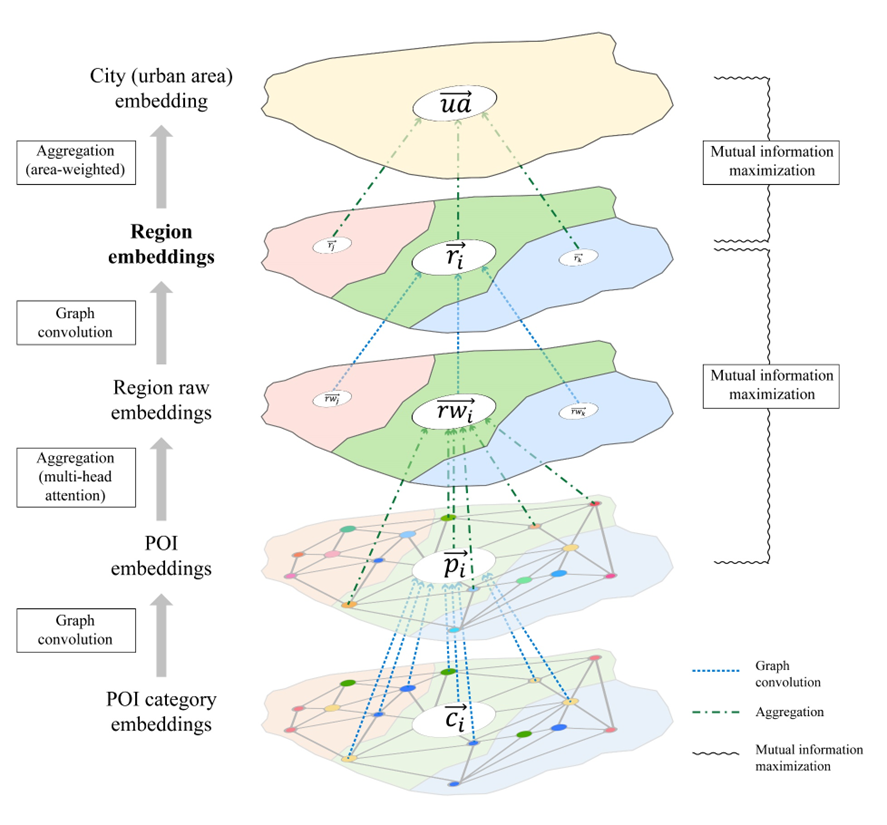 ## Quick start With this repository, you can - learn the region representations using the pre-constructed sub-sampled dataset in Shenzhen, China; - use the learned region embeddings for downstream tasks. ## Environment (here we only report the versions we used) - Python 3.8.13 - PyTorch 1.12.1 - Pytorch_geometric 2.1.0 - Scikit-learn 1.1.2 - Tdqm 4.61.4 - Pytorch_warmup 0.1.0 ## Structure There are two main scripts in this repository: `train.py` and `evaluation.py`. ## `train.py` `train.py` is used to learn the region representations. You can specify the dataset by setting the `--city` argument. For example, to learn the region representations for Shenzhen or xiamen, you can run `python train.py --city shenzhen` The learned region representations will be saved in the `./Emb` folder. The arguments that can be specified in `train.py` are as follows: - `--city`: the city name, e.g., "shenzhen". - We provide a sample pre-processed dataset (subset of the dataset) in Shenzhen, and you could download the [data](https://figshare.com/articles/dataset/Sub-sampled_dataset_for_Shenzhen_HGI_region_embedding_example_dataset_/21836496) `shenzhen_data.pkl` and put it under the folder `Data`. After that, you can run `python train.py --city shenzhen` to learn the region representations for Shenzhen. - `--dim`: the dimension of the learned region representations. - `--alpha`: the hyperparameter to ba balance mutual information. - `--attention_head`: number of attention heads in the aggregation function. - `--lr`: the learning rate. - `--max_norm`: the maximum norm of the gradient. - `--gamma`: gamma in learning rate scheduler. - `--warmup_period`: the warmup period, i.e., how many epochs for linear learning rate warmup. - `--epoch`: the number of epochs. - `--device`: the device to use, which can be `cpu` or `cuda` or `cuda:{}`. - `--save_name`: the name of the saved region representations.' In case you would like to construct your own dataset to learn region representations for other study areas, you need to construct a Data object in the `./Data` folder. The Data object should contain the following attributes: - `x`: POI initial features, which can be POI category embeddings (can even be one-hot vectors) or POI embeddings learned by other methods. - `edge_index`: the POI graph structure, which is a tensor of shape (2, E), where E is the number of edges. - `edge_weight`: the edge weights. - `region_id`: the region id of each POI. - `region_area`: the area proportion of each region in its city. - `coarse_region_similarity`: the coarse similarity of each region with all other regions. This is a (N, N) matrix, where N is the number of regions. - `region_adjacency`: the adjacency matrix of regions. ## `evaluation.py` `evaluation.py` is used to evaluate the learned region representations. Currently it supports two study areas: - `xiamen`: Xiamen Island, China - `shenzhen`: Shenzhen, China and three downstream tasks: - `uf`: urban function inference (this repo contains mocked ground truth data, the real ground truth data can be requested from [here](http://geoscape.pku.edu.cn/en.html)) - `pd`: population density estimation - `hp`: housing price estimation For example, you could run `python evaluation.py --city xiamen --task pd` to evaluate the learned region representations for Xiamen Island on population density estimation. The results will be printed in console.  ## Embeddings The learned region representations for Xiamen Island and Shenzhen are available in the `./Emb` folder. You can load them by `torch.load()`. ## Notes Some codes for the pooling from POIs to regions are borrowed from [Set Transformer's GitHub repository](https://github.com/juho-lee/set_transformer). ## Citation If you use the code in this project, please cite the paper the ISPRS Journal. ``` @article{huang2023hgi, title={Learning urban region representations with POIs and hierarchical graph infomax}, author={Huang, Weiming and Zhang, Daokun and Mai, Gengchen and Guo, Xu and Cui, Lizhen}, journal={ISPRS Journal of Photogrammetry and Remote Sensing}, volume={196}, pages={134--145}, year={2023} } ``` ## Contact Weiming Huang (Nanyang Technological University) Email: weiming.huang@ntu.edu.sg
