KO
|
EN
gitlite — search
Search
#javascript
#python
#hacktoberfest
#react
#ai
#typescript
#llm
#go
#golang
#android
#machine-learning
#rust
#deep-learning
#linux
gact
★ 10
Open GitHub ↗
Genomic Association of Complex Traits
Download README (.md)
Explore Similar Repositories
zhenxun_plugin_mccheck
:
Minecraft服务器状态查询,支持IPv6/Minecraft server status query, IPv6 supported
Joplin-Repeating-Todos-Plugin
:
This plugin allows to-do's in joplin to be repeated based on the to-do alarm date.
SteamModDownloader
:
Steam Workshop Downloader for Non-Steam Games
pantsu-xkjd6alter
:
星空键道6的个人魔改版
GPQHE
:
A C library doing fully homomorphic encryption under the license of LGPL.
// repository documentation
Was this content helpful?
★ 0
(0 ratings)
Select Rating:
★
★
★
★
★
Submit Feedback
Recent Feedback
×
Download README
Do you want to download the
README.md
file for
gact
?
Download (.md)
<!-- README.md is generated from README.Rmd. Please edit that file --> ### An R Package for Creating a Database of Genomic Association of Complex Traits The R package ***gact*** is designed for establishing and populating a comprehensive database focused on genomic associations with complex traits. The package serves two primary functions: infrastructure creation and data acquisition. It facilitates the assembly of a structured repository that includes single marker associations, carefully curated to maintain high data quality. Beyond individual genetic markers, the package integrates a broad spectrum of genomic entities, encompassing genes, proteins, and an array of biological complexes (chemical and protein), as well as various biological pathways. It is designed to aid in the biological interpretation of genomic associations, shedding light on their complex relationships in the context of genomic associations of complex traits. **gact** provides an infrastructure for efficient processing of large-scale genomic association data, including core functions for: - Establishing and populating a database for genomic association. - Downloading and processing a range of biological databases. - Downloading and processing summary statistics from genome-wide association studies (GWAS). - Conducting bioinformatic procedures to link genetic markers with genes, proteins, metabolites, and biological pathways. - Finemapping of genomic regions using Bayesian Linear Regression models. - Performing advanced gene set enrichment analysis utilizing a variety of tools and methodologies. <br> 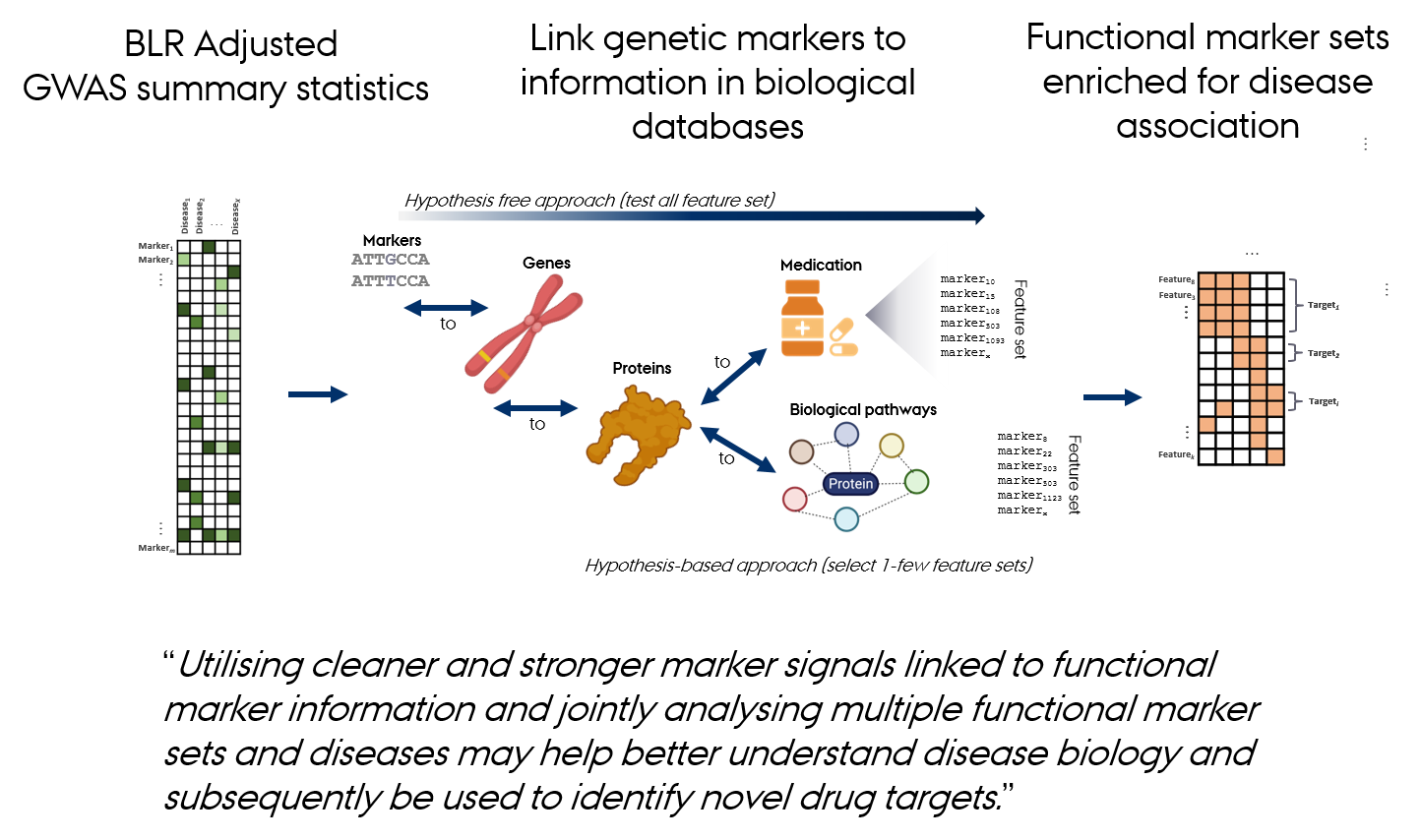 <br> <br> **gact** constructs gene and genetic marker sets from a range of biological databases including: - `"Ensembl"`: Gene, protein, transcript sets derived from the [Ensembl](https://www.ensembl.org/index.html) database. - `"Regulation"`: Regulatory genomic feature sets derived from the [Ensembl Regulation](https://www.ensembl.org/info/genome/funcgen/index.html) database. - `"GO"`: Gene Ontology sets from the [GO](https://geneontology.org) database. - `"Pathways"`: Pathway sets from the [Reactome](https://reactome.org) and [KEGG](https://www.genome.jp/kegg/pathway.html) databases. - `"ProteinComplexes"`: Protein complex sets derived from the [STRING](https://string-db.org) database. - `"ChemicalComplexes"`: Chemical complex sets derived from the [STITCH](http://stitch.embl.de/) database. - `"DrugGenes"`: Drug-gene interaction sets the [DrugBank](https://go.drugbank.com) database. - `"DrugATCGenes"`: Drug ATC gene sets based on the [ATC](https://www.whocc.no/atc_ddd_index/) and [DrugBank](https://go.drugbank.com) databases. - `"DrugComplexes"`: Drug gene complex sets combining information from [STRING](https://string-db.org) and [DrugBank](https://go.drugbank.com). - `"DiseaseGenes"`: Disease-gene sets based on experiments, textmining and knowledge base derived from the [DISEASE](https://diseases.jensenlab.org/Search) database. - `"GTEx"`: GTEx project eQTL sets derived from the [GTEx](https://www.gtexportal.org/home/downloads/adult-gtex/overview) database. - `"GWAScatalog"`: GWAS catalog sets derived from the [GWAScatalog](https://www.ebi.ac.uk/gwas/) database. - `"VEP"`: Variant Effect Predictor sets derived from the [Ensembl Variant Effect Predictor](https://grch37.ensembl.org/info/docs/tools/vep) database. <br> ### Installation of the gact package To install the most recent version of the gact and qgg package from GitHub, use the following commands in R: ``` r library(devtools) devtools::install_github("psoerensen/gact") devtools::install_github("psoerensen/qgg") ``` ### Tutorials for downloading and installing the gact database Below is a set of tutorials used for the gact package: Download and set up the gact database, which is focused on genomic associations for complex traits: [Download and install gact database](Document/Download_and_install_gact_database.html) Download and process genotype data from the 1000 Genomes Project (1000G) for different ancestries (European, East Asian, South Asian) used in different genomic analysis: [Download and process of 1000G data](Document/Process_1000G.html) Computing sparse Linkage Disequilibrium (LD) matrices for 1000 Genomes Project (1000G) data across different ancestries and exploring the LD data which is used in a number of genomic analysis (LD score regression, Vegas gene analysis, Bayesian Linear Regression models): [Compute sparse LD matrices for 1000G data](Document/Compute_sparseLD_1000G.html) Downloading and processing genome-wide association summary statistic and ingest into database: [Download and process new GWAS summary statistics](Document/Download_and_process_gwas.html) ### Tutorials for various types of genomic analysis using the gact database Gene analysis using the VEGAS (Versatile Gene-based Association Study) approach using the 1000G LD reference data processed above: [Gene analysis using VEGAS](Document/Gene_analysis_vegas.html) Gene set enrichment analysis (GSEA) based on BLR (Bayesian Linear Regression) model derived gene-level statistics and MAGMA (Multi-marker Analysis of GenoMic Annotation) (Bai et al. 2024). [Gene set analysis using MAGMA](Document/Gene_set_analysis_magma.html) Pathway prioritization using a single and multiple trait Bayesian MAGMA models and gene-level statistics derived from VEGAS (Gholipourshahraki et al. 2024). [Gene set analysis using Bayesian MAGMA](Document/Gene_set_analysis_bayesian_magma.html) Polygenic Prioritization Scoring (PoPS) using BLR models and gene-level statistics derived from VEGAS (work in progress). [Gene ranking using PoPS](Document/Gene_ranking_bayesian_pops.html) Finemapping with single trait Bayesian Linear Regression models and simulated data (Shrestha et al. 2023). [Finemapping using BLR models on simulated data](Document/Finemapping_bayesian_linear_regression_simulated_data.html) Finemapping of gene and LD regions using single trait Bayesian Linear Regression models (Shrestha et al. 2023). [Finemapping using BLR models on real data](Document/Finemapping_bayesian_linear_regression_real_data.html) Polygenic scoring (PGS) using Bayesian Linear Regression models and biological pathway information (work in progress). [Polygenic scoring using BLR models](Document/Polygenic_scoring_bayesian_linear_regression.html) Polygenic scoring (PGS) using summary statistics from PGS catalog and biological pathway information. [Polygenic scoring using PGS Catalog](Document/Polygenic_scoring_pgscatalog.html) LD score regression for estimating genomic heritability and correlations. [LD score regression](Document/LD_score_regression.html) ### Workshop and Course Materials **Workshop:** *From Integrative Genomics to Polygenic Risk Scoring* — presented at the [**9th Annual Danish Bioinformatics Conference**](https://eventsignup.ku.dk/9danishbioinfconference). - [**Workshop Slides (HTML)**](Document/workshop_slides.html) - [**Demonstration Slides (PDF)**](Document/workshop_slides.pdf) **Course:** *Bayesian Linear Regression* — theoretical notes, lecture slides, and practical R examples. [**Course Materials**](https://psoerensen.github.io/bayesian-linear-regression/) #### Funding These notes and scripts are prepared in the BALDER project funded by the ODIN platform. ODIN is sponsored by the Novo Nordisk Foundation (grant number NNF20SA0061466) #### References 1. Rohde PD, Sørensen IF, Sørensen P. qgg: an R package for large-scale quantitative genetic analyses. *Bioinformatics* 36:8 (2020). <https://doi.org/10.1093/bioinformatics/btz955> 2. Rohde PD, Sørensen IF, Sørensen P. Expanded utility of the R package, qgg, with applications within genomic medicine. *Bioinformatics* 39:11 (2023). <https://doi.org/10.1093/bioinformatics/btad656> 3. Shrestha et al. Evaluation of Bayesian Linear Regression Models as a Fine Mapping Tool. *Submitted* (2024) <https://doi.org/10.1101/2023.09.01.555889> 4. Bai et al. Evaluation of multiple marker mapping methods using single trait Bayesian Linear Regression models. *BMC Genomics* 25:1236 (2024). <https://doi.org/10.1186/s12864-024-11026-2> 5. Gholipourshahraki et al. Evaluation of Bayesian Linear Regression Models for Pathway Prioritization. *PLOS Genetics* 20(11) e1011463 (2025). <https://doi.org/10.1371/journal.pgen.1011463>. 6. Kunkel et al. Improving polygenic prediction from summary data by learning patterns of effect sharing across multiple phenotypes. *Plos Genetics* 21 (1), e1011519 (2025). <https://doi.org/10.1371/journal.pgen.1011519>.
