KO
|
EN
gitlite — search
Search
#javascript
#python
#hacktoberfest
#react
#ai
#typescript
#llm
#go
#golang
#android
#machine-learning
#rust
#deep-learning
#linux
StarElf
★ 9
Open GitHub ↗
An elf loader for COSMOS.
Download README (.md)
Explore Similar Repositories
kh-h
:
jm
StrTable
:
StrTable - simple, configurable ASCII table formatter for AutoHotkey, Python
pr-review-ollama-ai
:
Pull Requests Review Using Ollama AI
Sass-LLVM-Lifter
:
NVLift: A tool to lift NVIDIA GPU SASS to LLVM IR
Hack-3
:
No description available.
// repository documentation
Was this content helpful?
★ 0
(0 ratings)
Select Rating:
★
★
★
★
★
Submit Feedback
Recent Feedback
×
Download README
Do you want to download the
README.md
file for
StarElf
?
Download (.md)
# Star Elf (Stellar's Awesome Reader [for] ELF) ## Overview This project allows you to load and execute ELF files within a Cosmos-based C# operating system. It provides a small library with utility functions to interact with the operating system through direct function calls, including handling console input/output and memory management. (More functions will be added in the future.) ### Example Usage in C ```c #include "Cosmos.h" void example_IDT_GATE(void) { printf("Interrupt Called!\n"); } NO_NAME_MANGLE void main(void*** funcTable) { debug_serial_init(); Cosmos_RegisterFunctionTable(funcTable); clrscr(); get_current_idt(); idt_ptr_t idt = get_idt(); set_idt_gate(0x80, (int)example_IDT_GATE, 0x08, 0x8E); set_idt(idt); printf("IDT: 0x%p\n", &idt); asm volatile("int $0x80"); return; } ``` 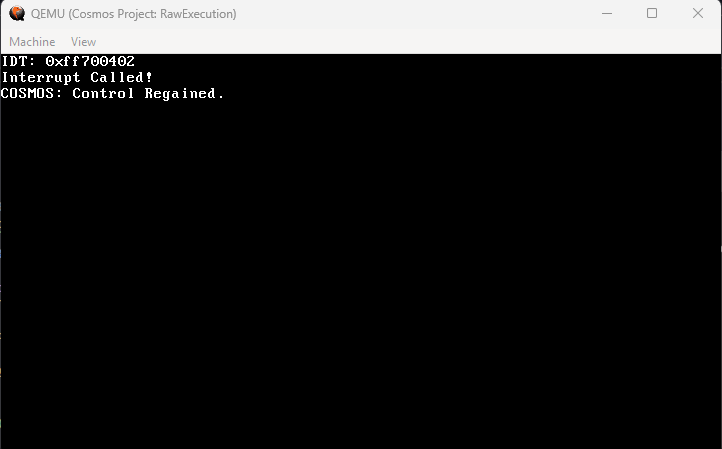 ### Key Features - **IDT Management**: Functions to set and retrieve the IDT (Interrupt Descriptor Table). - **Console Operations**: Includes functions for writing and reading text (UTF-16/ASCII) and clearing the console screen. - **Memory Management**: Functions to allocate, free, and manipulate memory (malloc, calloc, realloc). - **Basic I/O Functions**: Support for printing integers, floats, and other data types to the console. - **ELF File Loading**: Enables loading ELF files into memory and executing them in a Cosmos OS environment. ### Functions Provided - **IDT Functions**: - `set_idt_gate()`, `get_idt()`, `set_idt()` - **Console Functions**: - `Console_WriteLine16()`, `Console_Write16()`, `Console_ReadLine16()` - `Console_WriteLineA()`, `Console_WriteA()`, `Console_ReadLineA()`, etc... - **Memory Management**: - `Heap_Alloc()`, `Heap_Free()` - **ELF Loader**: Load and execute ELF files within the Cosmos OS environment. ### Getting Started 1. Download the project files. 2. Open the `CosmosExec` DIR to find the C files. <br/> 2.1 You can compile these with `make`. Run `make build` to compile the project. (Auto copied) 3. Open the `RawExecution` DIR to find the C# files and kernel. 4. Play/Build as normal in Visual Studio. 5. That's it! You can now run the kernel and load ELF files. ### C# Integration ```c# using Cosmos.Core; using Cosmos.Core.Memory; using Cosmos.HAL; using Stellib.Drivers.Injection; using System; using System.Collections.Generic; using System.Text; using Sys = Cosmos.System; using Stellib.ELF; using IL2CPU.API.Attribs; using XSharp.Assembler; using Cosmos.Core_Asm; namespace RawExecution { public unsafe class Kernel : Sys.Kernel { [ManifestResourceStream(ResourceName = "RawExecution.Drivers.ELF.TestElf")] public static byte[] TestElf; protected override void BeforeRun() { byte[] nElf = new byte[TestElf.Length]; for (int i = 0; i < TestElf.Length; i++) { nElf[i] = TestElf[i]; } Elf32 elf = new Elf32(nElf); elf.PrintElfInfo(); elf.LoadElf(); Console.WriteLine("COSMOS: Control Regained."); } protected override void Run() { } } } ``` ### Current Rewrite of STDLIB ```c++ void* malloc(size_t size); void free(void* ptr); void* calloc(size_t num, size_t size); void* realloc(void* ptr, size_t size); int isspace(int c); void itoa(int num, char* str, int base); void ltoa(long num, char* str, int base); void utoa(unsigned int num, char* str, int base); void ultoa(unsigned long num, char* str, int base); void uitoa(unsigned int num, char* str, int base); void atoi(int num, char* str, int base); void printf(const char* format, ...); int sprintf(char* str, const char* format, ...); int snprintf(char* str, size_t size, const char* format, ...); void vsnprintf(char *str, size_t size, const char *format, va_list args); void vsprintf(char* str, const char* format, va_list ap); void clrscr(void); void gets(char* str, size_t size); int scanf(const char *fmt, ...); int sscanf(const char* str, const char* format, ...); FILE* fopen(const char* filename, const char* mode); int fclose(FILE* file); int fread(void* buffer, unsigned int size, unsigned int nmemb, FILE* stream); int fwrite(void* buffer, unsigned int size, unsigned int nmemb, FILE* stream); int fseek(FILE* stream, int offset, int whence); int ftell(FILE* stream); int fflush(FILE* stream); ```
