KO
|
EN
gitlite — search
Search
#android
#react
#javascript
#docker
#php
#linux
#plugin
#bash
#dotfiles
#neovim
#flask
#streaming
MultiTabQA
★ 32
Open GitHub ↗
No description available.
Download README (.md)
Explore Similar Repositories
SafaricomDarajaFrontEnd
:
A frontend repository showing how to consume Daraja api from the frontend. Shows how to handle errors and status code recieved from safaricom daraja api.
surfingkeys
:
Soho vibes for Surfingkeys
RatInject
:
Rat Inject is C++ Executable to gain Undetectable Persistence in Windows via 4 Registry Keys
okx-rs
:
Unofficial Rust Library for the OKX V5 API.
relationalize
:
A utility for converting/transporting arbitrary JSON data into a relational database
// repository documentation
Was this content helpful?
★ 0
(0 ratings)
Select Rating:
★
★
★
★
★
Submit Feedback
Recent Feedback
×
Download README
Do you want to download the
README.md
file for
MultiTabQA
?
Download (.md)
# MultiTabQA: Generating Tabular Answers for Multi-Table Question Answering 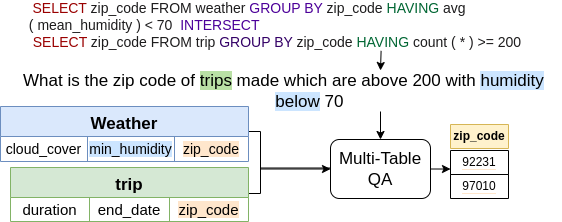 Details of dataset generation and results can be found in our [paper](https://arxiv.org/abs/2305.12820). Finetuning datasets present in data directory: Datasets present in data directory: data.txt: contains url to download all data. The zip file contains Tapex single-table pre-training data, Multi-Table pre-training data, spider dataset where each sample is comprised of the natural question/SQL query, context table/(s), and target table for multi-table QA. + **keys in datasets**: + 'source': flattened input sequence comprising of natural question and context input tables as concatenated string + 'target': flattened target table Loading MultiTabQA pretraining data: Spider pretraining dataset (stage 2) and MultiTabQA pretraining dataset (stage 3: Synthetic SQL): ``` from datasets import load_dataset, concatenate_datasets spider_pretraining = load_dataset("vaishali/spider-tableQA-pretraining") multitabqa_pretraining = load_dataset("vaishali/multitabqa_pretraining")["train"] multitabqa_pretraining = multitabqa_pretraining.shuffle() multitabqa_pretraining_splits = multitabqa_pretraining.train_test_split(0.01) multitab_pretraining_raw_train = concatenate_datasets([multitabqa_pretraining_splits["train"], spider_pretraining["train"]]) multitab_pretraining_raw_validation = concatenate_datasets([multitabqa_pretraining_splits["test"], spider_pretraining["validation"]]) multitab_pretraining_train_tokenized = multitab_pretraining_raw_train.map(tokenize_sample) multitab_pretraining_validation_tokenized = multitab_pretraining_raw_validation.map(tokenize_sample) ``` Loading the fine-tuning MultiTabQA datasets: ``` from datasets import load_from_disk, load_dataset spider_tableQA = load_dataset("vaishali/spider-tableQA") atis_tableQA = load_dataset("vaishali/atis-tableQA") geoQuery_tableQA = load_dataset("vaishali/geoQuery-tableQA") ``` **Model Architecture** 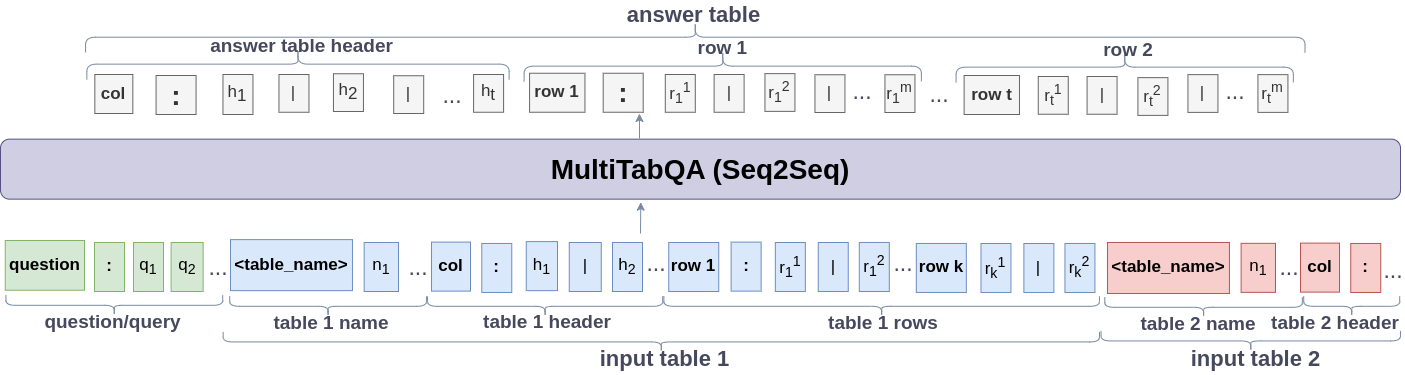 We train a sequence-to-sequence model with backbone architecute `bart-base`. The input sequence is the concatenated question, context tables and output is the flattened answer table. **Datasets** The datasets for pretraining and finetuning can be found in the data directory **Training Process** 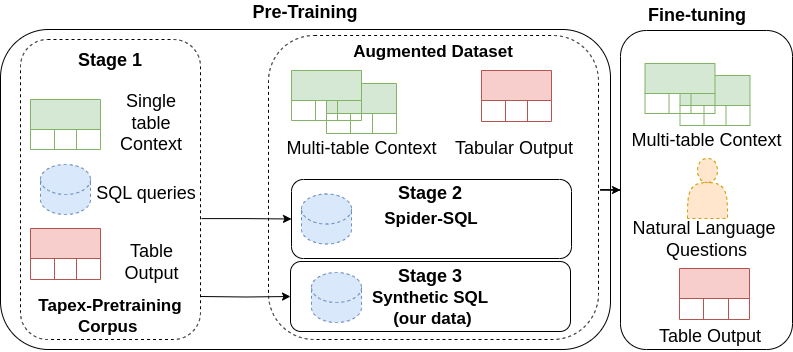 + Pre-training checkpoints can be found at: + [Stage 1 + Stage 2 + Stage 3 (Multi-Table pre-training)](https://huggingface.co/vaishali/multitabqa-base-sql) + Fine-tuning Natural Question model checkpoints can be found at: + [Spider](https://huggingface.co/vaishali/multitabqa-base/) + [Atis](https://huggingface.co/vaishali/multitabqa-base-atis) + [GeoQuery](https://huggingface.co/vaishali/multitabqa-base-geoquery) Arguments for pre-training (Stage 1): ``` python train.py --dataset_name "tapex_pretraining" --pretrained_model_name "microsoft/tapex-base" \ --learning_rate 1e-4 --train_batch_size 4 --eval_batch_size 4 \ --gradient_accumulation_steps 64 --eval_gradient_accumulation 64 \ --num_train_epochs 60 --use_multiprocessing False \ --num_workers 2 --decoder_max_length 1024 \ --local_rank -1 --seed 47 \ --output_dir "experiments/tapex_base_pretraining" ``` Arguments for pre-training (Stage 2+3): ``` python train.py --dataset_name "multitab_pretraining" --pretrained_model_name "experiments/tapex_base_pretraining" \ --learning_rate 1e-4 --train_batch_size 4 --eval_batch_size 4 \ --gradient_accumulation_steps 64 --eval_gradient_accumulation 64 \ --num_train_epochs 60 --use_multiprocessing False \ --num_workers 2 --decoder_max_length 1024 \ --local_rank -1 --seed 47 \ --output_dir "experiments/multitabqa_base_sql" ``` Arguments for fine-tuning: ``` python train.py --dataset_name "spider_nq" --pretrained_model_name "vaishali/multitabqa-base-sql" \ --learning_rate 1e-4 --train_batch_size 4 --eval_batch_size 4 \ --gradient_accumulation_steps 64 --eval_gradient_accumulation 64 \ --num_train_epochs 60 --use_multiprocessing False \ --num_workers 2 --decoder_max_length 1024 \ --local_rank -1 --seed 47 \ --output_dir "experiments/tapex_base_finetuning_on_spiderNQ" ``` To evaluate model finetuned on Spider natural langauge questions dataset: ``` python evaluate_multitabqa.py --batch_size 2 \ --pretrained_model_name "vaishali/multitabqa-base" \ --dataset_name "spider_nq" ``` To evaluate model finetuned on GeoQuery natural langauge questions dataset: ``` python evaluate_multitabqa.py --batch_size 2 \ --pretrained_model_name "vaishali/multitabqa-base-geoquery" \ --dataset_name "geo_test" ``` **Results** Dataset | Model | Table EM | Row EM (P) | Row EM (R) | Row EM (F1) | Column EM (P) | Column EM (R) | Column EM (F1) | Cell EM (P) | Cell EM (R) | Cell EM (F1) --------| ------- | ------------| ----------- | ------- | ------------ | ------------- |----------- | ---------- | -------------- | --------------- |------------ Spider |tapex-base |18.99 | 17.28 |19.83 | 18.27 | 19.75 | 19.39 | 19.57 | 23.15 | 27.71 | 25.03 | | MultiTabQA | **25.19*** |**22.88†** | **24.64*** | **23.70*** | **26.86*** | **26.76*** | **26.81*** | **28.07†** | **31.23*** | **29.55*** GeoQ |tapex-base | 39.84 |22.43 | 30.74 | 24.89 | 39.48 | 39.76 | 39.62 | 21.98 | 30.88 | 24.67 | | MultiTabQA | **52.22*** | **72.39*** | **46.90*** | **41.38*** | **52.10*** | **52.22*** | **52.16*** | **37.16†** | **46.92*** | **41.33*** Atis |tapex-base | 72.20 | 57.07† | 57.69 | 55.08 | 72.20† | 72.20 | 72.20 | 57.07† | 57.69 | 54.48 | | MultiTabQA | **73.88†** | 38.29 | **92.19*** | 54.36 | 69.55 | **75.24†** | **72.29** | 38.16 | **92.56*** | 54.16 **Citation** Please cite our work if you use our code or dataset: ``` @inproceedings{pal-etal-2023-multitabqa, title = "{M}ulti{T}ab{QA}: Generating Tabular Answers for Multi-Table Question Answering", author = "Pal, Vaishali and Yates, Andrew and Kanoulas, Evangelos and de Rijke, Maarten", booktitle = "Proceedings of the 61st Annual Meeting of the Association for Computational Linguistics (Volume 1: Long Papers)", month = jul, year = "2023", address = "Toronto, Canada", publisher = "Association for Computational Linguistics", url = "https://aclanthology.org/2023.acl-long.348", doi = "10.18653/v1/2023.acl-long.348", pages = "6322--6334", abstract = "Recent advances in tabular question answering (QA) with large language models are constrained in their coverage and only answer questions over a single table. However, real-world queries are complex in nature, often over multiple tables in a relational database or web page. Single table questions do not involve common table operations such as set operations, Cartesian products (joins), or nested queries. Furthermore, multi-table operations often result in a tabular output, which necessitates table generation capabilities of tabular QA models. To fill this gap, we propose a new task of answering questions over multiple tables. Our model, MultiTabQA, not only answers questions over multiple tables, but also generalizes to generate tabular answers. To enable effective training, we build a pre-training dataset comprising of 132,645 SQL queries and tabular answers. Further, we evaluate the generated tables by introducing table-specific metrics of varying strictness assessing various levels of granularity of the table structure. MultiTabQA outperforms state-of-the-art single table QA models adapted to a multi-table QA setting by finetuning on three datasets: Spider, Atis and GeoQuery.", } ```
