KO
|
EN
gitlite — search
Search
#javascript
#python
#hacktoberfest
#react
#ai
#typescript
#llm
#go
#golang
#android
#machine-learning
#rust
#deep-learning
#linux
hdtv
★ 22
Open GitHub ↗
Nuclear Spectrum Analysis Tool
Download README (.md)
Explore Similar Repositories
use-cofx
:
declarative side-effects inside react with hooks
zulu-assault
:
Trying to revive an old classic game of 1998 that I used to play a lot as a kid.
shear-picture
:
裁剪图片保存为base64,可用于头像上传
raft-kv
:
A C++ implementation of RAFT consensus algorithm based on asio
qKit
:
qKit is an open source JavaScript 2D rendering library that renders quadratic shapes (rectangles and squares).
// repository documentation
Was this content helpful?
★ 0
(0 ratings)
Select Rating:
★
★
★
★
★
Submit Feedback
Recent Feedback
×
Download README
Do you want to download the
README.md
file for
hdtv
?
Download (.md)
# HDTV - Nuclear Spectrum Analysis [](https://badge.fury.io/py/hdtv) [](https://codecov.io/gh/janmayer/hdtv) [](https://app.codacy.com/manual/janmayer/hdtv/dashboard) 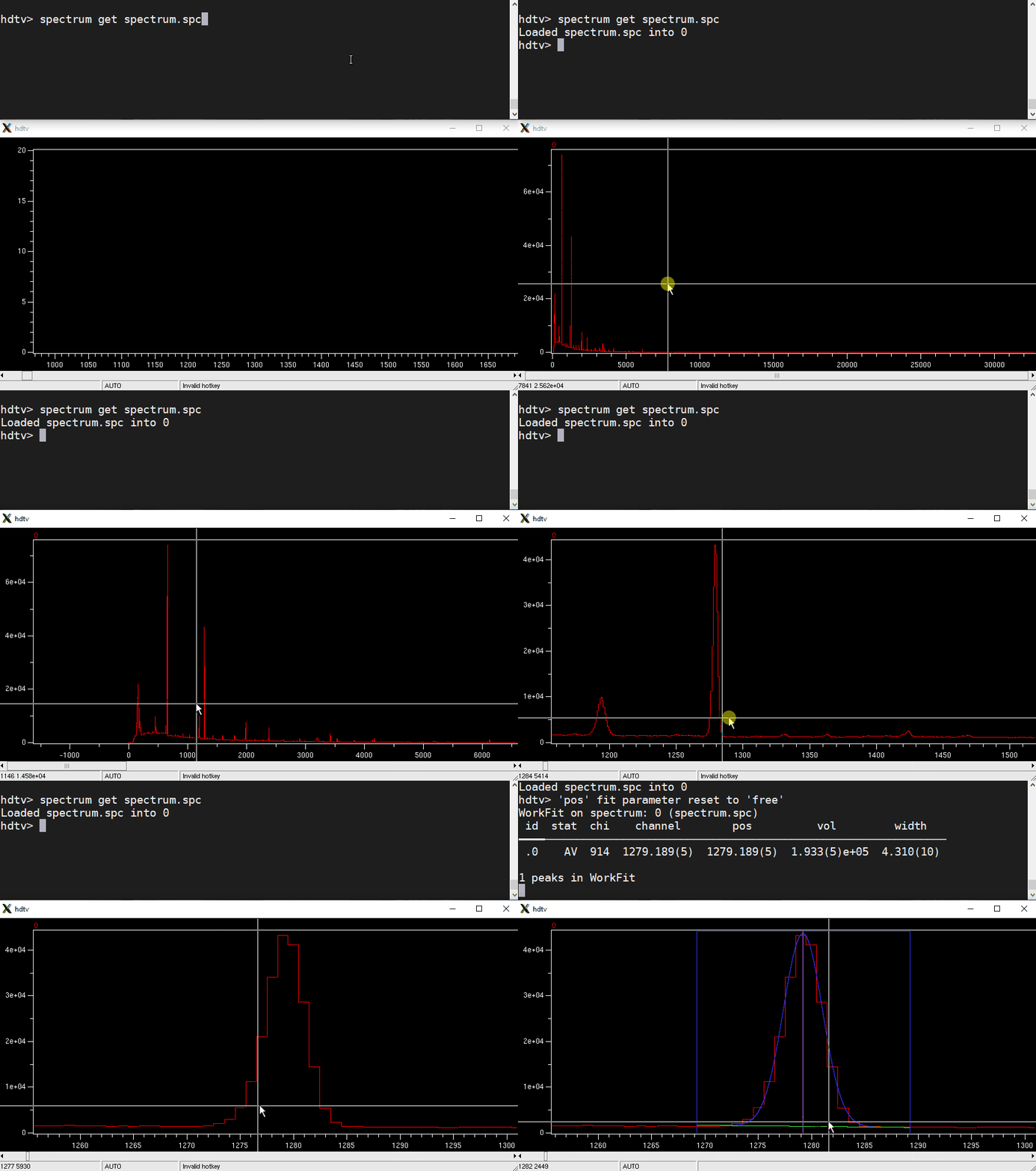 HDTV is a nuclear spectrum and coincidence matrix analysis tool. It can load uncompressed (text), compressed, and ROOT spectra and 2D-matrices. It calibrates spectra, fits peaks with background with different models, and cuts matrices. HDTV is written in a mixture of C++ and Python, glued together using PyROOT. ## Installation HDTV requires [CERN ROOT](https://root.cern.ch/) with working Python bindings. ```sh pip install hdtv ``` If pip raises `error: externally-managed-environment`, you can install hdtv in a virtual environment, for example by using `pipx`: ```sh pipx install hdtv --system-site-packages ``` If you use hdtv with a location-independent ROOT installation (i.e., you have to `source <...>/thisroot.sh`, e.g. in `.bashrc` or manually), you can leave out the `--system-site-packages` option. Please note that the python package (wheel) does currently not include the compiled libraries required to run, as these depend on the root version, the python version, the compiler, and the moon phases. Instead, these are compiled automatically at first start, which requires certain build tools (see below). Alternatively, the compilation can be triggered with ```sh hdtv --rebuild-usr ``` for the current user; or with ```sh hdtv --rebuild-sys ``` for all user (requires superuser privileges). ### Requirements To build and run HDTV, the following dependencies are required: * Python - Tested with 3.10, 3.11, 3.12, 3.13, and 3.14 - Python-dependencies are installed automatically when using pip/pipx - Packages: numpy scipy matplotlib prompt_toolkit>=3.0.14 uncertainties (when manually installed) - Packages for development & testing: docutils pytest pytest-cov * [Cern ROOT](https://root.cern/) 6 - Tested with version 6.26 and higher - Needs to be compiled against the correct python version and with support for C++14 or higher. - In python, **`import ROOT` must succeed**. - System packages may be available on some systems, e.g. `<tool> install root python3-root` ([More info](https://root.cern/install/#linux-package-managers)) * cmake, gcc, g++ (or similar, in a somewhat modern version) * libx11-dev `<tool> install libx11-6 libx11-dev` ### Usage with docker With docker installed, build the image with: ```sh git clone https://github.com/janmayer/hdtv.git cd hdtv docker build --tag hdtv . ``` On Linux and MacOS, no further installation is required and in the directory with your project you will be able to use HDTV with: ```sh docker run -e DISPLAY=${DISPLAY} -v /tmp/.X11-unix:/tmp/.X11-unix -v ${PWD}:/work -it hdtv ``` CLI arguments can be passed directly e.g. ```sh docker run ... -it hdtv --help ``` If your X server requires authorization, pass the .Xauthority file to the container. ```sh docker run -e DISPLAY=${DISPLAY} -v /tmp/.X11-unix:/tmp/.X11-unix -v ${PWD}:/work -v ${XAUTHORITY}:/root/.Xauthority -it hdtv ``` When using SELinux, the additional argument `--security-opt label=type:container_runtime_t` is required (before `-it`). On Windows, you will need to have an X-Server installed, for example with MobaXTerm, and be a bit more specific: ```sh docker run -e DISPLAY=<your ip>:0.0 -v <full path to your files>:/work -it hdtv ``` e.g. `docker run -e DISPLAY=192.168.178.21:0.0 -v D:\Project\Spectra:/work -it hdtv`. See also [https://hub.docker.com/r/rootproject/root](https://hub.docker.com/r/rootproject/root). ## Documentation For more information, including an overview of the available key bindings, refer to the [documentation](doc/guide/hdtv.rst). A [tutorial](doc/guide/hdtv-tutorial.rst) giving an introduction to HDTV and its basic features is also available. ## Development A development environment can be easily setup with [**uv**](https://docs.astral.sh/uv/) Install uv and all dependencies listed in the Requirements section above. Clone this repository ``` git clone https://github.com/janmayer/hdtv cd hdtv ``` Initialize a virtual environment with ``` uv venv --system-site-packages ``` HDTV can then be build and run with ``` uv run hdtv ``` All required Python dependencies are installed automatically. Other python tools can also be executed in the venv with `uv run ...`. Generate man pages: ``` cd doc/guide make doc ``` ## Handling different ROOT versions HDTV uses `ROOT.gSystem.Load(library)` to load some critical components. These need to be compiled against the *exact* ROOT version imported in python. HDTV will try to automatically recompile the libraries for the current ROOT if the available ones cannot be loaded. This can also be forced with: `hdtv --rebuild-usr` When installed system-wide, the libraries can be recompiled once for all users with: `hdtv --rebuild-sys` This eliminates the need to reinstall HDTV after changes to the root installation. Multiple Versions of ROOT can be used alongside, the correct library version will be chosen automatically.
