KO
|
EN
gitlite — search
Search
#python
#java
#python3
#arduino
#golang
#machine-learning
#rust
#html
#flask
#javascript
#seismology
#nodejs
quits
★ 72
Open GitHub ↗
QUITS: A modular Qldpc code circUIT Simulator
Download README (.md)
Explore Similar Repositories
Logic-Circuit-Simulator
:
A logic circuit simulator made with p5.js library.
logicrs
:
An easy-to-use simulator for logical circuits
OpenSignal
:
A Desktop logical circuit simulator Application and Website built with Tauri.
SwiftQuantumComputing
:
Quantum circuit simulator in Swift
qcsimulator.github.io
:
Quantum Circuit Simulator.
// repository documentation
Was this content helpful?
★ 0
(0 ratings)
Select Rating:
★
★
★
★
★
Submit Feedback
Recent Feedback
×
Download README
Do you want to download the
README.md
file for
quits
?
Download (.md)
# QUITS: A Modular QLDPC Code circUIT Simulator [](https://github.com/mkangquantum/quits/actions/workflows/ci.yml) [](https://pypi.org/project/quits/) [](https://pypi.org/project/quits/) [](https://pypi.org/project/quits/) [](https://pepy.tech/project/quits) QUITS is a modular and flexible circuit-level simulator for quantum low-density parity-check (QLDPC) codes. It is designed so users can choose and mix different options for each module independently: code construction, circuit strategy, decoder, noise model, and layout helper. *Example QLDPC code (Balanced Product Cyclic code) Tanner graph with cardinal circuit scheduling and transversal layout.* 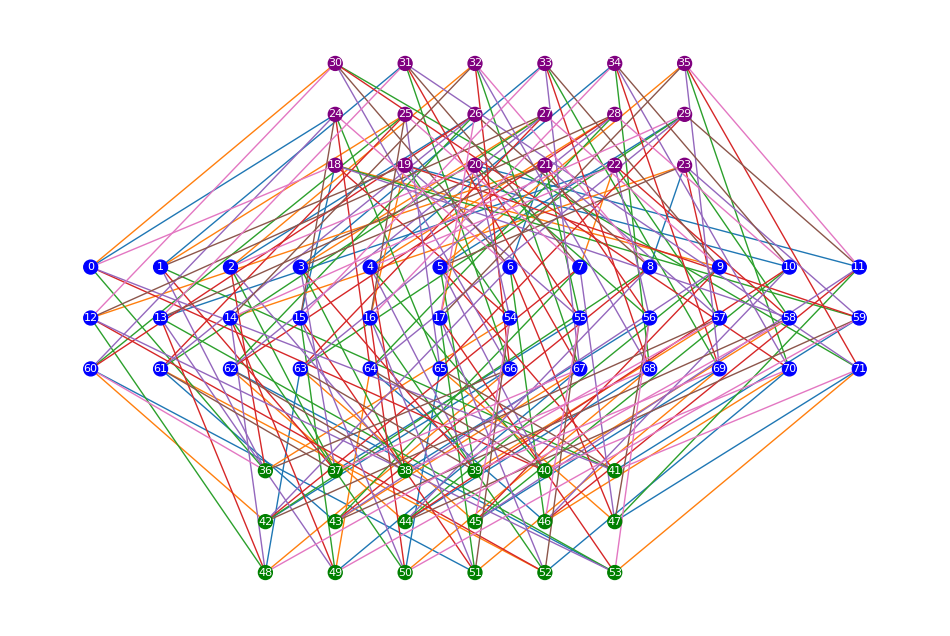 ## Modular Architecture QUITS is organized into clear modules, enabling flexible choice for each component: - `quits.qldpc_code`: QLDPC code families, code objects, and bring-your-own parity-check-matrix workflows. - `quits.qldpc_code.circuit_construction`: circuit-construction strategies and options. - `quits.decoder`: sliding-window phenomenological/circuit-level decoders, with flexibility in inner decoders (e.g. BP-OSD, BP-LSD, bring-your-own decoder). - `quits.noise.ErrorModel`: structured noise-model configuration (e.g. idling/single-qubit-gate/two-qubit-gate/SPAM error rates) for circuit generation. - `quits.layout`: layout and visualization helpers, including transversal and toric graph embeddings. For HGP codes, QUITS also includes a classical LDPC generator in `quits.ldpc_util`, including `generate_ldpc` and `generate_ldpc_good_girth`. Supported code families include: - Hypergraph Product (HGP) codes ([arXiv:0903.0566](https://arxiv.org/abs/0903.0566)) - Quasi-cyclic Lifted Product (QLP) codes ([arXiv:2308.08648](https://arxiv.org/abs/2308.08648)) - Balanced Product Cyclic (BPC) codes ([arXiv:2411.03302](https://arxiv.org/abs/2411.03302)) - Lift-Connected Surface (LCS) codes ([arXiv:2401.02911](https://arxiv.org/abs/2401.02911)) - Bivariate Bicycle (BB) codes ([arXiv:2308.07915](https://arxiv.org/abs/2308.07915)) - Mitten codes ([arXiv:2607.28795](https://arxiv.org/abs/2607.28795)) - [**Any code**, if you bring the parity check matrices](https://github.com/mkangquantum/quits/blob/v1.2.0/doc/01B_make_my_own_code.ipynb) For background on QUITS, see [arXiv:2504.02673](https://arxiv.org/abs/2504.02673). ## Circuit Construction Strategies | Code family | `zxcoloration` | `cardinal`<br>`cardinalNSmerge` | `custom` | | --- | --- | --- | --- | | HGP | yes | yes | no | | QLP | yes | yes | no | | BPC | yes | yes | no | | LCS | yes | yes | no | | BB | yes | no | yes | | Mitten | yes | no | yes | | Any | yes | no | no | - [`zxcoloration`](https://github.com/mkangquantum/quits/blob/v1.2.0/doc/02C_zxcoloration_circuit_generation.ipynb) is available for all QLDPC codes. - [`cardinal`, `cardinalNSmerge`](https://github.com/mkangquantum/quits/blob/v1.2.0/doc/02B_cardinal_circuit_generation.ipynb) are available for HGP, QLP, BPC, and LCS. - [`custom`](https://github.com/mkangquantum/quits/blob/v1.2.0/doc/02A_custom_circuit_generation.ipynb) is available for BB code. - For mitten codes, `custom` (the default) is the mitten-specific depth-12 interleaved mixed X/Z schedule, and the additional `hook_error_free` strategy is the depth-24 group-element-layer schedule of [arXiv:2607.28795](https://arxiv.org/abs/2607.28795); `zxcoloration` gives depth 18. ## Recommended Companion Libraries QUITS is best used together with the following libraries: - [Stim](https://github.com/quantumlib/Stim) (fast stabilizer circuit simulator) - [LDPC](https://github.com/quantumgizmos/ldpc) (BP-OSD, BP-LSD decoders for QLDPC codes) ## Installation Conda-first workflow: ```bash conda create -n quits python=3.12 -y conda activate quits pip install quits ``` For source/development installs from this repository: ```bash pip install -e . ``` ## Quick Start Docs - [doc/00_getting_started.ipynb](https://github.com/mkangquantum/quits/blob/v1.2.0/doc/00_getting_started.ipynb) ## Acknowledgments This project is based on [*QUITS: A modular Qldpc code circUIT Simulator*](https://doi.org/10.22331/q-2025-12-05-1931), originally developed by Mingyu Kang, Yingjia Lin, Hanwen Yao, Mert Gökduman, Arianna Meinking, and Kenneth R. Brown at the [Duke Quantum Center](https://quantum.duke.edu/), supported by NSF, ARO, and LPS. Since the release of QUITS, we acknowledge the feedback and suggestions from Ryan Tiew, Josias Old, qodesign, and Daniel Tan that helped improve the package. If you're working on QLDPC codes, decoders, or noise modeling, it'd be great if you could try QUITS, file issues, or contribute features. Let's build better tools for scalable, fault-tolerant quantum computing together. ## License This project is licensed under the MIT License. ## How to Cite Our Work If you use our work in your research, please cite it using the following reference: ```bibtex @article{Kang2025quitsmodularqldpc, doi = {10.22331/q-2025-12-05-1931}, url = {https://doi.org/10.22331/q-2025-12-05-1931}, title = {{QUITS}: {A} modular {Q}ldpc code circ{UIT} {S}imulator}, author = {Kang, Mingyu and Lin, Yingjia and Yao, Hanwen and G{\"{o}}kduman, Mert and Meinking, Arianna and Brown, Kenneth R.}, journal = {{Quantum}}, issn = {2521-327X}, publisher = {{Verein zur F{\"{o}}rderung des Open Access Publizierens in den Quantenwissenschaften}}, volume = {9}, pages = {1931}, month = dec, year = {2025} } ```
