KO
|
EN
gitlite — search
Search
#typescript
#ai-agents
#ai
#dsh-plugin
#deepseek-harness
#open-source
#cli
#claude-code
#codex
#developer-tools
#react
#windows
ngods
★ 74
Open GitHub ↗
New generation opensource data stack
Download README (.md)
Explore Similar Repositories
Gluten-Trino
:
Gluten: Plugin to Boost Trino's Performance
trino-client-ruby
:
Trino/Presto client library for Ruby
metabase-driver
:
Starburst Metabase driver
// repository documentation
Was this content helpful?
★ 0
(0 ratings)
Select Rating:
★
★
★
★
★
Submit Feedback
Recent Feedback
×
Download README
Do you want to download the
README.md
file for
ngods
?
Download (.md)
# ngods: opensource data stack This repository contains Docker compose script that creates opensource data analytics stack on your local machine. 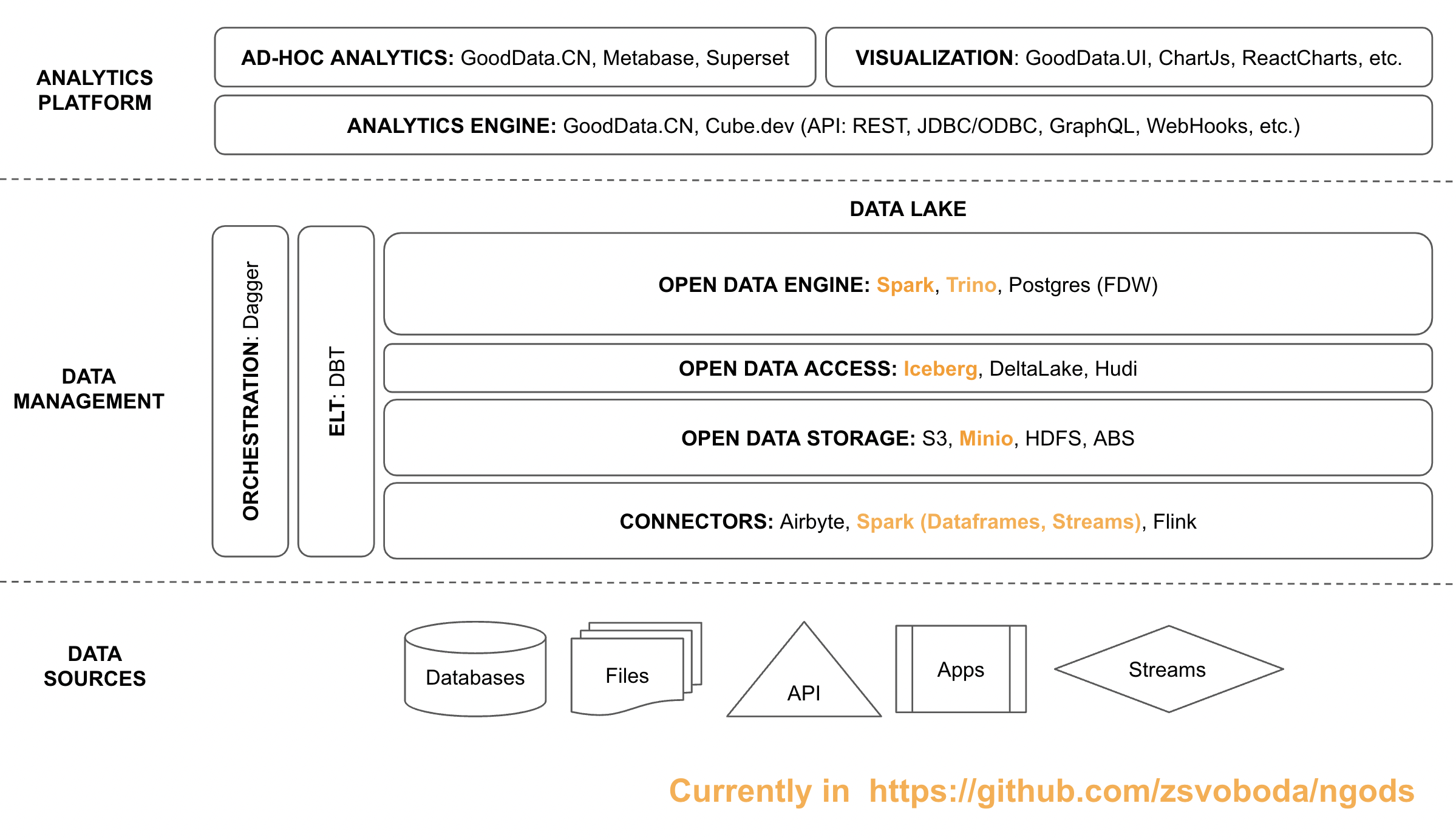 Currently, the stack consists of multiple components: - [**Trino**](https://trino.io/) for low-latency distributed SQL queries - [**Apache Spark**](https://spark.apache.org/) for data pipeline - [**Apache Iceberg**](https://iceberg.apache.org/) for atomic data pipeline with schema evolution, and partitioning for performance - [**Hive Metastore**](https://cwiki.apache.org/confluence/display/hive/design#Design-Metastore) for metadata management (metadata are stored in MariaDB) - [**Minio**](https://min.io/) for mimicking S3 storage on a local computer I plan to add more components soon: - [**Postgres**](https://www.postgresql.org/) for low-latency queries (if Trino on Iceberg doesn't provide satisfactory low-latency queries). I'll also add Postgre Foreign Data Wrapper technology for more convenient ELT between Trino and Postgres - [**DBT**](https://www.getdbt.com/) for ELT on top of Spark SQL or Trino - [**GoodData.CN**](https://www.gooddata.com/developers/cloud-native/) or [**Cube.dev**](https://cube.dev/) for analytics model and metrics - [**Metabase**](https://www.metabase.com/) or [**Apache Superset**](https://superset.apache.org/) for dashboards and data visualization ## How ngods works: Simple example You can simply start the ngds by executing ```bash docker-compose up ``` from the top-level directory where you've cloned this repo. Once all images are pulled and all containers start, open Minio in your browser [http://localhost:9000](http://localhost:9000) log in with ```minio``` username and ```minio123``` password and create a top level bucket called ```bronze``` . Then use your favorite SQL console tool (I use [DBeaver](https://dbeaver.io/)) and connect to the Trino instance running on your local machine (jdbc url: ```jdbc:trino://localhost:8080```, username: ```trino```, empty database) and execute the following script: ```sql create schema if not exists warehouse.bronze with (location = 's3a://bronze/'); drop table if exists warehouse.bronze.employee; create table warehouse.bronze.employee ( employee_id integer not null, employee_name varchar not null ) with ( format = 'parquet' ); insert into warehouse.bronze.employee (employee_id, employee_name) values (1, 'john doe'); insert into warehouse.bronze.employee (employee_id, employee_name) values (2, 'jane doe'); insert into warehouse.bronze.employee (employee_id, employee_name) values (3, 'joe doe'); insert into warehouse.bronze.employee (employee_id, employee_name) values (4, 'james doe'); select * from warehouse.bronze.employee; ``` ## How ngods works: Loading parquet file as table Now we'll load the February 2022 NYC taxi trip data parquet file as a new table to ngods. First, create a new ```nyc``` directory in the ```./data/stage``` directory and download the [February 2022 NYC taxi trips parquet file](https://s3.amazonaws.com/nyc-tlc/trip%20data/fhvhv_tripdata_2022-02.parquet) to it. Then open and execute the ngods [Spark notebook script](http://localhost:8888/notebooks/notebooks/spark.nyc.taxti.example.ipynb) that loads the data as a new table to the ```bronze``` schema of a ```warehouse``` database. ```python df=spark.read.parquet("/home/data/stage/nyc/fhvhv_tripdata_2022-02.parquet") df.writeTo("warehouse.bronze.ny_taxis_feb").create() ``` Now open your SQL console again, connect to the the Trino instance running on your local machine (jdbc url: ```jdbc:trino://localhost:8080```, username: ```trino```, empty database) and execute this SQL queries: ```sql select count(*) from warehouse.bronze.ny_taxis_feb; select hour(pickup_datetime), sum(trip_miles), sum(trip_time), sum(base_passenger_fare) from warehouse.bronze.ny_taxis_feb group by 1 order by 1; ``` You should see your query results in no time!
