KO
|
EN
gitlite — search
Search
#javascript
#ios
#python
#golang
#typescript
#android
#vue
#react
#game
#nodejs
#c
#opengl
delfta
★ 111
Open GitHub ↗
Δ-QML for medicinal chemistry
Download README (.md)
Explore Similar Repositories
ProtoTree
:
ProtoTrees: Neural Prototype Trees for Interpretable Fine-grained Image Recognition, published at CVPR2021
MediatR.AspNetCore.Endpoints
:
No description available.
mlflow-torchserve
:
Plugin for deploying MLflow models to TorchServe
transparency-exchange-api
:
A standard API specification for exchanging supply chain artifacts and intelligence
jokes-app-multiplatform
:
A sample Kotlin multiplatform project using Kotlin code in Android and iOS
// repository documentation
Was this content helpful?
★ 0
(0 ratings)
Select Rating:
★
★
★
★
★
Submit Feedback
Recent Feedback
×
Download README
Do you want to download the
README.md
file for
delfta
?
Download (.md)
# DelFTa: Open-source Δ-quantum machine learning for medicinal chemistry 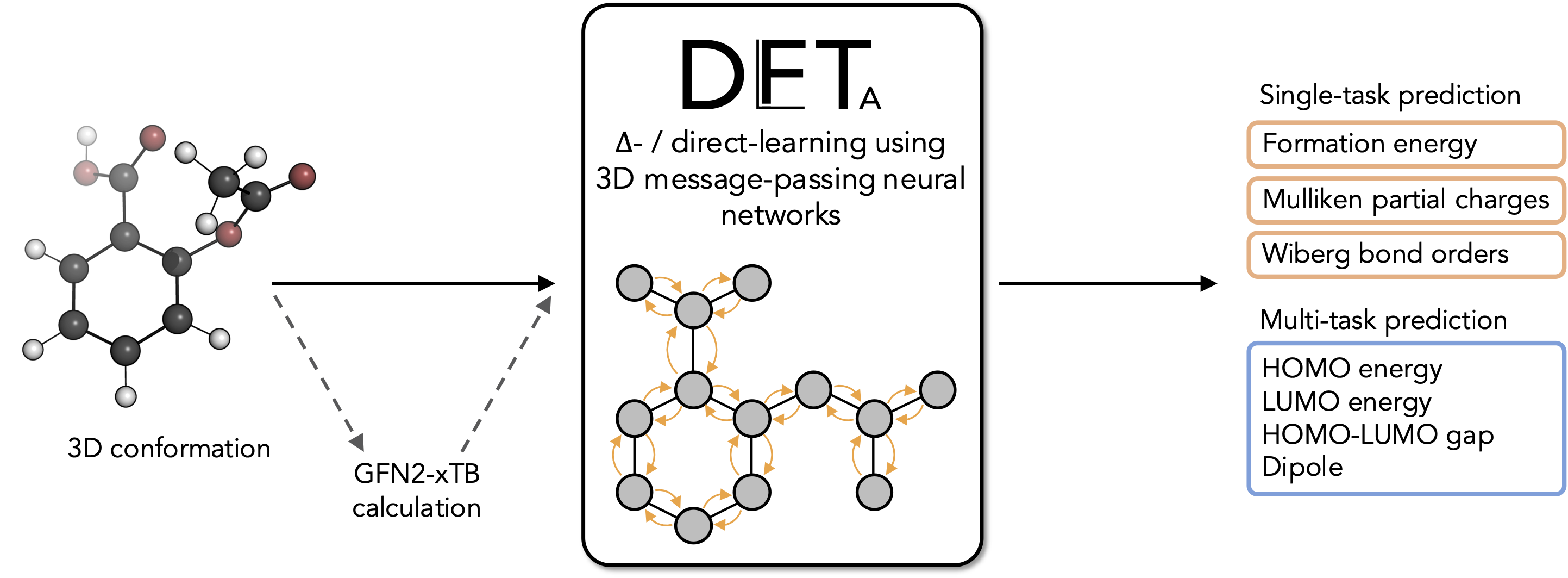 [](https://github.com/josejimenezluna/delfta/actions/workflows/build.yml) [](https://anaconda.org/delfta/delfta) [](https://delfta.readthedocs.io/en/latest/?badge=latest) [](https://codecov.io/gh/josejimenezluna/delfta)  ## Overview The DelFTa application is an easy-to-use, open-source toolbox for predicting quantum-mechanical properties of drug-like molecules. Using either ∆-learning (with a GFN2-xTB baseline) or direct-learning (without a baseline), the application accurately approximates DFT reference values (*ω*B97X-D/def2-SVP). It employs 3D message-passing neural networks trained on the QMugs dataset of quantum-mechanical properties, and can predict formation and orbital energies, dipoles, Mulliken partial charges and Wiberg bond orders. See the [paper](https://pubs.rsc.org/en/content/articlehtml/2022/cp/d2cp00834c) for more details (version 1.0.0 used in this work). ## Installation We currently only support Python 3.11 and 3.12 Linux builds. ### Installation via conda We recommend and support installation via the [conda](https://docs.conda.io/en/latest/miniconda.html) package manager, and that a fresh environment is created beforehand. Then fetch the package from our channel: ```bash conda install delfta -c delfta -c conda-forge ``` ### Installation via Docker A CUDA-enabled container can be pulled from [DockerHub](https://hub.docker.com/r/josejimenezluna/delfta). We also provide a Dockerfile for manual builds: ```bash docker build -t delfta . ``` Attach to the provided container with: ```bash docker run -it delfta bash ``` ## First run DelFTa requires some additional files (_e.g._ trained models) before it can be used. Execute the following in order to fetch those: ```bash python -c "import runpy; _ = runpy.run_module('delfta.download', run_name='__main__')" ``` ## Quick start We interface with Pybel (OpenBabel). Most molecular file formats are supported (_e.g._ .sdf, .xyz). ```python from openbabel.pybel import readstring mol = readstring("smi", "CCO") from delfta.calculator import DelftaCalculator calc = DelftaCalculator() preds = calc.predict(mol) print(preds) ``` Further documentation on how to use the package is available under [ReadTheDocs](https://delfta.readthedocs.io/en/latest/). ## Tutorials In-depth tutorials can be found in the `tutorials` subfolder. These include: - [delta_vs_direct.ipynb](tutorials/delta_vs_direct.ipynb): This showcases the basics of how to run the calculator, and compares results using direct- and Δ-learning models. - [calculator_options.ipynb](tutorials/calculator_options.ipynb): This dives into the different options you can initialize the calculator class with. - [training.ipynb](tutorials/training.ipynb): A simple example of how networks can be trained. ## Citation If you use this software or parts thereof, please consider citing the following BibTex entry: ``` @article{atz2022delta, title={$\Delta$-Quantum machine-learning for medicinal chemistry}, author={Atz, Kenneth and Isert, Clemens and B{\"o}cker, Markus NA and Jim{\'e}nez-Luna, Jos{\'e} and Schneider, Gisbert}, journal={Physical Chemistry Chemical Physics}, volume={24}, number={18}, pages={10775--10783}, year={2022}, publisher={Royal Society of Chemistry} } ```
