KO
|
EN
gitlite — search
Search
#javascript
#python
#hacktoberfest
#react
#ai
#typescript
#llm
#go
#golang
#android
#machine-learning
#rust
#deep-learning
#linux
geolocation
★ 24
Open GitHub ↗
No description available.
Download README (.md)
Explore Similar Repositories
timetable_csea
:
Timetable PWA of B.Tech CSEA, Batch of 2025, Amrita Vishwa Vidyapeetham
pump.fun-sniper
:
pump.fun wallet monitor and sniper
ShanghaiTech-YSYX
:
Unofficial guide for ysyx students applying to ShanghaiTech University
idd
:
A System for Differential Debugging
youtube-negativity-manager
:
No description available.
// repository documentation
Was this content helpful?
★ 0
(0 ratings)
Select Rating:
★
★
★
★
★
Submit Feedback
Recent Feedback
×
Download README
Do you want to download the
README.md
file for
geolocation
?
Download (.md)
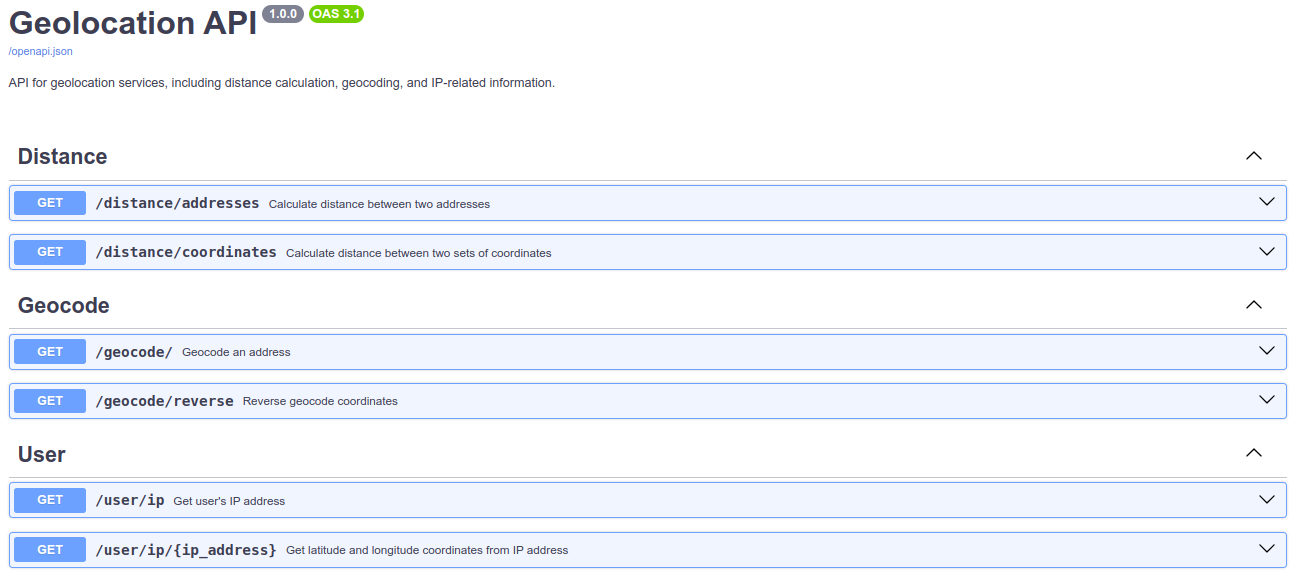
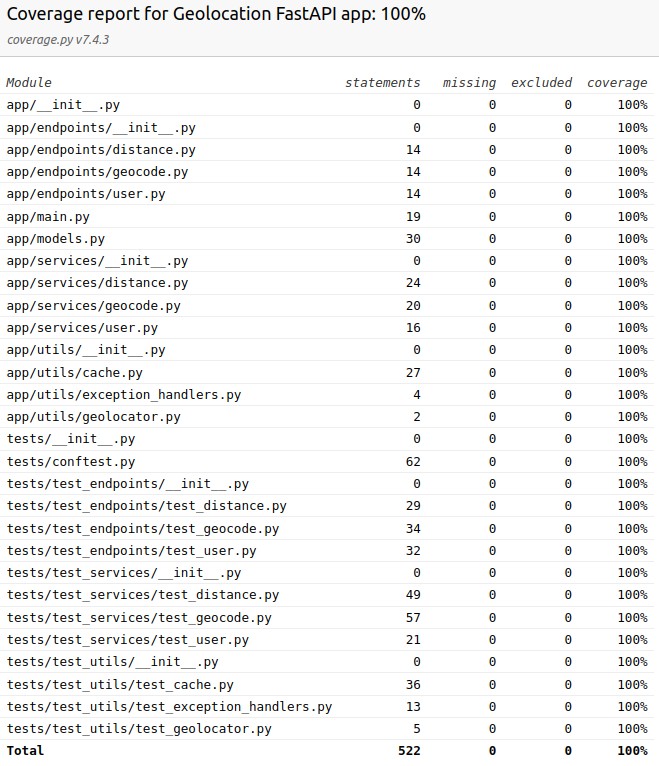
## API for Obtaining Coordinates This API retrieves coordinates (latitude and longitude) based on the address passed in the command line. Application written using ChatGPT 3.5. ### Step 1: - **Request:** [here](https://chat.openai.com/share/f7491fc4-a71f-4b4c-b779-ce5be96458c1) > Create a fastapi application with an endpoint that displays geolocation. > The address should be obtained from the passed parameter 'q'. > Use some Python library to determine the geolocation by address. > Run this API on Hypercorn with three workers. > Use nginx as a proxy server. And put all of this into Docker. > For convenience, use Docker Compose. And show the file hierarchy so I understand where to put what. - **Changes:** - Updated dependencies due to outdated specifications. - Python version upgraded from 3.9 to 3.12. - Added dependency on Hypercorn, as it was missing from requirements.txt. - Removed Uvicorn startup command from Dockerfile; instead, specified the command to run using Hypercorn in docker-compose.yml. - Minor edits in main.py to adhere to PEP8 standards (added 1 blank line before the `get_geolocation` function). ### Step 2: - **Request:** [here](https://chat.openai.com/share/9a01af30-71af-464b-8c72-358c5c05b810) > I have a FastAPI application. I would like to add an endpoint that will display the real IP address of the user. > It's possible to obtain the IP from httpbin. ### Step 3: - **Request:** [here](https://chat.openai.com/share/8ceb265f-7eb2-454e-a48c-62cb9c59062b) > I have a FastAPI application. > I would like to add another endpoint for reverse geocoding (coordinates to address) using > the same Python package, geopy. Also, don't forget to catch possible errors. ### Step 4: - **Request:** [here](https://chat.openai.com/share/5c2716aa-603d-43f9-b01d-79bd1ce1e1db) > How can I find the latitude and longitude for an IP address for free using Python? ### Step 5: - **Request:** [here](https://chat.openai.com/share/98d3fc0d-eb93-4149-987a-665b18dd61c4) > Let's create a new endpoint in my FastAPI application. It will be a search for the distance between objects. > I'm already using the geopy library. Maybe we can do something with it? ### Step 6: - **Request:** [here](https://chat.openai.com/share/26783b7c-16de-49f3-9342-73db1fddf1df) > In our FastAPI application, we already have an endpoint to find the distance in kilometers between objects. > We use the geopy library. I suggest adding an endpoint to find the distance as well, > but now the request arguments will be addresses instead of latitude and longitude. ### Step 7: - **Request:** [here](https://chat.openai.com/share/6850154c-ed76-4939-8718-801149e60f3c) > It was a full-fledged conversation where we updated the code, caught bugs, fixed them, > and ultimately even managed to get something working. ### Step 8: - **Request:** [here](https://chat.openai.com/share/7ea50016-ed08-4995-9317-d9e2efa94157) - **Extra information**: This was one of the longest conversations with ChatGPT. During the conversation, it replaced the already well-generated code with another. It was forgetting about the code that had already been written, coming up with non-existent calls to library methods, and a couple of other things. > You have written a FastAPI application with several endpoints for obtaining geolocation. > Act as the lead Python developer: I need to optimize and refactor your application and its deployment, > even if it's necessary to completely change the structure or code (for example, splitting a file into modules), > so proceed without hesitation. You will explore all possible edge cases that may lead to errors (you need to think > of some data validation for the data that will come from users). During the process, you should focus on code > cleanliness, relevance, and correct usage of various third-party libraries. Provide detailed documentation for FastAPI > endpoints so that it is displayed in Swagger, and don't forget to include descriptions not only for the endpoints > themselves but also descriptions of the status codes that may be displayed to the user (referring to the "responses" > parameter in the initialization of endpoints, for example, responses={429: {"model": YourModelName}}). > Please avoid code duplication, remember DRY and KISS principles. Output the final result in well-structured files and > their refactored code. Describe everything in detail, don't skip anything! > Here's the project structure: ``` project_root/ |-- app/ | |-- main.py |-- Dockerfile |-- docker-compose.yml |-- nginx/ | |-- nginx.conf |-- requirements.txt ``` > And here's the contents of the files: ...I copied the contents of all files... ### Step 9: - **Request:** [here](https://chat.openai.com/share/c2fcc1ae-a217-4e9c-a7ec-d338ae416152) > It was another full conversation where we were trying to find suitable conditions for tests, > encountering errors again, and fixing them. While writing the tests, we even found bugs in the API and corrected them. > As a result, we achieved 100% code coverage with our tests.