KO
|
EN
gitlite — search
Search
#javascript
#python
#react
#php
#cli
#golang
#nodejs
#go
#typescript
#html
#android
#redux
pyGPGO
★ 246
Open GitHub ↗
Bayesian optimization for Python
Download README (.md)
Explore Similar Repositories
authz
:
Docker Authorization Plugin
xng-breadcrumb
:
A lightweight, configurable and reactive breadcrumbs for Angular 2+
NXUI
:
NXUI (nex-ui), next-gen UI - Create minimal Avalonia applications using C# 10 and .NET 8
gpt-instagram
:
A GPT-based autonomous multi-agent AI in Next.js that research & recommends Instagram Viral Posts reflecting your personality.
ecto_mnesia
:
Ecto adapter for Mnesia Erlang term database.
// repository documentation
Was this content helpful?
★ 0
(0 ratings)
Select Rating:
★
★
★
★
★
Submit Feedback
Recent Feedback
×
Download README
Do you want to download the
README.md
file for
pyGPGO
?
Download (.md)
# pyGPGO: Bayesian Optimization for Python [](https://travis-ci.org/hawk31/pyGPGO) [](https://codecov.io/gh/hawk31/pyGPGO) [](http://pygpgo.readthedocs.io/en/latest/?badge=latest) [](https://zenodo.org/badge/latestdoi/74589922) [](http://joss.theoj.org/papers/7d60820fabf7fa81501e3d638cac522d) 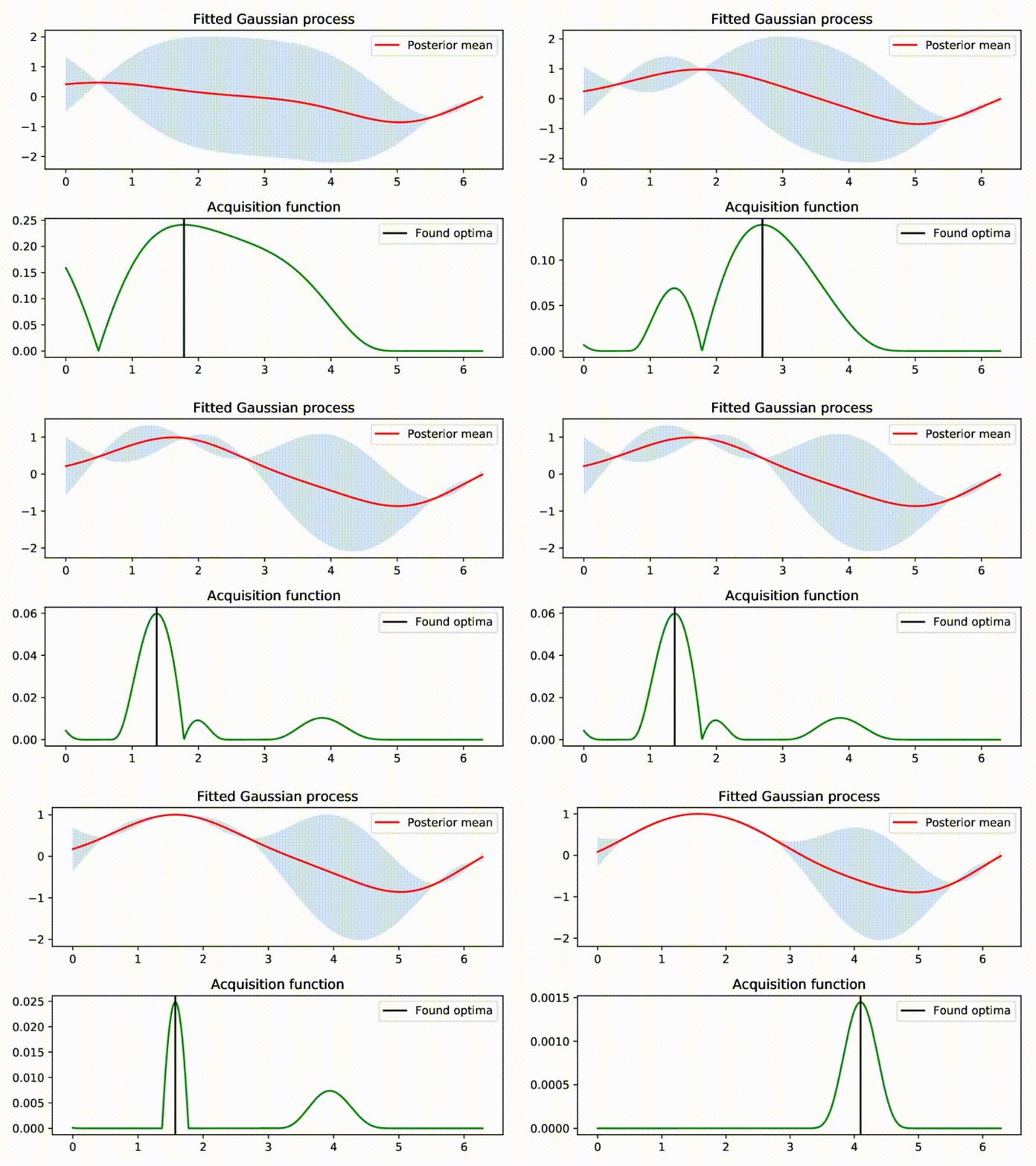 pyGPGO is a simple and modular Python (>3.5) package for bayesian optimization. Bayesian optimization is a framework that can be used in situations where: * Your objective function may not have a closed form. (e.g. the result of a simulation) * No gradient information is available. * Function evaluations may be noisy. * Evaluations are expensive (time/cost-wise) ### Installation Retrieve the latest stable release from pyPI: ```bash pip install pyGPGO ``` Or if you're feeling adventurous, retrieve it from this repo, ```bash pip install git+https://github.com/hawk31/pyGPGO ``` Check our documentation in http://pygpgo.readthedocs.io/. ### Features * Different surrogate models: Gaussian Processes, Student-t Processes, Random Forests, Gradient Boosting Machines. * Type II Maximum-Likelihood of covariance function hyperparameters. * MCMC sampling for full-Bayesian inference of hyperparameters (via `pyMC3`). * Integrated acquisition functions ### A small example! The user only has to define a function to maximize and a dictionary specifying input space. ```python import numpy as np from pyGPGO.covfunc import matern32 from pyGPGO.acquisition import Acquisition from pyGPGO.surrogates.GaussianProcess import GaussianProcess from pyGPGO.GPGO import GPGO def f(x, y): # Franke's function (https://www.mathworks.com/help/curvefit/franke.html) one = 0.75 * np.exp(-(9 * x - 2) ** 2 / 4 - (9 * y - 2) ** 2 / 4) two = 0.75 * np.exp(-(9 * x + 1) ** 2/ 49 - (9 * y + 1) / 10) three = 0.5 * np.exp(-(9 * x - 7) ** 2 / 4 - (9 * y -3) ** 2 / 4) four = 0.25 * np.exp(-(9 * x - 4) ** 2 - (9 * y - 7) ** 2) return one + two + three - four cov = matern32() gp = GaussianProcess(cov) acq = Acquisition(mode='ExpectedImprovement') param = {'x': ('cont', [0, 1]), 'y': ('cont', [0, 1])} np.random.seed(1337) gpgo = GPGO(gp, acq, f, param) gpgo.run(max_iter=10) ``` Check the `tutorials` and `examples` folders for more ideas on how to use the software. ### Citation If you use pyGPGO in academic work please cite: Jiménez, J., & Ginebra, J. (2017). pyGPGO: Bayesian Optimization for Python. The Journal of Open Source Software, 2, 431.
