KO
|
EN
gitlite — search
Search
#python
#java
#python3
#arduino
#golang
#machine-learning
#rust
#html
#flask
#javascript
#seismology
#nodejs
glyphbox
★ 13
Open GitHub ↗
Agent harness for NetHack
Download README (.md)
Explore Similar Repositories
rediff
:
A diff+assertion library for Facet types
mujoco-scene-editor
:
Lightweight, interactive scene editor for MuJoCo 3.x. Create or edit scenes in your browser to place shapes, import meshes, add robots, and edit elements interactively.
AIcode
:
一个嵌入式AICode的skills工程。
E-Learning-
:
No description available.
Vision-Transformer-ViT-for-Image-Classification
:
No description available.
// repository documentation
Was this content helpful?
★ 0
(0 ratings)
Select Rating:
★
★
★
★
★
Submit Feedback
Recent Feedback
×
Download README
Do you want to download the
README.md
file for
glyphbox
?
Download (.md)
# Glyphbox 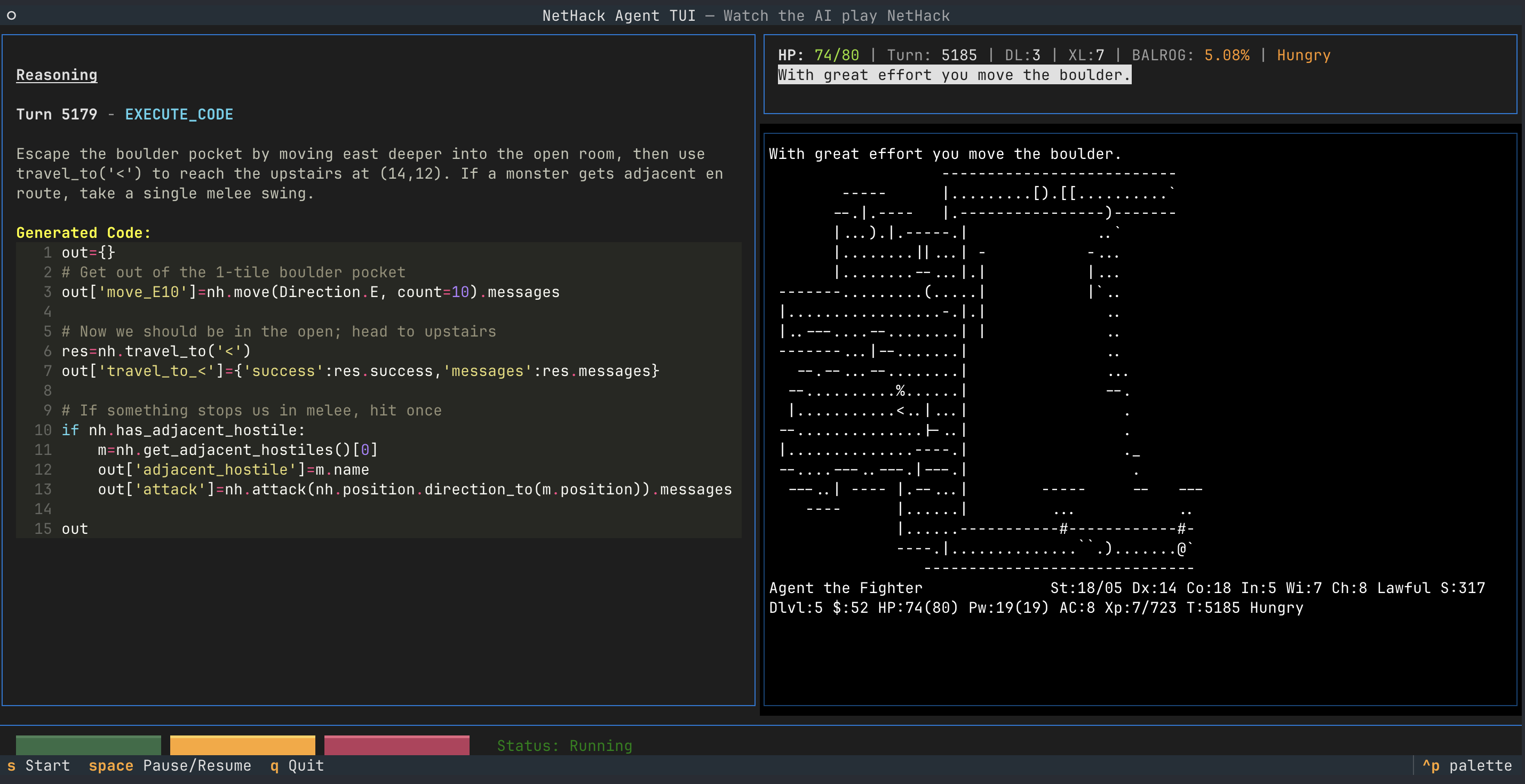 A NetHack harness that exposes a Python sandbox as the primary interface for LLMs to play NetHack. The LLM receives the full game screen each turn and responds with Python code that executes against a high-level game API. ## How It Works ``` LLM receives game screen each turn │ │ responds with Python code via execute_code tool call ▼ Python Sandbox (restricted execution environment) │ │ code calls methods on `nh` (NetHackAPI) ▼ NetHackAPI (high-level game interface) │ │ translates to gymnasium actions ▼ NetHack Learning Environment (NLE) NetHack 3.6.7 simulator ``` Each turn, the LLM sees the full 24x80 ASCII game screen, game messages, and results from its previous actions. It writes Python code that runs in a sandboxed environment with access to `nh` — a NetHackAPI instance that wraps all game interactions into clean method calls. ## Setup ```bash git clone <repo-url> cd glyphbox uv sync ``` Set an API key for your provider: ```bash # OpenRouter (default provider) export OPENROUTER_API_KEY="your-key" ``` Verify the setup: ```bash uv run python -m src.cli verify ``` ## Usage ```bash # Watch the agent play in a TUI uv run python -m src.cli watch # Use a specific model uv run python -m src.cli watch --model anthropic/claude-3-haiku-20240307 # Record the session with asciinema uv run python -m src.cli watch --record # Play back a recording asciinema play data/recordings/run_2026-01-19_19-34-49.cast ``` ### CLI Options | Flag | Description | |---|---| | `--model`, `-m` | Override the LLM model | | `--record`, `-r` | Record session with asciinema (saves to `data/recordings/`) | | `--config`, `-c` | Path to config file (default: `config/default.yaml`) | | `--log-level`, `-l` | `DEBUG`, `INFO`, `WARNING`, `ERROR` | ### TUI Controls | Key | Action | |---|---| | `S` | Start the agent | | `Space` | Pause / Resume | | `Q` | Quit | ## The Sandbox The LLM interacts with NetHack exclusively through an `execute_code` tool call. The submitted Python code runs in a restricted sandbox with these globals available: | Name | Type | Description | |---|---|---| | `nh` | `NetHackAPI` | Game interface — all actions and queries | | `Direction` | `Enum` | `N`, `S`, `E`, `W`, `NE`, `NW`, `SE`, `SW`, `UP`, `DOWN`, `SELF` | | `Position` | `dataclass` | `(x, y)` coordinates with `.distance_to()`, `.direction_to()`, `.adjacent()` | | `PathResult` | `dataclass` | Pathfinding result with `.path` and `.reason` | | `PathStopReason` | `Enum` | Why pathfinding stopped | | `TargetResult` | `dataclass` | Target search result with `.position` and `.success` | | `HungerState` | `Enum` | `SATIATED`, `NOT_HUNGRY`, `HUNGRY`, `WEAK`, `FAINTING`, `FAINTED` | | `random` | module | Python `random` module | Standard builtins (`print`, `len`, `range`, `min`, `max`, `sorted`, `list`, `dict`, etc.) are available. Imports are forbidden — all needed types are pre-loaded. ### Security Code is validated via AST inspection before execution: - **Forbidden imports**: `os`, `sys`, `subprocess`, `socket`, `http`, `pickle`, `threading`, `multiprocessing`, etc. - **Forbidden calls**: `exec`, `eval`, `compile`, `open`, `input`, `__import__` - **Forbidden attributes**: `__class__`, `__bases__`, `__dict__`, `__globals__`, `__code__` - **Timeout**: signal-based `SIGALRM` kills runaway code ### Example Code What the LLM submits each turn: ```python # Check health and eat if hungry if nh.is_hungry: food = nh.get_food() if food: nh.eat(food[0].slot) else: nh.pray() elif nh.has_adjacent_hostile: for monster in nh.get_adjacent_hostiles(): direction = nh.position.direction_to(monster.position) nh.attack(direction) else: nh.autoexplore() ``` ## NetHackAPI Reference All methods are synchronous. Actions consume game turns; queries do not. ### Properties | Property | Type | Description | |---|---|---| | `nh.hp` | `int` | Current hit points | | `nh.max_hp` | `int` | Maximum hit points | | `nh.position` | `Position` | Current `(x, y)` | | `nh.dungeon_level` | `int` | Current depth | | `nh.turn` | `int` | Game turn counter | | `nh.is_hungry` | `bool` | Hunger >= HUNGRY | | `nh.is_weak` | `bool` | Hunger is WEAK or FAINTING | | `nh.has_adjacent_hostile` | `bool` | Hostile monster in adjacent tile | | `nh.turns_since_last_prayer` | `int` | Turns since last prayer | | `nh.role` | `str` | Player class (e.g. `"Valkyrie"`) | | `nh.is_done` | `bool` | Episode has ended | ### State Queries ```python nh.get_stats() # Stats: hp, max_hp, pw, ac, xp_level, gold, hunger, etc. nh.get_position() # Position (x, y) nh.get_screen() # Full 24x80 ASCII screen as string nh.get_screen_lines() # List of 24 screen lines nh.get_local_map(radius=7) # Cropped view centered on player with coordinate guides nh.get_message() # Current top-of-screen message nh.get_messages(n=10) # Last n game messages nh.get_current_level() # DungeonLevel with parsed Tile grid nh.get_tile(pos) # Tile at position nh.get_adjacent_tiles() # Dict mapping "N"/"S"/"E"/etc. to tile descriptions nh.get_visible_monsters() # All visible monsters nh.get_adjacent_hostiles() # Hostile monsters in 8 adjacent tiles nh.get_hostile_monsters() # All non-peaceful monsters nh.get_inventory() # Inventory items (each has .slot, .name, .quantity) nh.get_food() # Food items in inventory nh.get_weapons() # Weapons in inventory nh.get_items_here() # Items on the ground at current position nh.get_items_here_glyphs() # Items at current position (glyph-based, no turn cost) nh.get_items_on_map() # All visible items on map with positions nh.find_stairs() # (stairs_up_pos, stairs_down_pos) nh.find_doors() # List of (Position, is_open) nh.find_altars() # List of altar positions nh.find_nearest_item() # TargetResult with .position and .success ``` ### Actions All actions return `ActionResult` with `.success`, `.messages`, `.turn_elapsed`. **Movement:** ```python nh.move(Direction.E) # Move one tile east nh.move(Direction.N, count=5) # Move up to 5 tiles north (auto-stops at walls/monsters) nh.run(Direction.E) # Run until wall/intersection/monster nh.move_to(Position(42, 12)) # Pathfind and walk to position nh.go_up() # Ascend stairs nh.go_down() # Descend stairs ``` **Combat:** ```python nh.attack(Direction.N) # Melee attack north nh.kick(Direction.S) # Kick south nh.fire(Direction.E) # Fire ranged weapon east nh.throw('a', Direction.W) # Throw inventory item 'a' west ``` **Items:** ```python nh.pickup() # Pick up all items here nh.drop('a') # Drop item by inventory letter nh.eat('a') # Eat from inventory nh.eat() # Eat from ground nh.quaff('a') # Drink potion nh.read('a') # Read scroll/spellbook nh.wield('a') # Wield weapon nh.wear('a') # Wear armor nh.take_off('a') # Remove worn armor nh.zap('a', Direction.N) # Zap wand nh.apply('a') # Use tool/key/horn ``` **Doors and Stairs:** ```python nh.open_door(Direction.E) # Open door east nh.close_door(Direction.W) # Close door west ``` **Special:** ```python nh.pray() # Pray to deity (has cooldown) nh.pay() # Pay shopkeeper nh.engrave("Elbereth") # Write on floor nh.cast_spell('a', Direction.N) # Cast spell nh.look() # Look at current square nh.send_keys("keys") # Raw keystrokes (escape hatch) ``` **Utility:** ```python nh.wait(count=10) # Rest for turns (auto-interrupts on attack) nh.search(count=20) # Search for secrets (auto-interrupts on danger) ``` **Prompt responses** (when the game asks `[ynq]` or `[yn]`): ```python nh.confirm() # Send 'y' nh.deny() # Send 'n' nh.escape() # Send ESC nh.space() # Send space (dismiss --More--) ``` ### Navigation ```python nh.autoexplore(max_steps=500) # Explore automatically # Returns AutoexploreResult with .stop_reason: # "fully_explored", "hostile", "low_hp", "hungry", "blocked" nh.move_to(Position(42, 12)) # Pathfind to specific position # Interrupts on: hunger change, HP < 30% nh.find_unexplored() # Find nearest unexplored tile # Returns TargetResult with .position ``` ### Reminders and Notes ```python nh.add_reminder(turns=50, msg="Check corpse") # One-time alert after N turns nh.add_note(turns=0, msg="Wand has 5 charges") # Persistent note (0 = permanent) nh.remove_note(note_id) # Remove a note nh.get_active_notes() # List (id, message) tuples ``` ## LLM Context Each turn, the agent receives a system prompt (once) and a decision prompt (every turn). **System prompt** contains: - The full NetHackAPI reference documentation - Available tool descriptions - Strategic advice for NetHack play **Decision prompt** contains: ``` === CURRENT GAME VIEW === Your position: (40, 12) {24x80 ASCII game screen} Adjacent tiles: N: wall | S: floor . E: goblin d ... Hostile Monsters: - goblin 'd' [E, adjacent] Inventory: a: long sword (wielded) b: leather armor (worn) c: 3 food rations Items on map: - gold coin at (38, 11) Stairs: - Stairs down (>) at (35, 10) Last Result: game_messages: - You hit the goblin! actions: - attack(E) ok Study the map. What do you observe, and what action will you take? ``` The context is configurable. Sections like inventory, adjacent tiles, items on map, and hostile monsters can each be toggled on or off. Old turns are compressed to save tokens — maps are stripped from history and old tool call arguments are compacted. ## Configuration All settings live in `config/default.yaml`. Every setting can also be overridden via environment variables. ### Agent | Setting | Default | Description | |---|---|---| | `agent.provider` | `"openrouter"` | LLM provider: `"openrouter"` or `"anthropic"` | | `agent.model` | `"openai/gpt-5.2"` | Model identifier (OpenRouter or Anthropic format) | | `agent.base_url` | `"https://openrouter.ai/api/v1"` | API endpoint | | `agent.temperature` | `0.1` | Sampling temperature (0.0 = deterministic, 1.0 = creative) | | `agent.reasoning` | `"high"` | Extended thinking effort: `none`, `minimal`, `low`, `medium`, `high`, `xhigh` | | `agent.max_turns` | `100000` | Maximum turns per episode | | `agent.max_consecutive_errors` | `5` | Errors before auto-quit | | `agent.decision_timeout` | `60.0` | Seconds to wait for LLM response | | `agent.skill_timeout` | `30.0` | Seconds to wait for skill execution | | `agent.hp_flee_threshold` | `0.3` | Flee when HP drops below this fraction | | `agent.skills_enabled` | `false` | Enable `write_skill`/`invoke_skill` tools | | `agent.auto_save_skills` | `true` | Auto-save successful skills | | `agent.log_decisions` | `true` | Log LLM decisions | ### Context Management These settings control what the LLM sees each turn and how much history is retained. | Setting | Default | Description | |---|---|---| | `agent.max_history_turns` | `1000` | How many turns to keep. `0` = unlimited (compress old turns) | | `agent.maps_in_history` | `0` | Recent turns that keep the full map. `0` = only current turn | | `agent.tool_calls_in_history` | `10` | Recent turns that keep full tool call args. Older ones show `[compacted]` | | `agent.show_inventory` | `true` | Include inventory in each turn's context | | `agent.show_adjacent_tiles` | `true` | Show tile descriptions for all 8 directions | | `agent.show_items_on_map` | `true` | List visible items with positions | | `agent.local_map_mode` | `false` | Show cropped local view instead of full map | | `agent.local_map_radius` | `7` | Radius of local view (7 = 15x15 area) | When `local_map_mode` is enabled, the LLM also gets a `view_full_map` tool to request the entire dungeon level when needed. ### Environment | Setting | Default | Description | |---|---|---| | `environment.name` | `"NetHackChallenge-v0"` | NLE environment name | | `environment.max_episode_steps` | `1000000` | NLE step limit per episode | | `environment.render_mode` | `null` | `null`, `"human"`, or `"ansi"` | | `environment.character` | `"random"` | `"random"` or specific like `"val-hum-law-fem"` | ### Skills | Setting | Default | Description | |---|---|---| | `skills.library_path` | `"./skills"` | Directory for saved skills | | `skills.auto_save` | `true` | Auto-save successful skills | | `skills.min_success_rate_to_save` | `0.3` | Minimum success rate to persist a skill | | `skills.max_actions_per_skill` | `500` | Action limit per skill execution | ### Logging | Setting | Default | Description | |---|---|---| | `logging.level` | `"INFO"` | `DEBUG`, `INFO`, `WARNING`, `ERROR`, `CRITICAL` | | `logging.file` | `"./data/agent.log"` | Log file path | | `logging.log_llm` | `true` | Log LLM prompts and responses | | `logging.log_actions` | `true` | Log game actions | ### Environment Variables | Variable | Description | |---|---| | `OPENROUTER_API_KEY` (or `OPENROUTER_KEY`) | API key for OpenRouter | | `ANTHROPIC_API_KEY` | API key for direct Anthropic access | | `NETHACK_AGENT_MODEL` | Override model | | `NETHACK_AGENT_PROVIDER` | Override provider | | `NETHACK_AGENT_BASE_URL` | Override API endpoint | | `NETHACK_AGENT_LOG_LEVEL` | Override log level | ## Project Structure ``` src/ ├── cli.py # Entry point (watch, verify) ├── config.py # Configuration loading ├── agent/ │ ├── agent.py # Main orchestration loop │ ├── llm_client.py # LLM API client (OpenRouter/Anthropic) │ ├── parser.py # LLM response parsing │ └── prompts.py # System and decision prompt templates ├── api/ │ ├── nethack_api.py # High-level game API (the `nh` object) │ ├── environment.py # NLE gymnasium wrapper │ ├── actions.py # Action execution │ ├── queries.py # Map and state queries │ ├── pathfinding.py # A* pathfinding │ ├── models.py # Position, Stats, Monster, Item, Tile, etc. │ ├── glyphs.py # Glyph identification │ └── knowledge.py # Monster/item knowledge base ├── sandbox/ │ ├── manager.py # Sandbox execution engine + API call tracking │ ├── validation.py # AST-based code security validation │ └── exceptions.py # Sandbox error types ├── memory/ │ ├── episode.py # Episode-level memory coordination │ ├── dungeon.py # Dungeon level map tracking │ ├── working.py # Working memory (current session) │ └── manager.py # SQLite persistence ├── skills/ │ ├── executor.py # Skill execution │ ├── library.py # Skill file management │ ├── models.py # Skill data structures │ └── statistics.py # Skill performance tracking ├── scoring/ │ └── progress.py # Game progress scoring └── tui/ ├── app.py # Textual TUI application ├── runner.py # Agent runner for TUI ├── events.py # Event system ├── logging.py # TUI logging └── widgets/ # Stats bar, game screen, decision log, etc. ``` ## Development ```bash # Run tests (unit tests only by default) uv run pytest # Run a specific test file uv run pytest tests/test_nethack_api.py -v # Run integration tests (requires API key) uv run pytest -m integration # Lint uv run ruff check src/ tests/ uv run ruff format src/ tests/ ``` ## Logs and Recordings Logs are written to `data/logs/` with filenames like `run_2026-01-19_19-34-49.log`. They include LLM requests/responses, game state, agent decisions, and API call results. Recordings (when using `--record`) are saved to `data/recordings/` as `.cast` files playable with `asciinema play`. ## License MIT
