KO
|
EN
gitlite — search
Search
#typescript
#ai-agents
#deepseek-harness
#dsh-plugin
#open-source
#ai
#cli
#dsh
#claude-code
#codex
#developer-tools
#react
alloydb
★ 75
Open GitHub ↗
AlloyDB is a distributed SQL database.
Download README (.md)
Explore Similar Repositories
alloydb-go-connector
:
A Go library for connecting securely to your AlloyDB instances
pytest-databases
:
Reusable database fixtures for any and all databases.
Testing_BI_Engine
:
TPC-H_SF10
alloydb-python-connector
:
A Python library for connecting securely to your AlloyDB instances.
alloydb
:
Skills for AlloyDB
// repository documentation
Was this content helpful?
★ 0
(0 ratings)
Select Rating:
★
★
★
★
★
Submit Feedback
Recent Feedback
×
Download README
Do you want to download the
README.md
file for
alloydb
?
Download (.md)
 [](https://travis-ci.org/Dong-Chan/alloydb ) ## What is AlloyDB? AlloyDB is a distributed SQL database. Inspired by the design of Google [F1](http://research.google.com/pubs/pub41344.html), AlloyDB supports the best features of both traditional RDBMS and NoSQL. - __Horizontal scalability__ Grow AlloyDB as your business grows. You can increase the capacity simply by adding more machines. - __Asynchronous schema changes__ Evolve AlloyDB schemas as your requirement evolves. You can add new columns and indices without stopping or affecting the on-going operations. - __Consistent distributed transactions__ Think AlloyDB as a single-machine RDBMS. You can start a transaction that acrosses multiple machines without worrying about consistency. AlloyDB makes your application code simple and robust. - __Compatible with MySQL protocol__ Use AlloyDB as MySQL. You can replace MySQL with AlloyDB to power your application without changing a single line of code in most cases. - __Written in Go__ Enjoy AlloyDB as much as we love Go. We believe Go code is both easy and enjoyable to work with. Go makes us improve AlloyDB fast and makes it easy to dive into the codebase. - __Multiple storage engine support__ Power AlloyDB with your most favorite engines. AlloyDB supports most of the popular storage engines in single-machine mode. You can choose from goleveldb, LevelDB, RocksDB, LMDB, BoltDB and even more to come. ## Status AlloyDB is at its early age and under heavy development, some of the features mentioned above have not been fully implemented. __Please do not use it in production.__ ## Roadmap Read the [Roadmap](./ROADMAP.md). ## Quick start - __Pre-requirement__ ``` go get -d github.com/Dong-Chan/alloydb cd $GOPATH/src/github.com/Dong-Chan/alloydb make ``` - __Run command line interpreter__ Interpreter is an interactive command line AlloyDB client. You can just enter some SQL statements and get the result. ``` make interpreter cd interpreter && ./interpreter ``` Press `Ctrl+C` to quit. - __Run as go library__ See [USAGE.md](./docs/USAGE.md) for detailed instructions to use AlloyDB as library in Go code. - __Run as MySQL protocol server with single-machine KV storage engine__ Comming soon. - __Run as MySQL protocol server with distributed transactional KV storage engine__ Comming soon. ## Architecture 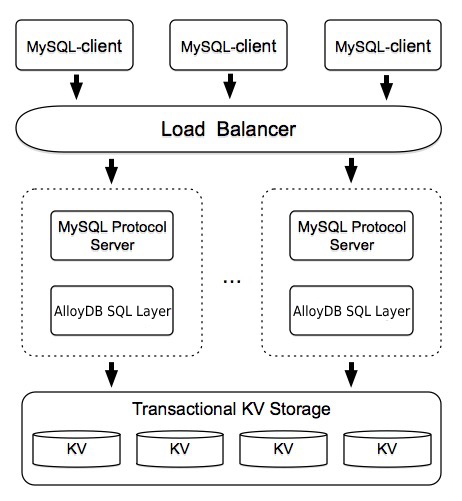 ## Contributing Contributions are welcomed and greatly appreciated. See [CONTRIBUTING.md](./docs/CONTRIBUTING.md) for details on submitting patches and the contribution workflow. ## Follow us Author Email: tomyyear@gmail.com ## License AlloyDB is under the Apache 2.0 license. See the [LICENSE](./LICENSE.md) file for details. ## Acknowledgments - Thanks [cznic](https://github.com/cznic) for providing some great open source tools. - Thanks [GolevelDB](https://github.com/syndtr/goleveldb), [LMDB](https://github.com/LMDB/lmdb), [BoltDB](https://github.com/boltdb/bolt) and [RocksDB](https://github.com/facebook/rocksdb) for their powerful storage engines.
