KO
|
EN
gitlite — search
Search
#javascript
#python
#hacktoberfest
#react
#ai
#typescript
#llm
#go
#golang
#android
#machine-learning
#rust
#deep-learning
#linux
FedNest
★ 15
Open GitHub ↗
Federated Bilevel Optimization
Download README (.md)
Explore Similar Repositories
stm32-crc32-calculator
:
STM32 CRC32 software calculation utility
DistilProtBert
:
DistilProtBert implementation, a distilled version of ProtBert model.
profet
:
No description available.
vmu-tools
:
A set of tools to modify and read VMU files and filetypes
moon-case
:
Simple Whatsapp - MultiAuth
// repository documentation
Was this content helpful?
★ 0
(0 ratings)
Select Rating:
★
★
★
★
★
Submit Feedback
Recent Feedback
×
Download README
Do you want to download the
README.md
file for
FedNest
?
Download (.md)
# FedNest : Federated Bilevel, Minimax, and Compositional Optimization 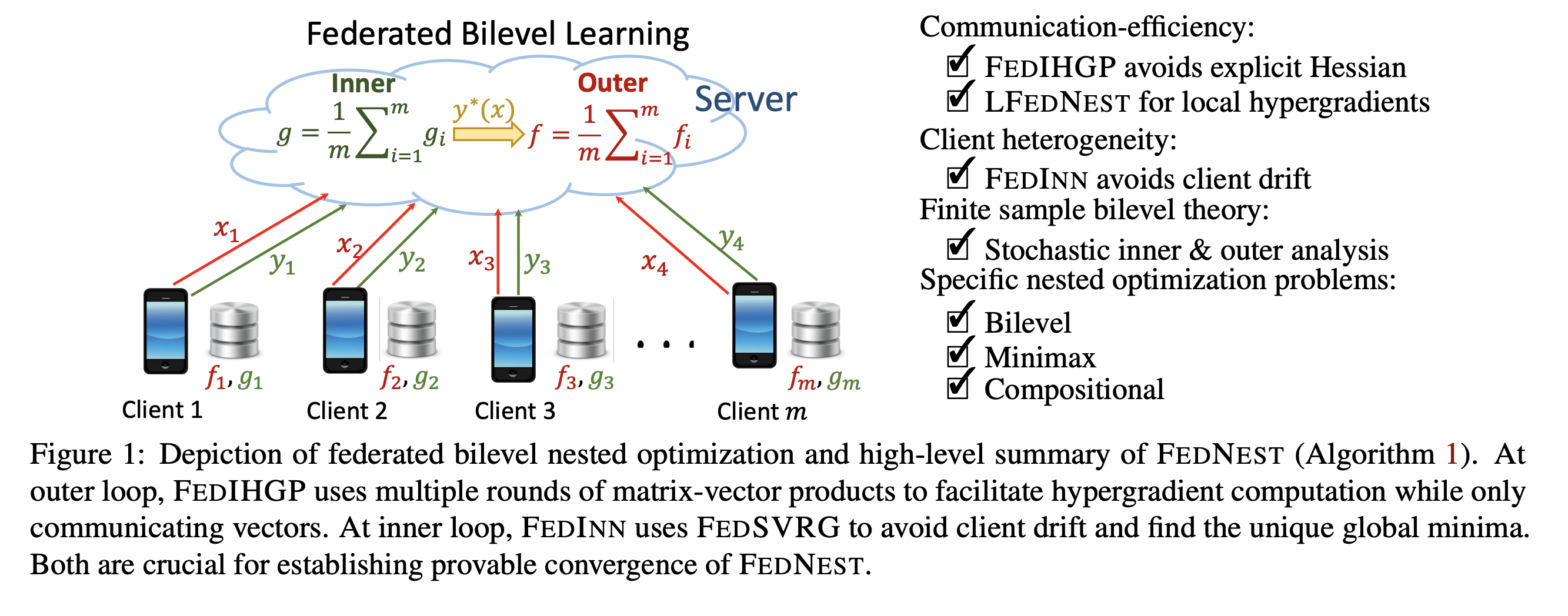 This directory contains source code for evaluating federated bilevel learning with different optimizers on various models and tasks. In federated bilevel learning, we consider the following nested optimization problem as depicted in Figure 1: $$\min_{x \in \mathbb{R}^{d_1}}~f(x)=\frac{1}{m} \sum_{i=1}^{m}~f_{i}(x,y^*(x))$$ $$\text{subj. to } y^*(x)\in \text{arg}min_{y\in \mathbb{R}^{d_2}}\frac{1}{m}\sum_{i=1}^{m} g_i(x,y).$$ The code was originally developed for the paper "FedNest: Federated Bilevel, Minimax, and Compositional Optimization" ([arXiv link](https://arxiv.org/abs/2205.02215)) ([ICML 2022 link](https://icml.cc/Conferences/2022/Schedule?showEvent=17792)). The federated code is adopted from [shaoxiongji's](https://github.com/shaoxiongji/federated-learning) implenmentation under MIT license. The code is organized as follows: - The bilevel implenmentation follows the algorithm of [*Optimizing Millions of Hyperparameters by Implicit Differentiation (Jonathan Lorraine, Paul Vicol, David Duvenaud)*](https://arxiv.org/abs/1911.02590). - The parametric loss tuning experiments on imbalanced dataset follows the loss function design idea of [*AutoBalance: Optimized Loss Functions for Imbalanced Data (Mingchen Li, Xuechen Zhang, Christos Thrampoulidis, Jiasi Chen, Samet Oymak)*](https://openreview.net/pdf?id=ebQXflQre5a), but we only use MNIST in imbalanced loss function design. - The algorithm is also implemented on a (synthetic) federated minimax problem, i.e. the above federated bilevel problem with $g_i(x,y)=-f_i(x,y)$ for all $i \in [m]$, where $$f_i(x,y)=-\frac{1}{2} ||y||^2 -b_i^\top y + y^\top A_i x + \frac{\lambda}{2} ||x||^2.$$ This is a saddle-point formulation of $\min_{x \in \mathbb{R}^{d_1}} \frac{1}{2} ||\frac{1}{m} \sum_{i\in[m]} A_i x - b_i||^2$. Note: The scripts will be slow without the implementation of parallel computing. # Requirements python>=3.6 pytorch>=0.4 # Reproducing Results on FL Benchmark Tasks ## Hyper-Representation Learning 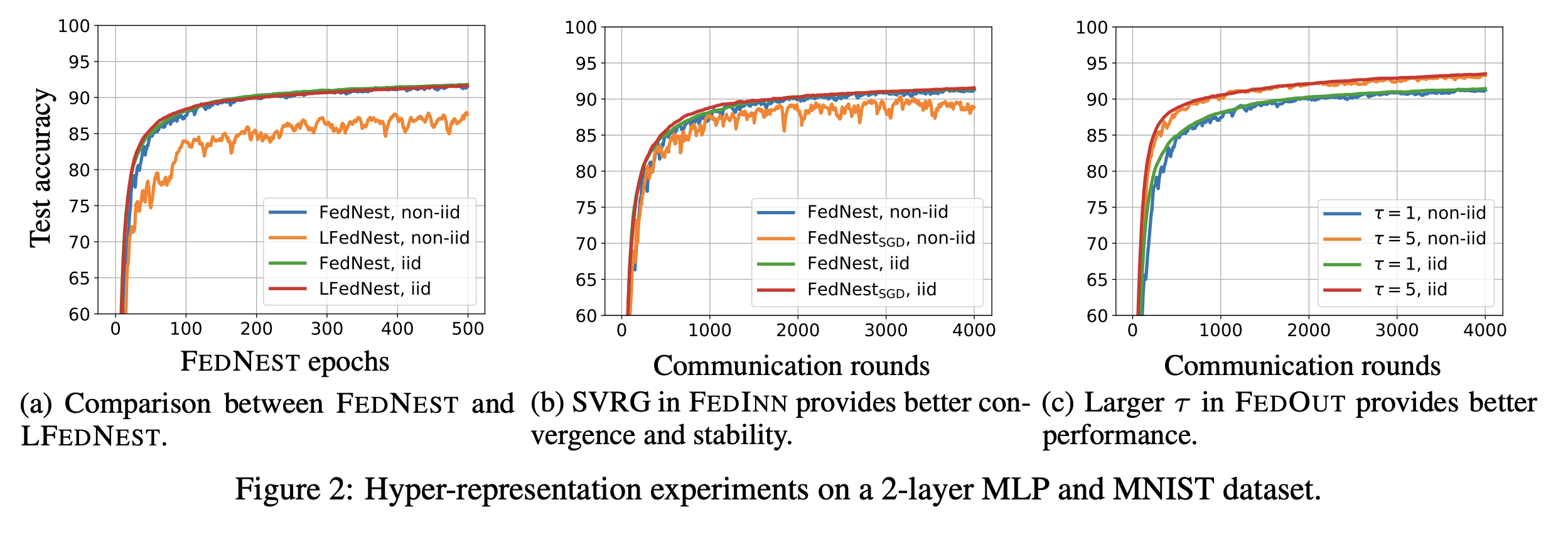 To reproduce the hyper-representation experiments on MNIST dataset, the [**script**](reproduce/fig2.sh) provides the setup. After running this script, use following command to generate the corresponding figure. >python reproduce/fig2.py ## Loss Function Tuning on Imbalanced Dataset 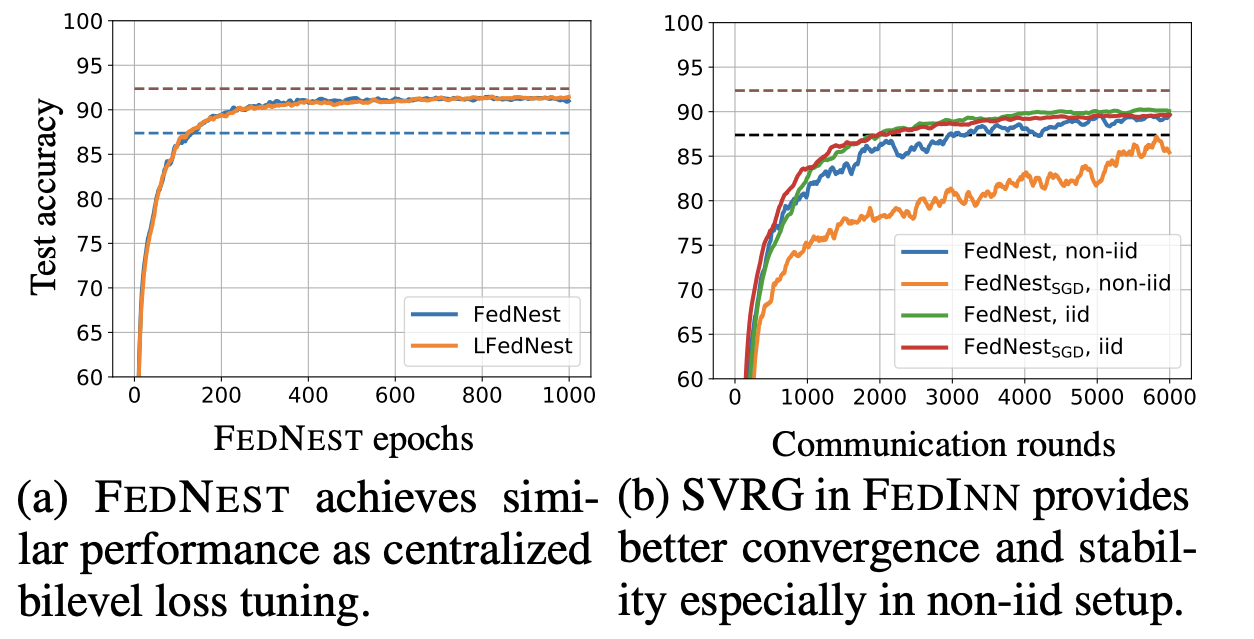 Figure 3: Loss function tuning on a 3-layer MLP and imbalanced MNIST dataset to maximize class-balanced test accuracy. The top dashed line is the accuracy on [*non-federated bilevel optimization*](https://openreview.net/pdf?id=ebQXflQre5a), and the bottom dashed line is the accuracy without tuning the loss function. To reproduce the imbalanced learning experiments on MNIST dataset, the [**script**](reproduce/fig3.sh) provides the setup. After running this script, use following command to generate the corresponding figure. >python reproduce/fig3.py ## Federated Minimax Problem 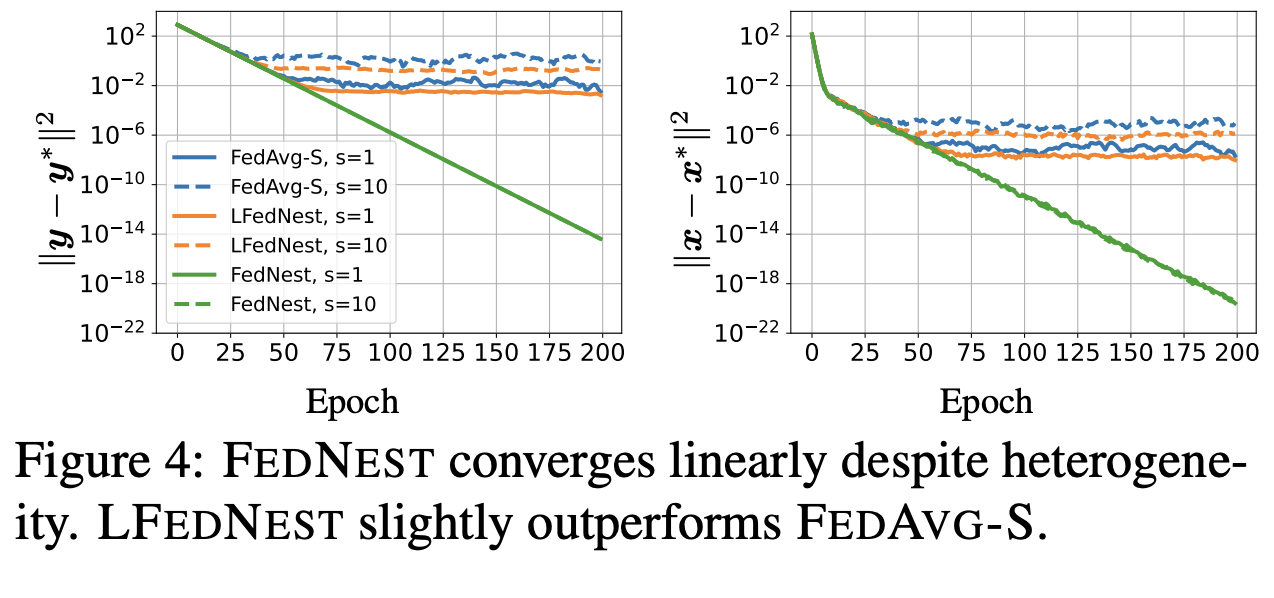 For Figure 4, directly runing the jupyter notebook file [minmax_synthetic.ipynb](minmax_synthetic.ipynb) will generate the result. # Customize Run The hyper-representation experiments are produced by: > python [main_hr.py](main_hr.py) The imbalanced MNIST experiments are produced by: > python [main_imbalance.py](main_imbalance.py) The min-max synthetic experiments are produced in the Jupyter Notebook [minmax_synthetic.ipynb](minmax_synthetic.ipynb) A simple run example is as following > python main_hr.py --iid --epochs 50 --gpu 0 By control the augments, there can be more configuration. In the paper, the authors mainly discuss four varients of FedNest. Here we provide the corresponding parameters to run each of them: 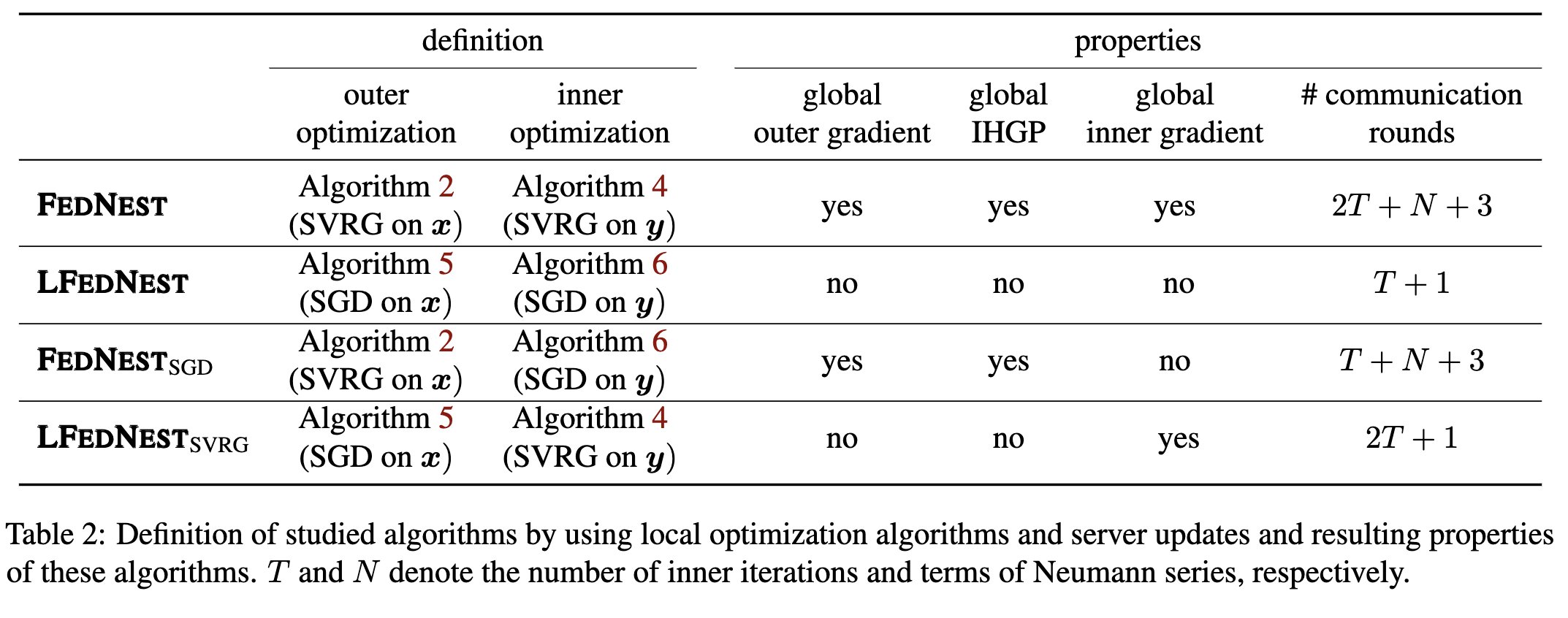 - FedNest > --hvp_method global --optim svrg - LFedNest > --hvp_method seperate --optim sgd - FedNest<sub>SGD</sub> > --hvp_method global --optim sgd - LFedNest<sub>SVRG</sub> > --hvp_method seperate --optim svrg To control the epoch, data distribution (iid or non-iid), inner learning rate, outer learning rate, the arguments are availiable: > --epoch [epoch number] --iid [default is non-iid, with argument iid client data is iid] --hlr [outer learning rate] --lr [inner learning rate] More arguments are avaliable in [options.py](utils/options.py).
