KO
|
EN
gitlite — search
Search
#typescript
#ai-agents
#deepseek-harness
#dsh-plugin
#open-source
#ai
#cli
#dsh
#claude-code
#codex
#developer-tools
#react
lua-star
★ 79
Open GitHub ↗
Easy A* path finding for Lua
Download README (.md)
Explore Similar Repositories
Hands-On-Reactive-Programming-with-Python
:
Hands-On-Reactive-Programming-with-Python, published by Packt
AttributedStringBuilder
:
Easily construct attributed strings in swift
fluent-sqlite-driver
:
Fluent driver for SQLite
eagle
:
Eagle分布式rpc调用,借助Zookeeper实现服务注册和发现,基于AQS实现高性能连接池,支持分布式追踪、监控、过载保护等配置。提供Spring和SpringBoot插件,方便与Spring和SpringBoot集成。
phpadr
:
A PHP based command-line interface tool for working with Architecture Decision Records (ADR)
// repository documentation
Was this content helpful?
★ 0
(0 ratings)
Select Rating:
★
★
★
★
★
Submit Feedback
Recent Feedback
×
Download README
Do you want to download the
README.md
file for
lua-star
?
Download (.md)
# lua-star [](https://www.travis-ci.com/wesleywerner/lua-star) Lua-star is a pure Lua A* path-finding library. 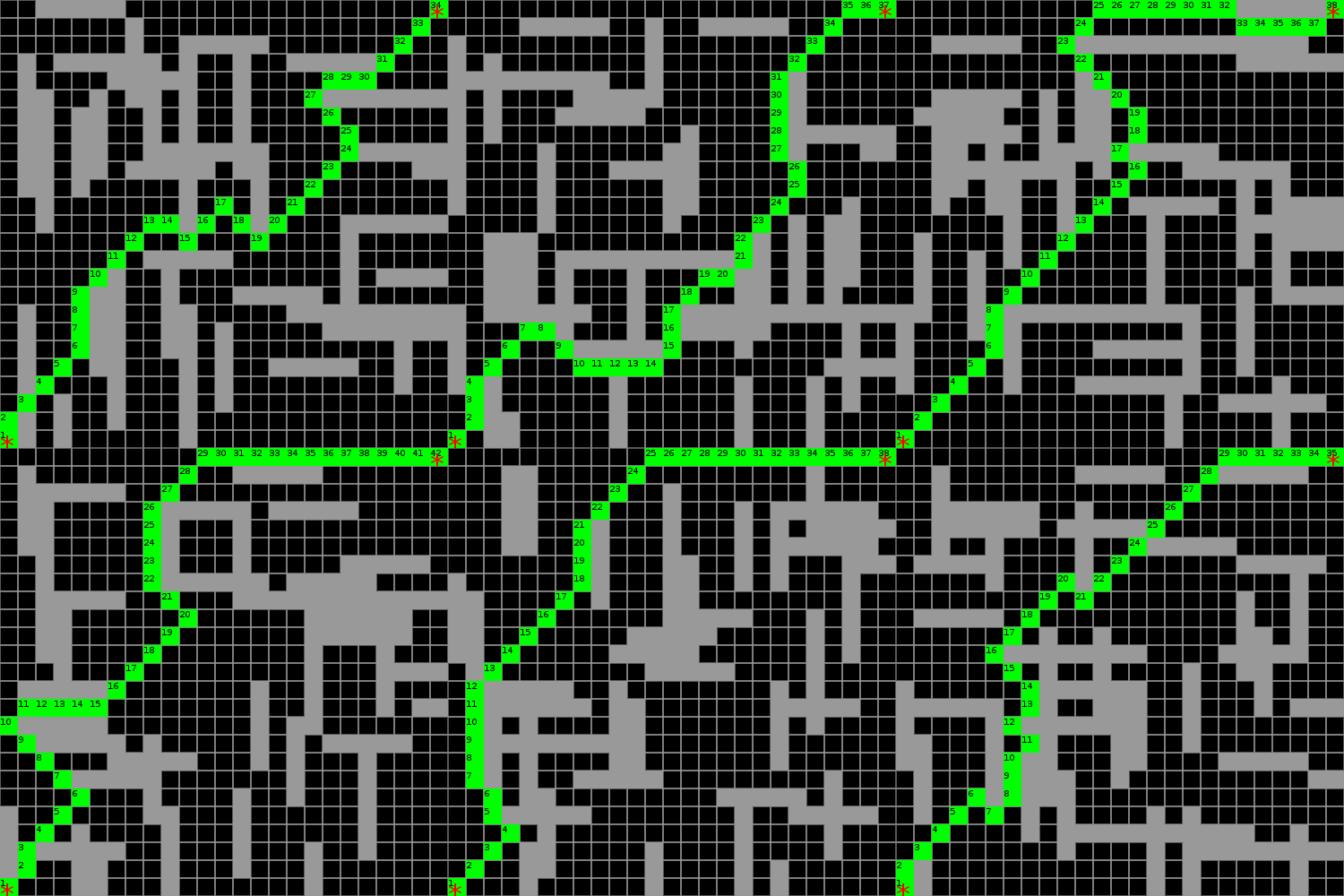 # Quick Start Easy to use, it will make you more attractive and you feel sensual doing so. local luastar = require("lua-star") function positionIsOpenFunc(x, y) -- should return true if the position is open to walk return mymap[x][y] == walkable end local path = luastar:find(width, height, start, goal, positionIsOpenFunc, useCache, excludeDiagonalMoving) `path` will be false if no path was found, otherwise it contains a list of points that travel from `start` to `goal`: if path then for _, p in ipairs(path) do print(p.x, p.y) end end Lua star does not care how your map data is arranged, it simply asks you if the map position at `x,y` is walkable via a callback. `width` and `height` is your map size. `start` and `goal` are tables with at least the `x` and `y` keys. local start = { x = 1, y = 10 } local goal = { x = 10, y = 1 } `positionIsOpenFunc(x, y)` is a function that should return true if the position is open to walk. `useCache` is optional and defaults to `false` when not given. If you have a map that does not change, caching can give a speed boost. If at any time you need to clear all cached paths: luastar:clearCached() `excludeDiagonalMoving` also optional value defaults to `false`. If you want to exclude the possibility of moving diagonally set the value `true`. i.e, by default, diagonal movement is **enabled** # Requirements * [Lua 5.x](http://www.lua.org/) For running unit tests: * [Lua Rocks](https://luarocks.org/) * busted These commands are for apt-based systems, please adapt to them as needed. sudo apt-get install luarocks sudo luarocks install busted Unit testing is done with busted, the `.busted` config already defines everything, so simply run: busted # Performance There is a performance measurement tool in `tests/performance.lua`, it calculates the average time to find a path on a large, random map. # copy the lib to tests $ cp ../src/lua-star.lua . # measure performance $ lua performance.lua Running with seed 1540584306 Building a map of 3000x3000... Precalculating 6000 random start/goal positions... Finding 1000 paths... Done in 16.37 seconds. That is 0.0164 seconds, or 16 milliseconds, per path. The map has 9.0 million locations, with about 65% open space. # Example There is an [interactive example](example/main.lua) that can be run with [Love](https://love2d.org). # License See the file [LICENSE](LICENSE)
