KO
|
EN
gitlite — search
Search
#typescript
#ai-agents
#ai
#dsh-plugin
#deepseek-harness
#open-source
#cli
#claude-code
#codex
#developer-tools
#react
#windows
epsagon-go
★ 28
Open GitHub ↗
Automated tracing library for Go 1.x ⚡️
Download README (.md)
Explore Similar Repositories
serverless-golang-template
:
Multi-function Serverless Framework template for Golang (AWS Lambda).
vesper
:
🛵 Golang Middleware for AWS Lambda
lambdamux
:
Golang HTTP router for AWS lambda
ginger
:
Serverless framework for Go runtime.
aws-sdk-go-bindings
:
Helper package to easily access some aws-sdk-go's methods (SNS, SQS, DynamoDB, Rekognition, S3) & aws-lambda-go utilities.
// repository documentation
Was this content helpful?
★ 0
(0 ratings)
Select Rating:
★
★
★
★
★
Submit Feedback
Recent Feedback
×
Download README
Do you want to download the
README.md
file for
epsagon-go
?
Download (.md)
<p align="center"> <a href="https://epsagon.com" target="_blank" align="center"> <img src="https://cdn2.hubspot.net/hubfs/4636301/Positive%20RGB_Logo%20Horizontal%20-01.svg" width="300"> </a> <br /> </p> [](https://travis-ci.com/epsagon/epsagon-go) [](https://godoc.org/github.com/epsagon/epsagon-go) # Epsagon Tracing for Go 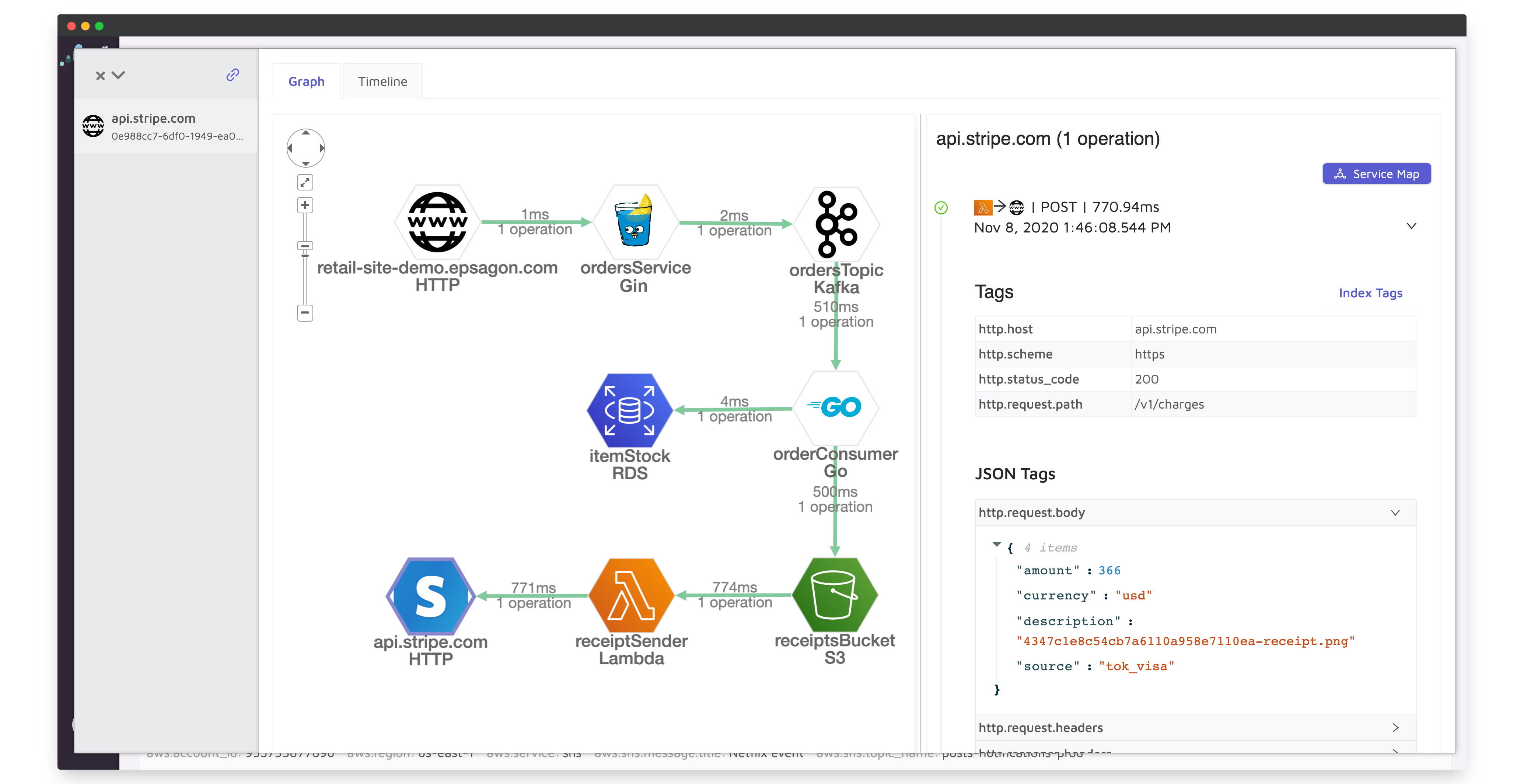 This package provides tracing to Go applications for the collection of distributed tracing and performance metrics in [Epsagon](https://app.epsagon.com/?utm_source=github). ## Contents - [Installation](#installation) - [Usage](#usage) - [Tagging Traces](#tagging-traces) - [Custom Errors](#custom-errors) - [Ignored Keys](#ignored-keys) - [Frameworks](#frameworks) - [Integrations](#integrations) - [Configuration](#configuration) - [Getting Help](#getting-help) - [Opening Issues](#opening-issues) - [License](#license) ## Installation To install Epsagon, simply run: ```sh go get github.com/epsagon/epsagon-go ``` Or using `dep`: ```sh dep ensure -add github.com/epsagon/epsagon-go ``` ## Usage ### Tagging Traces You can add custom tags to your traces, for easier filtering and aggregations. Add the following call inside your code: ```go epsagon.Label("key", "value") epsagon.Label("user_id", user_id) ``` You can also use it to ship custom metrics: ```go epsagon.Label("key", "metric") epsagon.Label("items_in_cart", items_in_cart) ``` Valid types are `string`, `bool`, `int` and `float`. Custom labels are not trimmed with the trace events in case the trace is too big ### Custom Errors You can set a trace as an error (although handled correctly) to get an alert or just follow it on the dashboard. Add the following call inside your code: ```go epsagon.TypeError("My custom error", "Custom Error Type") # Or manually add an error epsagon.TypeError(errors.New("My custom error"), "Custom Error Type") ``` You can also set a tracer as an error with a default error type: ```go epsagon.Error("My custom error") # Or manually add an error epsagon.Error(errors.New("My custom error")) ``` Valid types are `string` and `error`. ### Ignored Keys You can set keys that will be masked in the sent trace from the events metadata to hide selected information: ```go config.IgnoredKeys = []string{"password"} client := http.Client{Transport: epsagonhttp.NewTracingTransport(ctx)} // This password will be masked in the sent trace: decodedJSON, err := json.Marshal(map[string]string{"password": "abcde", "animal": "lion"}) resp, err := client.Post("http://example.com/upload", "application/json", bytes.NewReader(decodedJSON)) ``` ## Frameworks The following frameworks are supported by Epsagon: |Framework |Supported Version | |----------------------------------------|---------------------------| |[AWS Lambda](#aws-lambda) |All | |[Generic Function](#generic) |All | |[HTTP](#http) |All | |[Gin](#gin) |All | |[Fiber](#fiber) | >= 2.11.0 | |[go-redis](#go-redis) | >= 8.0.0 | |[mongo](#mongo) |>=1.0 | ### AWS Lambda Tracing Lambda functions can be done in the following method: ```go package main import ( "github.com/aws/aws-lambda-go/events" "github.com/aws/aws-lambda-go/lambda" "github.com/epsagon/epsagon-go/epsagon" "log" ) func myHandler(request events.APIGatewayProxyRequest) (events.APIGatewayProxyResponse, error) { log.Println("In myHandler, received body: ", request.Body) return events.APIGatewayProxyResponse{Body: request.Body, StatusCode: 200}, nil } func main() { log.Println("enter main") lambda.Start(epsagon.WrapLambdaHandler( epsagon.NewTracerConfig("app-name-stage","epsagon-token"), myHandler)) } ``` ### Generic You can instrument a single function, this function can use go routines inside and their operations will still be traced. ```go func doTask(a int, b string) (int, error) { log.Printf("inside doTask: b = %s", b) return a + 1, fmt.Errorf("boom") } func main() { // With Epsagon instrumentation config := epsagon.NewTracerConfig("generic-go-wrapper", "") config.Debug = true response := epsagon .GoWrapper(config, doTask)(5, "hello") res2 := response[0].Int() errInterface := response[1].Interface() } ``` Optionally, you can pass a custom name for your wrapped function. In the epsagon dashboard, your wrapped function will be displayed with your configured name in all the relevant screens: traces search, service map and more. ``` response := epsagon.GoWrapper(config, doTask, "<MyInstrumentedFuncName>")(5, "hello") ``` ### Concurrent Generic In order to support more than one function being traced in the same environment (using different goroutines), use this wrapper as shown in the example below. The wrapped function has to receive a context as its first parameter, and pass it to the relevant wrapped operations. ```go func doTask(ctx context.Context, a int, b string, wg *sync.WaitGroup) (int, error) { defer wg.Done() log.Printf("inside doTask: b = %s", b) client := epsagonhttp.Wrap(http.Client{}, ctx) client.Get("https://epsagon.com/") return a + 1, fmt.Errorf("boom") } func main() { config := epsagon.NewTracerConfig("generic-go-wrapper", "") config.Debug = true var wg sync.WaitGroup for i := 0; i < 5; i++ { go epsagon.ConcurrentGoWrapper(config, doTask)(i, "hello", &wg) } wg.Wait() time.Sleep(2 * time.Second) } ``` Optionally, you can pass a custom name for your wrapped function. In the epsagon dashboard, your wrapped function will be displayed with your configured name in all the relevant screens: traces search, service map and more. ``` go epsagon.ConcurrentGoWrapper(config, doTask, "<MyInstrumentedFuncName>")(i, "hello", &wg) ``` ### http Wrapping http handlers with Epsagon: ```go import ( "github.com/epsagon/epsagon-go/epsagon" epsagonhttp "github.com/epsagon/epsagon-go/wrappers/net/http" ) func main() { mux := http.NewServeMux() mux.HandleFunc("/ping", epsagonhttp.WrapHandleFunc( epsagon.NewTracerConfig("test-http-mux", ""), func(rw http.ResponseWriter, req *http.Request) { epsagon.Error("Ping Endpoint Called", req.Context()) rw.Write([]byte("Pong.\n")) }), "my-handler-name", ) http.ListenAndServe(":8080", mux) } ``` The third and fourth arguments to `epsagonhttp.WrapHandleFunc` are optional and set the resource name and the hostname. If the resource name is not set then the wrapped funcdtion name is used and the hostname is taken from the request URL if omitted. ```go mux.HandleFunc("/ping", epsagonhttp.WrapHandleFunc( epsagon.NewTracerConfig("test-http-mux", ""), func(rw http.ResponseWriter, req *http.Request) { epsagon.Error("Ping Endpoint Called", req.Context()) rw.Write([]byte("Pong.\n")) }), "my-handler-name", "test.hostname.com", ) ``` To wrap nested libraries you can get the epsagon context from the request context: ```go client := http.Client{ Transport: epsagonhttp.NewTracingTransport(req.Context())} resp, err := client.Get("http://example.com") ``` ### gin You can easily instrument gin applications with Epsagon: ```go import ( "github.com/epsagon/epsagon-go/epsagon" epsagongin "github.com/epsagon/epsagon-go/wrappers/gin" "github.com/gin-gonic/gin" ) func main() { r := epsagongin.GinRouterWrapper{ IRouter: gin.Default(), Hostname: "my_site", Config: epsagon.NewTracerConfig( "test-gin-application", "", ), } r.GET("/ping", func(c *gin.Context) { c.JSON(200, gin.H{ "message": "pong", }) }) r.IRouter.(*gin.Engine).Run() ``` If you want to instument other integrated libraries inside the gin handler you can get the Epsagon context from the gin.Context to do that: ```go client := http.Client{ Transport: epsagonhttp.NewTracingTransport(epsagongin.EpsagonContext(c))} resp, err := client.Get("http://example.com") ``` ### fiber You can easily instrument fiber applications with Epsagon middleware: ```go import ( "github.com/epsagon/epsagon-go/epsagon" epsagonfiber "github.com/epsagon/epsagon-go/wrappers/fiber" "github.com/gofiber/fiber/v2" ) func main() { config := epsagon.NewTracerConfig( "fiber-example", "", ) config.MetadataOnly = false app := fiber.New() // Match all routes epsagonMiddleware := &epsagonfiber.FiberEpsagonMiddleware{ Config: config, } app.Use(epsagonMiddleware.HandlerFunc()) app.Post("/", func(c *fiber.Ctx) error { return c.SendString("Hello, World 👋!") }) app.Listen("0.0.0.0:3000") } app.Post("/", func(c *fiber.Ctx) error { return c.SendString("Hello, World 👋!") }) ``` If you want to instument other integrated libraries inside the fiber handler you can get the Epsagon context from the fiber.Ctx UserContext function to do that: ```go client := http.Client{ Transport: epsagonhttp.NewTracingTransport(c.UserContext() )} resp, err := client.Get("http://example.com") ``` ### go-redis The go-redis instrumentation supports both single and pipeline operations ([full example](https://github.com/epsagon/epsagon-go/tree/master/example)): ```go func main() { config := epsagon.NewTracerConfig("redis-wrapper-test", "") config.MetadataOnly = false mux := http.NewServeMux() mux.HandleFunc("/ping", epsagonhttp.WrapHandleFunc( config, func(w http.ResponseWriter, req *http.Request) { // initialize the redis client as usual // make sure to pass in the epsagon tracer context rdb := epsagonredis.NewClient(&redis.Options{ Addr: "localhost:6379", Password: "", DB: 0, }, req.Context()) value, _ := rdb.Get(context.Background(), "somekey").Result() io.WriteString(w, value) }), ) http.ListenAndServe(":8080", mux) } ``` ### mongo Trace through all Mongo collection operations by wrapping the Collection: ```go package main import ( "context" "github.com/epsagon/epsagon-go/epsagon" epsagonmongo "github.com/epsagon/epsagon-go/wrappers/mongo" "time" ) func main() { ctx, cancel := context.WithTimeout(context.Background(), 30*time.Second) defer cancel() client, err := mongo.Connect( ctx, options.Client().ApplyURI("mongodb://..."), ) defer func() { if err = client.Disconnect(ctx); err != nil { panic(err) } }() db := client.Database("DB") coll := epsagonmongo.WrapMongoCollection( db.Collection("COLL"), ) } ``` ## Integrations Epsagon provides out-of-the-box instrumentation (tracing) for many popular frameworks and libraries. |Library |Supported Version | |---------------------|---------------------------| |[net/http](#net/http)|Fully supported | |aws-sdk-go |`>=1.10.0` | |aws-sdk-go-v2 |`>=0.23.0` | ### net/http Any http request can be traced using a custom RoundTripper implementation and using that in an http.Client: ```go import ( "github.com/epsagon/epsagon-go/wrappers/net/http" ... client := http.Client{Transport: epsagonhttp.NewTracingTransport()} resp, err := client.Get(anyurl) ``` If you are already using a custom RoundTripper implementation, such as for AWS V4 request signing, you can wrap it: ```go import ( "github.com/epsagon/epsagon-go/wrappers/net/http" ... rt := &custom.Roundtripper{} client := http.Client{Transport: epsagonhttp.NewWrappedTracingTransport(rt)} resp, err := client.Get(anyurl) ``` The wrapped http.Client functionality exists for backwards compatibility: ```go import ( "github.com/epsagon/epsagon-go/wrappers/net/http" ... client := epsagonhttp.Wrap(http.Client{}) resp, err := client.Get(anyurl) ``` If you want to disable data collection only for the calls made by this client set `client.MetadataOnly = true` ### aws-sdk-go Wrapping of aws-sdk-go is done through the Session object that has to be created to communicate with AWS: ```go import ( ... "github.com/epsagon/epsagon-go/wrappers/aws/aws-sdk-go/aws" ) ... sess := epsagonawswrapper.WrapSession(session.Must(session.NewSession())) svcSQS := sqs.New(sess) ``` ### aws-sdk-go-v2 Wrapping of aws-sdk-go-v2 is done through the service object: ```go import ( ... "github.com/aws/aws-sdk-go-v2/service/dynamodb" "github.com/epsagon/epsagon-go/epsagon" ) svc := epsagon.WrapAwsV2Service(dynamodb.New(cfg)).(*dynamodb.Client) ... ``` ## Configuration Advanced options can be configured as a parameter to the `Config` struct to the `WrapLambdaHandler` or as environment variables. |Parameter |Environment Variable |Type |Default |Description | |----------------------|------------------------------------|-------|-------------|-----------------------------------------------------------------------------------| |Token |EPSAGON_TOKEN |String |- |Epsagon account token | |ApplicationName |- |String |- |Application name that will be set for traces | |MetadataOnly |EPSAGON_METADATA |Boolean|`true` |Whether to send only the metadata (`True`) or also the payloads (`False`) | |CollectorURL |EPSAGON_COLLECTOR_URL |String |- |The address of the trace collector to send trace to | |Debug |EPSAGON_DEBUG |Boolean|`False` |Enable debug prints for troubleshooting | |SendTimeout |EPSAGON_SEND_TIMEOUT_SEC |String |`1s` |The timeout duration to send the traces to the trace collector | |MaxTraceSize |EPSAGON_MAX_TRACE_SIZE |Integer|`1287936` |The max allowed trace size (in bytes). Defaults to 64KB, max allowed size - 512KB | |_ |EPSAGON_LAMBDA_TIMEOUT_THRESHOLD_MS |Integer|`200` |The threshold in milliseconds to send the trace before a Lambda timeout occurs | ## Getting Help If you have any issue around using the library or the product, please don't hesitate to: * Use the [documentation](https://docs.epsagon.com). * Use the help widget inside the product. * Open an issue in GitHub. ## Opening Issues If you encounter a bug with the Epsagon library for Go, we want to hear about it. When opening a new issue, please provide as much information about the environment: * Library version, Go runtime version, dependencies, etc. * Snippet of the usage. * A reproducible example can really help. The GitHub issues are intended for bug reports and feature requests. For help and questions about Epsagon, use the help widget inside the product. ## License Provided under the MIT license. See LICENSE for details. Copyright 2020, Epsagon
