KO
|
EN
gitlite — search
Search
#typescript
#ai-agents
#ai
#dsh-plugin
#deepseek-harness
#open-source
#cli
#claude-code
#codex
#developer-tools
#react
#windows
e3nn_Unet
★ 36
Open GitHub ↗
No description available.
Download README (.md)
Explore Similar Repositories
batmobile
:
High-performance CUDA kernels for equivariant graph neural networks (MACE, NequIP, Allegro). 10-20x faster than e3nn.
DeNS
:
[TMLR 2024 J2C Certification] Generalizing Denoising to Non-Equilibrium Structures Improves Equivariant Force Fields
e3nn.c
:
Pure C implementation of e3nn
tensor-spherical-harmonics
:
Fully-Differentiable Tensor Spherical Harmonics in JAX
e3tools
:
Building Blocks for Equivariant Neural Networks in e3nn and PyTorch 2.0
// repository documentation
Was this content helpful?
★ 0
(0 ratings)
Select Rating:
★
★
★
★
★
Submit Feedback
Recent Feedback
×
Download README
Do you want to download the
README.md
file for
e3nn_Unet
?
Download (.md)
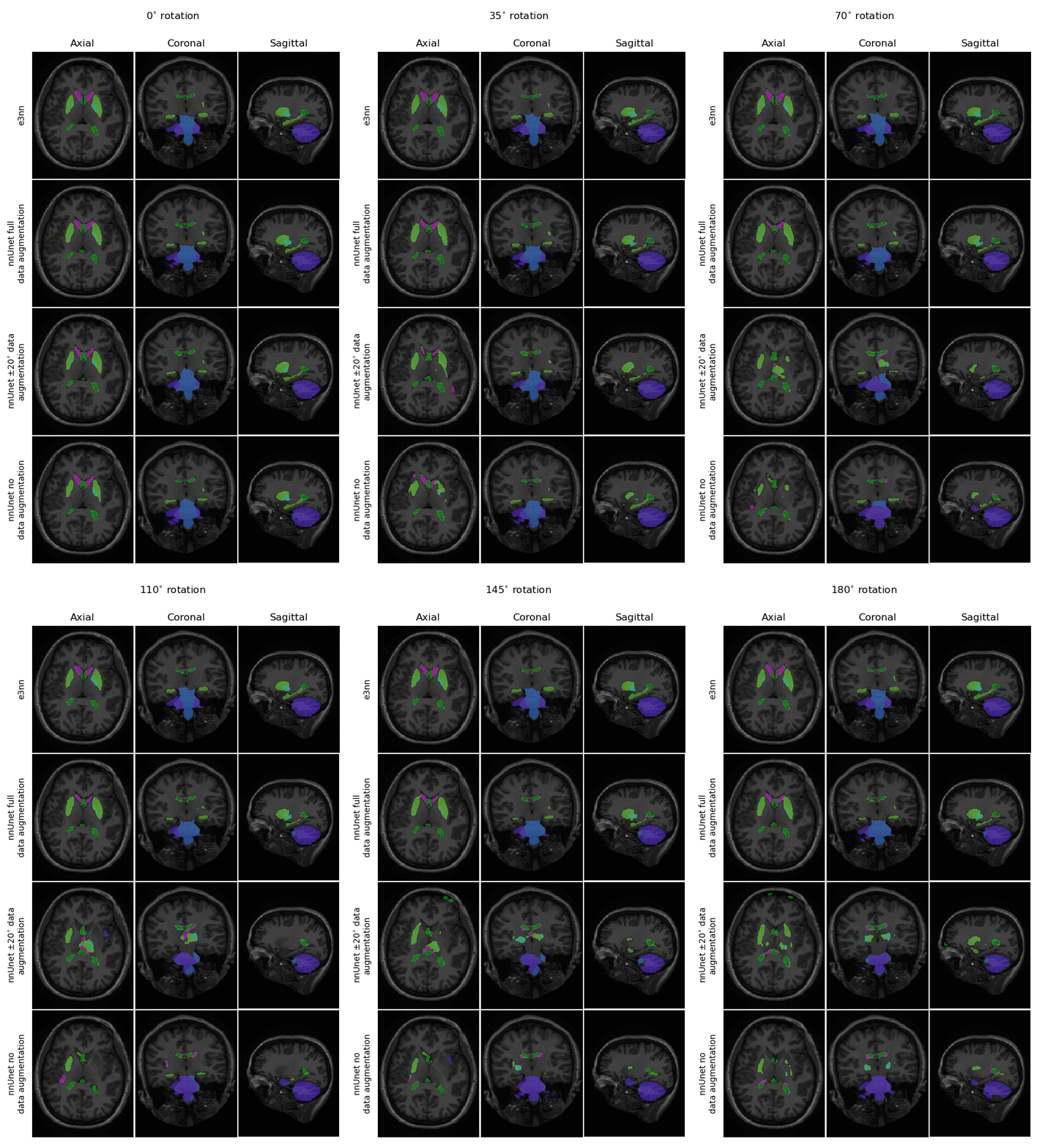
# About e3nn_Unet Segmentation networks based on e3nn O3 and SO3 equivariant convolutions. The networks allow for scalar, vector or tensor inputs, user-defined number and type of downsampling operations, type of equivariance, and number of hidden irreps. ## Installation ```bash git clone https://github.com/SCAN-NRAD/e3nn_Unet.git cd e3nn_Unet pip install -e . ``` ## Sample UNet The following commands create a U-net for a segmentation task with two input scalar channels, 2 downsampling steps, and SO3 equivariance and which outputs 5 scalar classes. In this example the kernel diameter is set to five units and the voxel dimensions are 1x1x1 units. ```bash from e3nn_Unet.network.equivariant_unet_physical_units import UNet net = UNet('2x0e','5x0e',5,5,(1,1,1),n_downsample=2,equivariance='SO3') ``` ## Segmentation of brain structures The following animation shows the segmentation of seven brain structures from the Mindboggle 101 dataset. Each row contains three views of a single segmentation. Each model segmented the same case rotated by angles from O to 180 degrees. The equivariant model (e3nn) is stable as the rotation angle changes. The non-equivariant model with full rotation data augmentation is also exhibits a stable segmentation but exhibits problems with the hippocampus and brain stem. Finally the two bottom rows show unstable segmentations for both a non-equivariant model trained with moderate rotational equivariance and a model trained with no rotational equivariance.