KO
|
EN
gitlite — search
Search
#claude-code
#ai
#python
#claude
#codex
#ai-agents
#llm
#automation
#developer-tools
#mcp
#typescript
#open-source
flask-openapi
★ 268
Open GitHub ↗
A simple API framework based on Flask.
Download README (.md)
Explore Similar Repositories
Identity.Dapper
:
Identity package that uses Dapper instead EntityFramework for use with .NET Core
grpc-web-demo
:
Dockerized Go microservices and their envoy proxies for a flow which showcases gRPC for Web Clients. Check the medium story!!!
Breast-cancer-risk-prediction
:
Classification of Breast Cancer diagnosis Using Support Vector Machines
jezail
:
Android pentesting toolkit with REST API, web terminal, screen mirroring, Frida, and full device control from your rooted device
bvh
:
A fast BVH using SAH in rust
// repository documentation
Was this content helpful?
★ 0
(0 ratings)
Select Rating:
★
★
★
★
★
Submit Feedback
Recent Feedback
×
Download README
Do you want to download the
README.md
file for
flask-openapi
?
Download (.md)
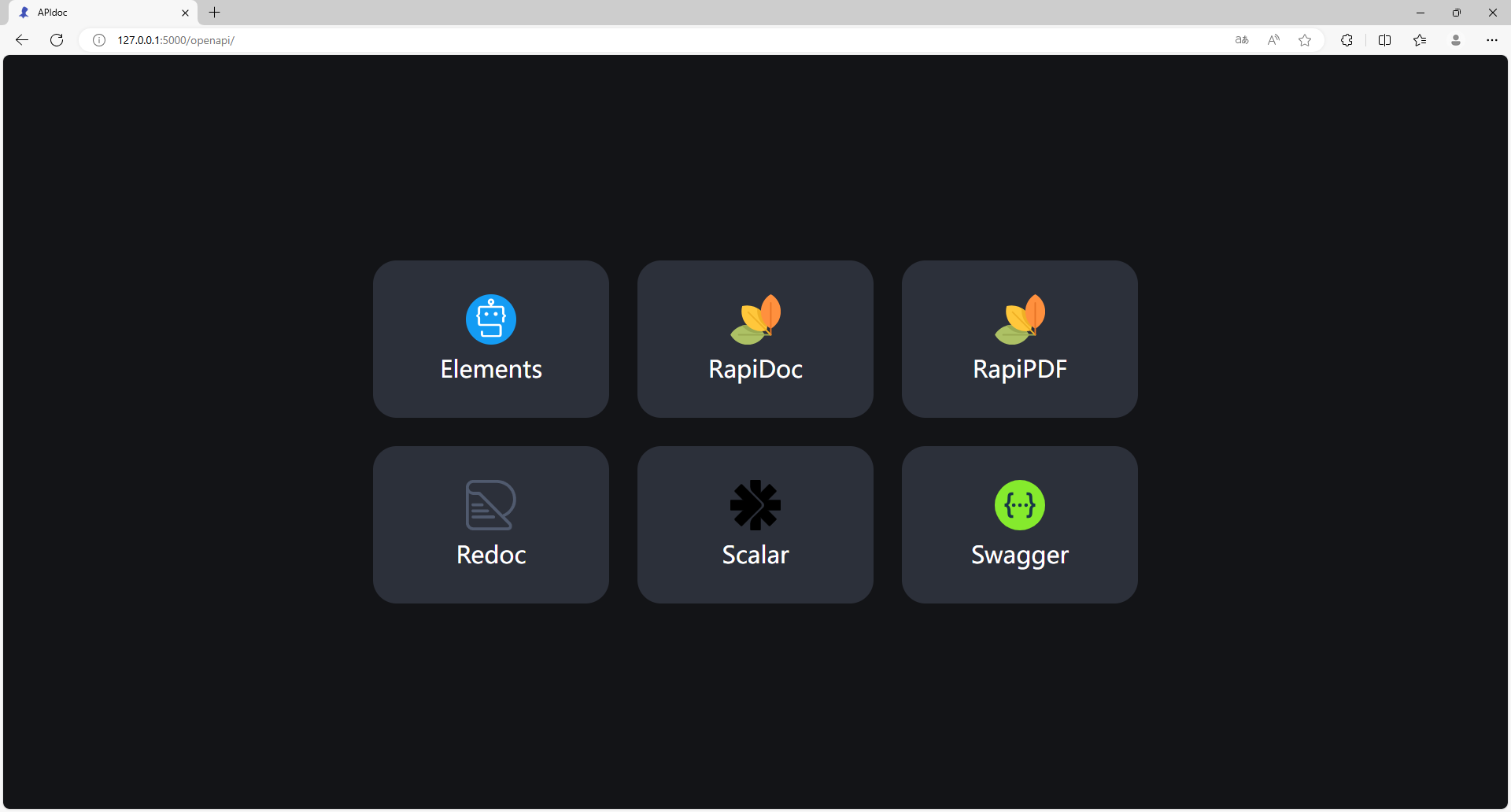
<div align="center"> <a href="https://luolingchun.github.io/flask-openapi/" target="_blank"> <img class="off-glb" src="https://raw.githubusercontent.com/luolingchun/flask-openapi/main/docs/images/logo-text.svg" width="60%" height="auto" alt="logo"> </a> </div> <p align="center"> <em>A simple API framework based on Flask.</em> </p> <p align="center"> <a href="https://github.com/luolingchun/flask-openapi/actions/workflows/tests.yml" target="_blank"> <img class="off-glb" src="https://img.shields.io/github/actions/workflow/status/luolingchun/flask-openapi/tests.yml?branch=master" alt="test"> </a> <a href="https://pypi.org/project/flask-openapi/" target="_blank"> <img class="off-glb" src="https://img.shields.io/pypi/v/flask-openapi" alt="pypi"> </a> <a href="https://pypistats.org/packages/flask-openapi" target="_blank"> <img class="off-glb" src="https://img.shields.io/pypi/dm/flask-openapi" alt="pypistats"> </a> <a href="https://pypi.org/project/flask-openapi/" target="_blank"> <img class="off-glb" src="https://img.shields.io/pypi/pyversions/flask-openapi" alt="pypi versions"> </a> </p> **Flask OpenAPI** is a simple web API framework based on **Flask**. It uses **Pydantic** to verify data and automatic generation of interaction documentation. The key features are: - **Easy to code:** Easy to use and easy to learn - **Standard document specification:** Based on [OpenAPI Specification](https://spec.openapis.org/oas/v3.1.0) - **Interactive OpenAPI documentation:** [Swagger](https://github.com/swagger-api/swagger-ui), [Redoc](https://github.com/Redocly/redoc), [RapiDoc](https://github.com/rapi-doc/RapiDoc), [RapiPdf](https://mrin9.github.io/RapiPdf/), [Scalar](https://github.com/scalar/scalar), [Elements](https://github.com/stoplightio/elements) - **Data validation:** Fast data verification based on [Pydantic](https://github.com/pydantic/pydantic) ## Requirements Python 3.11+ flask-openapi is dependent on the following libraries: - [Flask](https://github.com/pallets/flask) for the web app. - [Pydantic](https://github.com/pydantic/pydantic) for the data validation. ## Installation ```bash pip install -U flask-openapi[swagger] ``` <details markdown="block"> <summary>Optional dependencies</summary> - [python-email-validator](https://github.com/JoshData/python-email-validator) supports email verification. - [python-dotenv](https://github.com/theskumar/python-dotenv#readme) enables support for [Environment Variables From dotenv](https://flask.palletsprojects.com/en/latest/cli/#dotenv) when running `flask` commands. - [pyyaml](https://github.com/yaml/pyyaml) is used to output the OpenAPI document in yaml format. - [asgiref](https://github.com/django/asgiref) allows views to be defined with `async def` and use `await`. - [flask-openapi-plugins](https://github.com/luolingchun/flask-openapi-plugins) Provide OpenAPI UI for flask-openapi. To install these dependencies with flask-openapi: ```bash pip install flask-openapi[yaml] # or pip install flask-openapi[async] # or pip install flask-openapi[dotenv] # or pip install flask-openapi[email] # or all pip install flask-openapi[yaml,async,dotenv,email] # or manually pip install pyyaml asgiref python-dotenv email-validator # OpenAPI UI plugins pip install -U flask-openapi[swagger,redoc,rapidoc,rapipdf,scalar,elements] ``` </details> ## A Simple Example Here's a simple example, further go to the [Example](https://luolingchun.github.io/flask-openapi/latest/Example/). ```python from pydantic import BaseModel from flask_openapi import Info, Tag from flask_openapi import OpenAPI info = Info(title="book API", version="1.0.0") app = OpenAPI(__name__, info=info) book_tag = Tag(name="book", description="Some Book") class BookQuery(BaseModel): age: int author: str @app.get("/book", summary="get books", tags=[book_tag]) def get_book(query: BookQuery): """ to get all books """ return { "code": 0, "message": "ok", "data": [ {"bid": 1, "age": query.age, "author": query.author}, {"bid": 2, "age": query.age, "author": query.author} ] } if __name__ == "__main__": app.run(debug=True) ``` <details> <summary>Class-based API View Example</summary> ```python from pydantic import BaseModel, Field from flask_openapi import OpenAPI, Tag, Info, APIView info = Info(title="book API", version="1.0.0") app = OpenAPI(__name__, info=info) api_view = APIView(url_prefix="/api/v1", view_tags=[Tag(name="book")]) class BookPath(BaseModel): id: int = Field(..., description="book ID") class BookQuery(BaseModel): age: int | None = Field(None, description="Age") class BookBody(BaseModel): age: int | None = Field(..., ge=2, le=4, description="Age") author: str = Field(None, min_length=2, max_length=4, description="Author") @api_view.route("/book") class BookListAPIView: a = 1 @api_view.doc(summary="get book list") def get(self, query: BookQuery): print(self.a) return query.model_dump_json() @api_view.doc(summary="create book") def post(self, body: BookBody): """description for a created book""" return body.model_dump_json() @api_view.route("/book/<id>") class BookAPIView: @api_view.doc(summary="get book") def get(self, path: BookPath): print(path) return "get" @api_view.doc(summary="update book") def put(self, path: BookPath): print(path) return "put" @api_view.doc(summary="delete book", deprecated=True) def delete(self, path: BookPath): print(path) return "delete" app.register_api_view(api_view) if __name__ == "__main__": app.run(debug=True) ``` </details> ## API Document Run the [simple example](https://github.com/luolingchun/flask-openapi/blob/master/examples/simple_demo.py), and go to http://127.0.0.1:5000/openapi. > OpenAPI UI plugins are optional dependencies that require manual installation. > > `pip install -U flask-openapi[swagger,redoc,rapidoc,rapipdf,scalar,elements]` > > More optional ui templates goto the document > about [UI_Templates](https://luolingchun.github.io/flask-openapi/latest/Usage/UI_Templates/).